Engraved on three stone slabs at Canterbury Cathedral is a list of all the archbishops of Canterbury, beginning with St. Augustine in A.D. 597.
The first 105 names belong to men.
The newest name, though, inscribed by a stonemason two months ago, breaks the mold: Sarah Elisabeth Mullally.
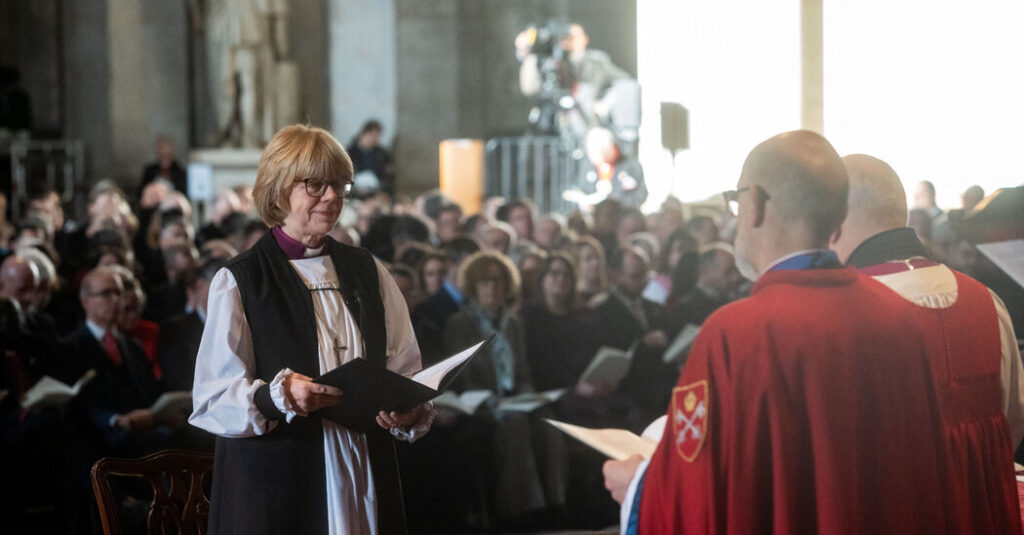
On Wednesday, Archbishop Mullally, 63, will be formally installed as the most senior cleric in the Church of England and spiritual leader of the Anglican Communion, which includes some 85 million Anglicans around the world. The ceremony, rich with tradition and set to be attended by the British prime minister and the prince and princess of Wales, will be weighted with significance for many in the church.
“Installing Sarah as our first female archbishop would have almost been unimaginable even 50 years ago,” said the Very Rev. Dr. David Monteith, dean of Canterbury Cathedral, speaking ahead of the ceremony. “Today matters.”
While she legally took up the role in January, Archbishop Mullally’s installation on Wednesday is the symbolic start of her ministry, where she will deliver her inaugural sermon to around 2,000 people.
Despite the celebratory nature of the day’s events, the new archbishop inherits a church in a moment of transition and unease, both in Britain and the world. For more than two decades, the global Anglican Communion — which includes the Episcopal Church in the United States and the Church of Nigeria, among others — has been divided over issues including same-sex marriage and the ordination of women and L.G.B.T.Q. people. After Archbishop Mullally’s appointment was announced, a conservative alliance of Anglicans abroad denounced the news, expressing “sorrow” and stating that “the Bible requires a male-only episcopacy.”
In England, growing secularism has left the church struggling to fill pews, and the institution’s handling of a sex abuse scandal led to the resignation of Archbishop Mullally’s predecessor, Justin Welby.
But there is hope within the church that the appointment of Archbishop Mullally, a trusted and familiar leader with a background in health care, will signal a new, more welcoming era for the institution and a break with the scandals of the past.
A Knock on a Door and a 13th-Century Chair
At the start of the ceremony in Canterbury, the archbishop will knock on the cathedral’s Great West Door, seeking admission, and will then be let in by local schoolchildren. A mandate sent by King Charles III instructing the church to install her as the archbishop will be read out — he won’t be present, but Prince William and Catherine, Princess of Wales, will be — and the archbishop will renew her vows and commitments to her ministry before taking an oath.
Near the end of the ceremony, she will be enthroned in St. Augustine’s chair, a large marble seat that dates to the early 13th century.
Canterbury Cathedral, a UNESCO heritage site in southeast England, was founded in A.D. 597 by Augustine, who came to England from Rome to convert people to Christianity.
Over the centuries it grew to become the most important Christian site in England. The cathedral, rebuilt after a fire in 1174, stands at a mesmerizing scale, with soaring Gothic arches, ribbed vaults and exceptional stained glass windows.
After the murder of Archbishop Thomas Becket in the church in A.D. 1170 and his subsequent canonization, the cathedral became a major site of pilgrimage, immortalized in Geoffrey Chaucer’s “The Canterbury Tales.”
Ahead of her installation, Archbishop Mullally embarked on her own 87-mile pilgrimage, walking for six days from St. Paul’s Cathedral in London to Canterbury. She is the first archbishop in the modern era to make the journey.
Before being ordained as a priest, Archbishop Mullally spent years as a nurse in Britain’s National Health Service, where she worked as a specialized cancer nurse before eventually becoming the director of nursing at the Chelsea and Westminster Hospital in London.
She became the youngest person ever appointed to the post of chief nursing officer for England in the Department of Health in 1999 when she was 37. Through it all, she has said, she felt a calling to the church.
She was ordained in 2001 and left her government post in 2004, which she described at the time as “the biggest decision I have ever made.”
Dr. Monteith, who has worked alongside the archbishop for years, described her as a person of “really deep and profound faith,” as demonstrated by her decision to give up her nursing career to become a cleric.
“That’s a big, risky thing to do, and it’s born of somebody who had a lively sense of faith and connection with God, sufficient for her to hear a call to turn in a different direction and follow another path,” he said. “And I think that speaks well to me of somebody of integrity and of depth as well.”
During her installation ceremony, the archbishop will wear a clasp on her clerical garments decorated with a belt buckle from her time working as a nurse. Church observers say she will bring to the role her nursing background and years of experience in leadership roles, most recently as the bishop of London, and in the House of Lords, the upper house of Parliament, where she holds a seat.
It is likely she will need to call on her experience navigating large and complex institutions in her new role. The Anglican Church’s center of gravity has moved away from its ancestral home to the global south, with a vast majority of Anglicans now living outside England and rising membership in Africa, parts of Asia and Latin America.
The most recent statistics compiled by the Church of England showed that by almost every measure, congregations in England are smaller than they were before the pandemic; the number of regular worshipers fell to 1,009,000 people in 2024 from 1,114,000 in 2019. Anglicanism in parts of Africa has tended to be more conservative and has resisted the Church of England’s more progressive stance on social issues.
The plans for the ceremony on Wednesday include deliberate efforts to reflect the church’s diversity and global reach into 165 countries. A key prayer will be sung in Urdu, another prayer will be delivered in the Bemba language of Zambia, there will be a gospel reading in Spanish, and hymns will be sung by the African Choir of Norfolk.
Megan Specia reports on Britain, Ireland and the Ukraine war for The Times. She is based in London.
The post After 1,400 Years, the First Female Archbishop of Canterbury Is About to Be Enthroned appeared first on New York Times.