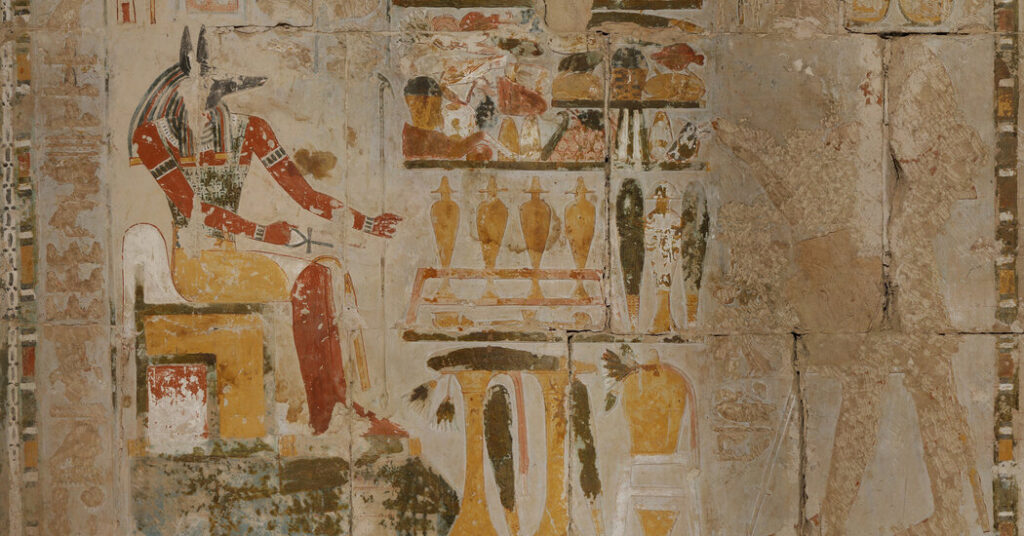
In the 1920s, while excavating for tombs at Deir el-Bahri in Luxor, archaeologists were confronted with a baffling crime scene: thousands of smashed statues and desecrated reliefs of Hatshepsut, one of ancient Egypt’s few, and most successful, female pharaohs.
During the 15th century B.C., Hatshepsut (pronounced hat-SHEP-soot), the daughter of the Pharaoh Thutmose I, had carried out one of antiquity’s most audacious political power plays. Following the sudden death of her husband-brother, Thutmose II, she appointed herself regent for her young stepson, Thutmose III, a child born of a lesser queen. Several years into the regency, Hatshepsut seized the throne; she ruled for nearly two decades, cementing her legitimacy by cultivating the persona of a living god and styling herself “Lord of the Two Lands.”
Scholars of the 19th and early 20th century typically portrayed her as a wicked stepmother of the distant past — a usurper whose political acumen was framed as villainous. Egyptologists initially maintained that Thutmose III, who succeeded Hatshepsut, ordered the destruction after her death in a fit of spiteful erasure. But by the 1960s, the breakage was attributed to an orchestrated program initiated some 25 years later.
But lately, Hatshepsut has been receiving a reputational makeover, reimagined by scholars as a masterful diplomat whose reign was one of artistic innovation and economic growth. A recent study in the journal Antiquity further softens her image.
Jun Yi Wong, a doctoral candidate in Egyptology at the University of Toronto, reassessed decades of excavation records, including unpublished notes, photographs and field reports. He concluded that some of the damage to Hatshepsut’s statues was not the handiwork of Thutmose III, and that the actions Thutmose III did take were less brutal than previously assumed.
Building on other recent scholarship, Mr. Wong proposed that Thutmose III’s demolition of Hatshepsut’s statuary was a ritualistic “deactivation” designed to nullify her spiritual power, rather than a vendetta. By breaking the statues at specific points — the neck, waist and knees — Thutmose III aimed to neutralize the inherent clout of these images before they were jettisoned.
The statuary of other kings, most of whom were not known to have suffered persecution, was treated similarly, Mr. Wong noted. Many sculptures of Hatshepsut were later repurposed as raw material, causing additional damage that obscured the nature of Thutmose III’s actions.
Edward Bleiberg, a curator emeritus of Egyptian art at the Brooklyn Museum, said that Mr. Wong’s study refines scholars’ understanding of how Hatshepsut’s monuments were treated. By prioritizing forensic evidence over accepted interpretations, Mr. Wong demonstrated that the physical, often cumulative scars on artifacts tell a different story than the history books.
“He clearly demonstrates that individual statues were broken with different processes and therefore different intentions,” Dr. Bleiberg said. “There is no one-size-fits-all explanation for this destruction, and personal animosity is the least likely explanation.”
Aunt, stepmother and mother-in-law
Fourteen centuries before Cleopatra, Hatshepsut upended the patriarchal norms of the Nile. Some evidence implied that to cement her authority, she married off her daughter, Neferure, to Thutmose III, creating a genealogical thicket that defied even ancient Egyptian convention. By the time the incense cleared, Hatshepsut would have become the young king’s aunt, stepmother and mother-in-law — a masterstroke of dynastic consolidation.
Hatshepsut didn’t just rule; she transformed, commissioning a series of statues and relief carvings that blended feminine subtlety with the muscular authority of a male monarch. This curated identity — a masculinized king, complete with a ceremonial beard, a kilt and an idealized, chiseled form — was a calculated transformation, allowing her to claim a full divine mandate.
The result was a stable era of prosperity and cultural significance, establishing a durable foundation for the New Kingdom that enabled the future splendor of Tutankhamen. From Hatshepsut’s cliff-hugging mortuary temple at Deir el-Bahri to the soaring 97-foot granite obelisks she raised at Karnak, her architectural daring was a masterful campaign of sanctified propaganda. By reviving long-lost trade routes — notably a maritime expedition to the Land of Punt (possibly present-day Eritrea) that returned with gold, ivory, ebony and live myrrh trees — she built the financial bedrock of the 18th dynasty.
Yet the physical remnants of Hatshepsut’s tenure were not simply forgotten; they seemed to have been actively vandalized in a damnatio memoriae, an attempt to scrub the memory of a dead monarch fallen out of favor. Her monuments were defaced, her cartouches hacked away, her name expunged from subsequent king lists along with her achievements, including the temple at Deir el-Bahri, reputedly by the man who succeeded her.
Damnatio memoriae
By 2014, when Mr. Wong became interested in Hatshepsut, Egyptologists had long abandoned the dramatic narrative of a scorned stepson in favor of a colder, bureaucratic analysis. Scholars were split, increasingly interpreting the damnatio memoriae as a desperate attempt to legitimize a male heir, or a correction against a woman who had governed too effectively.
What began as Mr. Wong’s undergraduate fascination at Durham University in England deepened into a scholarly calling at Cambridge University, where he specialized in Egyptology. He initially mistook the project for a master’s thesis, but a sobering realization of its complexity drove him to the University of Toronto. There, as a doctoral candidate, he tackled the monumental mystery that fundamentally redrew his professional map.
Mr. Wong spent more than two years studying the erasure of Hatshepsut’s reliefs at her mortuary temple at Deir el-Bahri. But the shattered remnants of her statues posed an entirely different challenge: They resembled a chaotic puzzle that refused to be solved.
“There seems to be little rhyme or reason to the condition of the statues,” Mr. Wong said. “Some were heavily fragmented; others were found in pretty good condition, with their faces still intact. Most of them also had a lot of missing parts, which added to the complexity of it all.”
Eventually, Mr. Wong arrived at a breakthrough by applying the principles of taphonomy — the study of how artifacts are altered and deposited. Because most of the statues had not been buried after their disposal, they became a convenient source of stone material in the centuries that followed.
Treating the temple grounds like a prehistoric kill site, he saw that regularly shaped bits of the statues — the most useful parts for reuse as raw material — were consistently missing. What had initially looked like a mess of mangled faces and torsos was actually the dross of an ancient recycling operation.
By reconstructing the findspots of the statues, Mr. Wong found that those with intact faces tended to be the least affected by reuse. This suggested that the wreckage caused by Thutmose III was far more limited — the statues had been deactivated, but their faces had been spared from harm.
“Much of the significant damage only occurred during the repurposing of material,” Mr. Wong said. The detached pieces, particularly the block-like bodies, were refashioned as building components or construction filler, causing further damage. Importantly, some sherds were used as infill for a neighboring temple causeway built by Thutmose III.
“The statues found below the causeway were akin to a time capsule, since they were certainly never disturbed after his reign,” Mr. Wong said. “Here, most of the free-standing statues, the ones least likely to have been accidentally damaged, have their faces fully intact.”
Moreover, Mr. Wong’s analysis of the two-dimensional images within Hatshepsut’s temple unearthed a layered narrative that upends long-held Egyptological hypotheses and indicates that some of the modifications attributed to Thutmose III were implemented more than a century later.
When the radical monotheism of the pharaoh Akhenaten swept through Egypt, the names and images of traditional gods were violently chiseled from history. This religious revolution did not last, and subsequent kings soon restored the traditional deities. But the artisans restoring Hatshepsut’s mortuary temple after this upheaval faced a twofold challenge. They had to repair Akhenaten’s religious erasures while also navigating the jagged, intentional voids left by Thutmose III. Some artists replaced the damaged images of Hatshepsut with those of male kings. Misattributed to Thutmose III, these alterations have long skewed our understanding of Hatshepsut’s persecution, Mr. Wong said.
Although Thutmose III did replace some of Hatshepsut’s images, Mr. Wong argued that his campaign was a targeted, strategic edit, as changes were concentrated in areas where key festivals and processions took place. The temple’s evolution reflects a practical effort to keep sacred spaces relevant for those events.
Kara Cooney, an Egyptologist at the University of California, Los Angeles, champions a feminist counter-theory, She proposes that, by deleting Hatshepsut’s name and likeness after her death, Thutmose III sought to relegate a successful female pharaoh to a forgotten footnote. By targeting the very monuments she built, he attempted to remove her kingly lineage and secure a purely masculine line of succession. This ancient ghosting, Dr. Cooney claims, was a hostile move designed to show that a woman ruling this well constituted an intolerable overreach.
In response, Mr. Wong said that Dr. Cooney’s theory “is plausible, but some images of Neferure have survived, contradicting the idea of an enforced male succession.”
Jumping to conclusions
Past scholarship was often cavalier about assuming that any damage to Hatshepsut’s monuments was intentional, said Peter F. Dorman, an emeritus professor of Egyptology and Near Eastern Languages and Civilizations at the University of Chicago. Mr. Wong, he said, has shown that a good portion of the harm was incidental, caused by the physical removal of her statuary from her temples.
“The remainder of the attacks to her figure and name were essentially a scrubbing or re-ascription of her male kingship, and her earlier queenly portrayals were rarely touched,” Dr. Dorman said. “Such niceties are critical in interpreting the political context of ancient history.”
Dr. Dorman said that Mr. Wong’s methodology has further implications for unraveling the phenomenon of damnation memoriae.
“That is, it advises us not to jump to conclusions about personal animosities where none may exist,” he said.
The post Wicked Stepmother No Longer, a Female Pharaoh Gets a Reputational Makeover appeared first on New York Times.