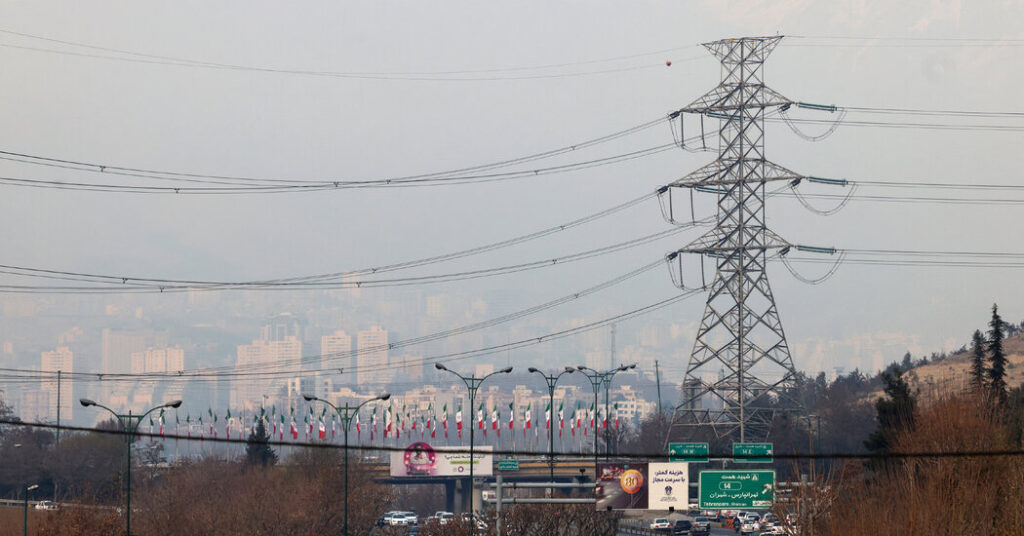
President Trump’s threat to “obliterate” power stations in Iran if its leaders failed to open the Strait of Hormuz suggests that the United States is willing to violate international humanitarian law as part of its military campaign, according to current and former human rights officials.
“If Iran doesn’t FULLY OPEN, WITHOUT THREAT, the Strait of Hormuz, within 48 HOURS from this exact point in time, the United States of America will hit and obliterate their various POWER PLANTS, STARTING WITH THE BIGGEST ONE FIRST!” Mr. Trump wrote on social media on Saturday.
He later extended the deadline to Friday.
The president’s threat appears to be part of his erratic messaging campaign, which is often construed as bluster or misdirection.
“Trump is openly threatening a war crime,” said Kenneth Roth, a former executive director of Human Rights Watch. “And people aren’t saying anything because they’re numb to it.”
By threatening to attack civilian infrastructure, Mr. Trump has once again pushed the United States into territory more familiar to its enemies than its allies.
In 2024, the International Criminal Court issued four arrest warrants to Russian military officers and officials charging them with war crimes for attacking “Ukrainian electric infrastructure.”
International law, specifically Article 52 of the first additional protocol of the Geneva Conventions, prohibits attacks on civilian objects. These laws are meant to protect civilians and those who can no longer fight, such as wounded soldiers, from the “barbarity of war.”
Energy infrastructure such as power grids often has civilian and military uses. In the case of Russia’s attacks on Ukraine’s power grid, prosecutors deemed the strikes a violation of humanitarian law. Despite the charges, Russian forces continued their campaign.
“I see no difference between what Trump is threatening to do in Iran and what the International Criminal Court charged four Russian commanders for doing in Ukraine,” Mr. Roth said.
The court also issued arrest warrants for Prime Minister Benjamin Netanyahu of Israel, Mr. Trump’s close ally, accusing the Israeli military of committing war crimes and crimes against humanity in Gaza. Human rights groups say Israel’s actions in the territory constituted genocide.
“What we are seeing from all sides — the United States, Iran and Israel — is a race to the bottom in which threats against civilian infrastructure are becoming normalized,” said Sarah Yager, the Washington director at Human Rights Watch. “This kind of rhetoric doesn’t just escalate tensions irresponsibly, it signals a dangerous willingness to erode the very rules designed to protect civilians in war.”
The U.S. military’s recent history of targeting power infrastructure goes back to the early 1990s, when the American-led air campaign during the Persian Gulf war damaged the Iraqi power grid, water treatment plants and parts of its oil industry.
At the war’s end, most of Iraq’s electricity-generating plants were destroyed. The country, once an urbanized modern society, was set back decades, drawing condemnation from human rights groups.
By 1999, when the United States and NATO started its air war over Yugoslavia to protect civilians in Kosovo from further repression and abuse by Yugoslav forces, the Pentagon had changed its tactics targeting energy infrastructure. U.S. forces dropped a new weapon designed to temporarily shut down power stations without destroying them.
The weapons currently in the Pentagon’s arsenal spread tens of thousands of thin graphite strands over several acres. Released by hundreds of small submunitions the size of a soda can, the strands wreak havoc on unprotected electric wires and transformers. Their effect is designed to be temporary. Power can be restored once the graphite strands are cleared off and damaged electrical components are replaced.
According to a 2009 U.S. Air Force fact file, the devices are called Power Distribution Denial Munitions and can be released from Tomahawk cruise missiles and cluster bombs.
In a 2001 report, the RAND Corporation said a cluster bomb version was used in 1999 during attacks on several Yugoslav power distribution centers, “draping enemy high-voltage power lines like tinsel and causing them to short out.”
The munitions were used again in 2003 during the invasion of Iraq, according to a U.S. defense official involved in the current targeting process for the war in Iran.
The U.S. military currently does not have plans to completely destroy Iranian power plants, added the official, who spoke on the condition of anonymity to discuss military matters. But the military could disable the plants if there were a need to do so.
Thomas Gibbons-Neff is a national correspondent for The Times, covering gun culture and policy.
The post Trump’s Threat to Iran Crosses a Line, Rights Experts Say appeared first on New York Times.