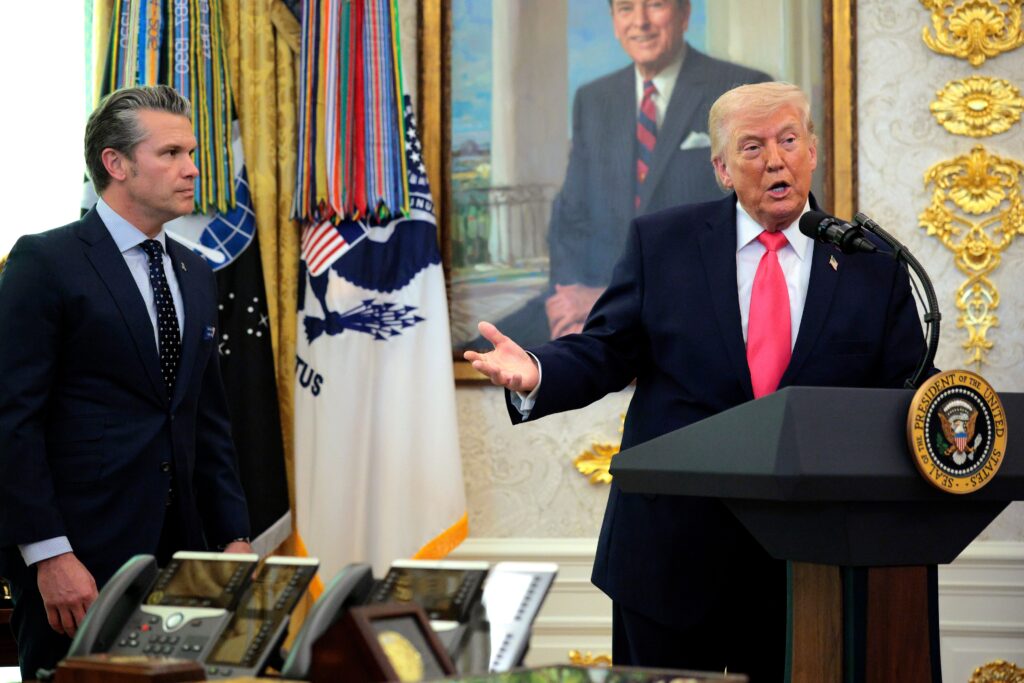
President Donald Trump said Tuesday that the war in Iran has already been won and regime change achieved as more than three weeks of U.S. and Israeli airstrikes have killed many of Iran’s senior leaders and destroyed much of its military capability.
“We’re talking to the right leaders, and they want to make a deal so badly,” Trump said of nascent U.S.-Iranian talks that were happening “right now,” he said in the Oval Office.
Egypt, Pakistan and Turkey have moved to broker a ceasefire amid a new wave of Iranian attackson Persian Gulf countries and Israel, Iran’s continued closure of the Strait of Hormuz and reports that the U.S. is mobilizing additional ground troops to send to the region.
Trump said Tuesday that his son-in-law Jared Kushner, White House envoy Steve Witkoff, Secretary of State Marco Rubio and Vice President JD Vance were all engaged in talks but didn’t specify which Iranian leaders were involved.
But, he said, proof that they were talking to the “right people” came when the Iranians “gave us a present, and the present arrived today,” suggesting without further explanation that it was “oil and gas related” and “worth a tremendous amount of money.”
Trump’s declaration that victory had already been achieved came as senior officials from all three mediating countries, in a flurry of phone calls begun over the weekend, appealed to both sides to end the war following Trump’s Saturday ultimatum giving Iran 48 hours to reopen the vital Hormuz waterway or face the destruction of its energy infrastructure.
On Monday, Trump extended the deadline for five days after what he said were high-level talks over the weekend with Iran that reached “points of major agreement.”
Officials from several governments knowledgeable about the diplomacy, who spoke on the condition of anonymity to describe sensitive negotiations, said the conversations — involving Witkoff and Iranian Foreign Minister Abbas Araghchi — so far were indirect through mediators. Iran publicly insisted there were no direct or indirect conversations, and it was uninterested in having them.
Trump had suggested Monday that the two sides would meet directly “very, very soon.” One proposed venue, several people familiar with the planning said, was Islamabad, the Pakistani capital, although they said no decision had been made.
In a Tuesday post on X, Pakistani Prime Minister Shehbaz Sharif said that “subject to concurrence by the U.S. and Iran,” Pakistan “stands ready and honored to be the host to facilitate meaningful and conclusive talks for a comprehensive settlement of the ongoing conflict.” Trump reposted the message on his Truth Social platform.
Anadolu, Turkey’s state-run news agency, said late Monday in a report it attributed to Pakistani Foreign Ministry officials that a U.S. delegation was expected to arrive in Pakistan “in a day or two.”
Earlier, White House press secretary Karoline Leavitt declined to confirm the Islamabad site, saying, “this is a fluid situation and speculation about meetings should not be deemed as final until they are formally announced by the White House.”
Previous efforts headed by Qatar and Oman to discuss a ceasefire failed to gain traction when Washington rejected Tehran’s demand that attacks by the U.S. and Israel halt before talks could begin.
Iranian officials have also previously demanded assurances, including compensation for war damage, and rejected U.S. demands that it commit to cease all enrichment, hand over its stockpile of highly enriched uranium, sharply curtail its ballistic missile program and end all support for militant proxy forces in the region.
Qatar and Oman are not directly participating in the new rounds of discussions, while Pakistan — a relatively new player — has taken on a prominent role along with Egypt and Turkey.
The foreign ministers of Pakistan, Egypt, Turkey and Saudi Arabia met in the Saudi capital, Riyadh, on Thursday on the sidelines of a summit of Islamic countries. Amid a roiling Middle East and conflict between Pakistan and Afghanistan, Ankara has been seeking a long-term security pact with Islamabad and Riyadh — which it hopes would also include Cairo. Pakistan has been steadily strengthening its ties with the Middle East and last year signed a mutual defense pact with the Saudis.
“We are exploring how, as countries with a certain degree of influence in the region, we can combine our strengths to solve problems,” Turkish Foreign Minister Hakan Fidan said Saturday.
On Sunday evening, Egypt’s Foreign Ministry said that “amid concerns that the situation in the region could slip out of control in light of the current dangerous escalation, a series of phone calls took place” that day. Participants, the ministry said, included Egyptian Foreign Minister Badr Abdelatty, Fidan, Pakistani Foreign Minister Mohammad Ishaq Dar, Araghchi and Witkoff.
Calls were also made to Mohammed bin Abdulrahman Al Thani, who serves as Qatar’s prime minister and foreign minister. Qatari Foreign Ministry spokesman Majed al-Ansari confirmed Tuesday that “there is no direct Qatari effort regarding mediation between the two sides.” For now, Ansari said, “we are focused on defending our country and its sovereignty.”
On Sunday, Trump called Pakistan’s military chief of staff, Gen. Asim Munir, a White House official said.
Trump has taken an apparent liking to Pakistan, beginning last summer when he invited Munir to lunch at the White House a month after claiming to have “solved” a breakout of fighting between nuclear powers Pakistan and India. The next day, Pakistan’s civilian government said it had nominated Trump for the Nobel Peace Prize.
Since then, he has repeatedly praised the government in Islamabad and Munir in particular.
On Monday, Pakistan said, Dar spoke with Araghchi as did Turkey’s Fidan, according to Turkish media. On Tuesday, Iranian media reported that President Masoud Pezeshkian and Sharif had also spoken.
“Numerous messages have already been exchanged with the warring sides,” said a former Egyptian official familiar with the talks, adding that the “mediation has received a noticeable degree of acceptance” among the warring parties.
Noting that strikes from both sides are likely to continue “until negotiations can formally begin,” the former official said that “the expectation is to move from a phase of reciprocal military strikes to de-escalation, then to calm, followed by a complete end to the war and ultimately toward negotiations that yield positive and mutually satisfactory outcomes, ensuring that such a conflict does not recur.”
The war has left significantly fewer Iranian officials for the Trump administration or mediators to engage with. In addition to Israeli strikes that killed the supreme leader, Ayatollah Ali Khamenei, and a number of other senior officials, a strike last week killed Ali Larijani, secretary of Iran’s Supreme National Security Council, who in previous years held back-channel talks with the United States.
Araghchi and Iran’s parliamentary speaker, Mohammad Bagher Ghalibaf, are among the few remaining in senior roles. Ghalibaf would make sense for engagement, according to a European official who said that while the speaker was not as “pragmatic” as Larijani, he has the power and influence necessary to discuss a possible ceasefire. Ghalibaf on Monday publicly denied media reports that he was involved in any talks.
Araghchi, a longtime diplomat, headed Iran’s negotiating team in indirect talks with Witkoff last summer and, along with Kushner, in two abortive sessions earlier this year until the war began.
Meanwhile, both sides claimed to be winning.
“We have really regime change, you know. This is a change in the regime, because the leaders are all very different than the ones that we started off with that created all those problems,” Trump said Tuesday. “We’ve won this war. This war has been won.”
Iran’s retaliatory strikes have decreased but continue throughout the region amid reports of declining U.S. weapon stocks and air defense munitions. But weeks of intense U.S. and Israeli airstrikes numbering in the tens of thousands have had a devastating impact on the Iranian military, destroying missile launchers and defenses, weapons manufacturing and storage sites.
“The Iranians have been stripped of almost all their military capabilities except drones, and those aren’t enough to tip the strategic balance,” said Joel Rayburn, who served as a senior White House official on Iran in Trump’s first administration. “We are seeing Iranian weakness exposed in real time.”
Natalie Allison, Michael Birnbaum and Isaac Arnsdorf contributed to this report.
The post Trump declares Iran war ‘won’ as Tehran denies claims of peace talk progress appeared first on Washington Post.