To understand the Swedish artist Lap-See Lam’s practice, it helps to know about bamboo. The way that it spreads, through underground stems called rhizomes, connects to how she creates interrelated films, sculptures and installations that draw on mythology and the experiences of Chinese families living abroad, across generations.
Her method is “not linear,” she said, in a video interview from her studio in central Stockholm, while discussing its relationship to bamboo. “It branches out in different directions.”
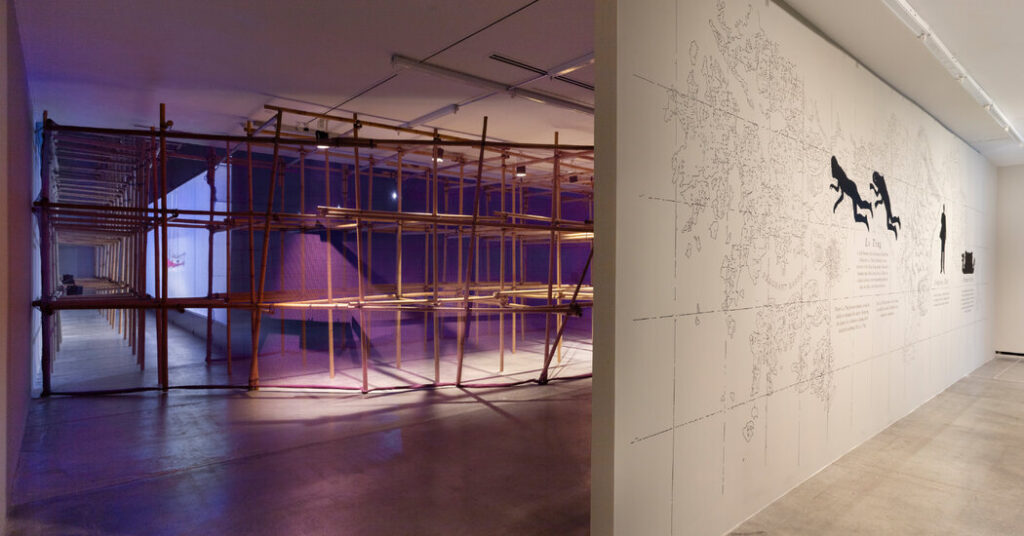
That approach has made her a star. Since the start of 2023, Lam, 36, has completed a dozen shows in six countries, including at the 2024 Venice Biennale, where she staged a multidisciplinary project in the Nordic Pavilion with other artists that included a video inspired by Cantonese opera and the bamboo scaffolding traditionally used in Hong Kong.
A 13th just opened ahead of Art Basel Hong Kong at Blindspot Gallery in the city. Her first solo show in Asia, it runs through May 2.
The show represents a kind of homecoming for Lam, though she was born in Sweden. After moving from Hong Kong to London, her maternal grandmother and her grandmother’s brother opened a Chinese restaurant called Bamboo Garden in 1970s Stockholm. The artist’s parents later ran it, and they all lived above the place.
Her father started another restaurant in the capital in the 1980s called Bamboo Palace, before helping some of her aunts and uncles create a karaoke parlor and restaurant with the same name in Hong Kong. An uncle opened a Bamboo City in 1990s Helsinki.
Such establishments have become the fuel for Lam’s art, as potent metaphors for diasporic displacement and cultural adaptation, and as raw material.
When the artist’s parents sold Bamboo Garden in 2014, she started making 3-D scans — digital models — of the interiors of Chinese restaurants in the city. These files contain glitches and omissions, and when she 3-D printed furniture recorded in them, ghostly sculptures emerged. She has likened the gaps in such renderings to the loss of family history over many years.
Using virtual reality in 2019, she floated viewers through a darkened restaurant. This summer, both works will appear in a solo show at the SCAD Museum of Art in Savannah, Ga.
An eatery with an almost-impossible-to-believe history figures in “Floating Sea Palace,” a 26-minute 2024 video featured in the gallery exhibition in Hong Kong. The Floating Restaurant Sea Palace, a three-story dragon ship, sailed from Shanghai in the early 1990s, serving Chinese food at different European ports. However, it failed and ended up docked in Stockholm, repurposed as an exotic fun house, “a ship from the Orient” with “a thousand-year-old curse,” ads read.
Lam spotted the ship through a studio window as a student at the Royal Institute of Art and investigated. Eventually she 3-D scanned it and used it as a setting for her Venice piece and “Floating Sea Palace,” which features two versions of Lo Ting, a mythological half-fish, half-man creature said to be the ancestor of Hong Kongers. One hopes to return to the “Fragrant Harbor,” the literal translation of Hong Kong from Cantonese; the other, played by the performance artist Ivan Cheng, speaks of “losing my grip on the language I had before” as he wanders the ship, his breath visible in the cold.
In the video, a ship’s silhouette sinks in a shadow play, a Chinese “tradition that had migrated and sort of mutated into ombres chinoises” in France, Lam said, through maritime trade in the 1700s. Her father did a voice over, as her mother has in the past. “They sold the restaurant, they retired, and now they have all the time to be my amateur actors in my pieces,” she said.
The floating restaurant also appears in “Tales of the Altersea” (2023), which is in a group show at Tai Kwun Contemporary in Hong Kong through May 31.
During its 2023 run at the Swiss Institute in New York, “as you walked down the stairs, it felt almost like you walked under the sea or into the sunken shipwreck at the bottom of the ocean,” Stefanie Hessler, its director, said. A shadow play charts the harrowing adventures of twin sisters.
The curator and artist met around 2010, when Lam was starting in art. She had been in fashion, but “was having a little bit of a crisis, not knowing what to do,” she said. A friend told her to take art classes. “I was quite introverted as a kid, and I was drawing a lot, and enjoying that,” Lam said, but she didn’t have a clear sense “that you could become an artist.” Then she did.
“What I love about her work,” Hessler said, “is that you can access it with a lot of prior knowledge, both of her work and of the different histories that she engages, but you can also just enter it with a sense of wonder and experience this fairy tale or these mythologies.”
Lam seems to approach her own art with a similar curiosity. Arriving for a residency last year at Cirva, the International Center of Glass and Plastic Arts in Marseille, France, “I was honestly quite burned out from doing exhibitions, and I didn’t have any ideas,” she said. But an earlier resident had left behind bamboo, and the glass blowers suggested working with it. She went for it, and her Blindspot exhibition includes a glass sculpture resembling a bamboo raft.
“The resilience of bamboo” has been on her mind, she said at one point.
Lately, Lam has been visiting Hong Kong regularly to see family and conduct research, as she prepares for shows this year at the Henie Onstad Art Center in Oslo and at the Vienna Secession exhibition space, and the ARoS in Aarhus, Denmark, in 2027. She has been learning about her family’s Bamboo Palace karaoke spot in Hong Kong, which ran from 1988 to 1991.
“There’s basically no documentation” of the place, Lam said, because one of her aunts discarded photo albums during a move. In dense Hong Kong, “you have to be very unsentimental about things,” she said.
As part of a residency in the city, in December she invited some of her aunts and uncles to speak at an event at a tiny bar. One aunt sang an Anita Mui classic, and Lam 3-D scanned it all. “Let’s see what happens with the material,” she said. “Hopefully it will guide me.”
On one Hong Kong visit, she stayed on a street where her paternal grandmother had sold fruit from the 1950s to the 1970s. That street was “feeding the whole family throughout all these years,” she said.
Even before she knew that history, she had been on that stretch, scanning bamboo scaffolding, which is being phased out in Hong Kong construction projects for metal.
Spending time with family there, she said, “I understood that the stories are just right in front of me, through them and with them.”
The post Through Bamboo, a Swedish Artist Explores Her Family’s History appeared first on New York Times.