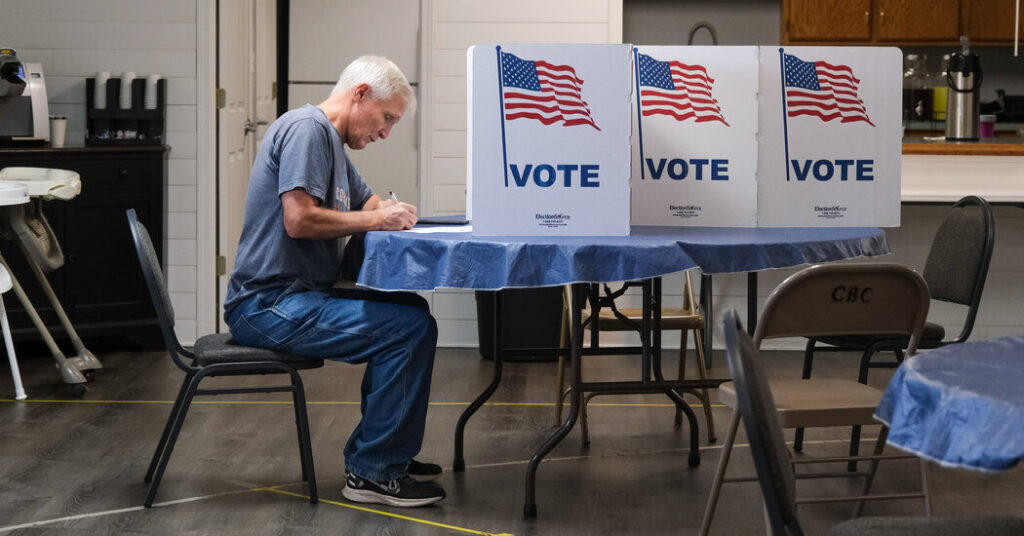
As President Trump digs in on his demand that senators pass a strict voter identification bill, lawmakers debating the potential impacts of the Republican-backed SAVE America Act might look to one place that already tried it — Kansas.
In 2013, Republicans in that state passed legislation so similar it bore a nearly identical name — the Secure and Fair Elections, or SAFE, Act. It, too, aimed to root out voting fraud by noncitizens. As voters nationwide would be required to do under the SAVE Act, those seeking to register to vote in Kansas had to provide proof of citizenship, such as a passport or a birth certificate.
The results weren’t great.
A federal judge struck down the law within a few years, after it was found to have blocked tens of thousands of eligible voters from registering while catching fewer than thirty noncitizens trying to do the same.
Many of those who were blocked — young Kansans and less politically attuned voters who were seeking to register for the first time — were from constituencies that have flocked to Mr. Trump since his rise in 2016.
Still, the state’s current elected officials are ready to try it again at the federal level. Asked about the Kansas experiment in an interview with The Topeka Capital-Journal, Senator Roger Marshall, a Republican, said that expecting citizens to provide a birth certificate or a passport in order to vote was still reasonable.
“I think that the benefits of having safe and secure elections outweigh that potential concern,” he said.
The Kansas cautionary tale started in 2013, when the documentary proof of citizenship law, which was passed in 2011, went into force. A federal judge struck down the law as unconstitutional in 2018, by which time the law had blocked the registration of around 31,000 otherwise eligible voters, or about 12 percent of all those who had tried to register for the first time.
Among them was Steven Fish, one of the plaintiffs in the lawsuit that successfully challenged the law. Mr. Fish, hoping to vote for the first time, was prevented from registering when he couldn’t furnish the necessary documents. Like about half of American citizens, he didn’t have a passport, and, having been born on a since-shuttered military base, he was unable to track down his birth certificate.
“With these numbers, with that success ratio, I’m not really sure why anybody would think that nationwide this is a good idea,” Mr. Fish said of the federal bill.
Moreover, the federal judge found that while the state law was in effect, requiring documentary proof of citizenship had thwarted only 28 noncitizen applicants from registering. And in the roughly 13 years leading up to when the law took effect, just 39 noncitizens had successfully registered to vote.
Even those few cases were most likely the result of human or administrative errors, not a real intent to commit voter fraud, said Lorraine Minnite, an associate professor at Rutgers University who served as an expert witness in the case that struck down the Kansas law.
“There was very little evidence of noncitizen voting in Kansas, either before 2011 or after,” Ms. Minnite said.
Kansas’ experience has done little to stop what Ms. Minnite said was once a fringe theory of widespread illegal voting from becoming a nationwide doctrine of the Republican Party, pushed in large part by the president.
Among the stricter provisions in the proposed federal legislation are criminal penalties for elections officials who don’t properly verify a prospective voter’s eligibility, and a requirement that voters present proof-of-citizenship documents in person. The Kansas law allowed voters to submit those documents electronically or by mail.
Compared with the Kansas law, the SAVE America Act “looks like it would be much worse in terms of its impact on American citizens who will lose their right to vote,” Ms. Minnite said.
Kansas’ experience — as well as the experience of Arizona, where voters must prove citizenship to vote in state and local elections but not federal elections — have been well studied, though they are not featuring heavily in the current debates in Congress.
A report published late last year by researchers from three different organizations examined the financial impacts of legislation requiring documentary proof of citizenship in Arizona and Kansas. Those organizations were the Campaign Legal Center; Demos, a left-leaning think tank; and State Voices, a network of state-based progressive advocacy groups.
The study found that, in addition to blocking eligible voters from the rolls, the SAFE Act had most likely cost Kansas’ government as much as $353,000. That figure didn’t account for expenses incurred by county-level elections officials, who had to to bulk up staffing to institute the new requirements.
The cost of enforcing similar requirements across the country would be orders of magnitude higher, said Danielle Lang, vice president for voting rights and rule of law at the Campaign Legal Center. The costs would be spread across thousands of local elections offices, she said, each with its own voter registration system and its own capacity to carry out the new restrictions.
“We can expect the cost for the SAVE Act to be much larger, both because it’s national in scale and because it’s even stricter than the Kansas law,” Ms. Lang said.
Scott Schwab, Kansas’ secretary of state, who backed the SAFE Act as a member of the state’s House of Representatives, told The Associated Press in 2024 that the federal government should avoid replicating it. “Kansas did that 10 years ago,” said Mr. Schwab, a Republican who is now running for governor. “It didn’t work out so well.”
Mr. Schwab’s office did not reply to requests for comment on the SAVE America Act.
Other Kansas Republicans have not been so reticent. The state’s attorney general, Kris Kobach, championed the SAFE Act while serving as its secretary of state and later headed a voter fraud commission during the first Trump administration. He has called on Congress to act nationally against noncitizen voting. Kansas’ two senators, Mr. Marshall and Jerry Moran, have also thrown their support behind the SAVE America Act.
Democrats opposing the bill in Congress have argued that in trying to catch an impossibly small number of potential rule-breakers, requiring documentary proof of citizenship would disenfranchise an untold number of Americans.
Chris Hippensteel is a reporter covering breaking news and a member of the 2025-26 Times Fellowship class, a program for journalists early in their careers.
The post Should You Need to Prove Citizenship to Vote? Ask Kansas. appeared first on New York Times.