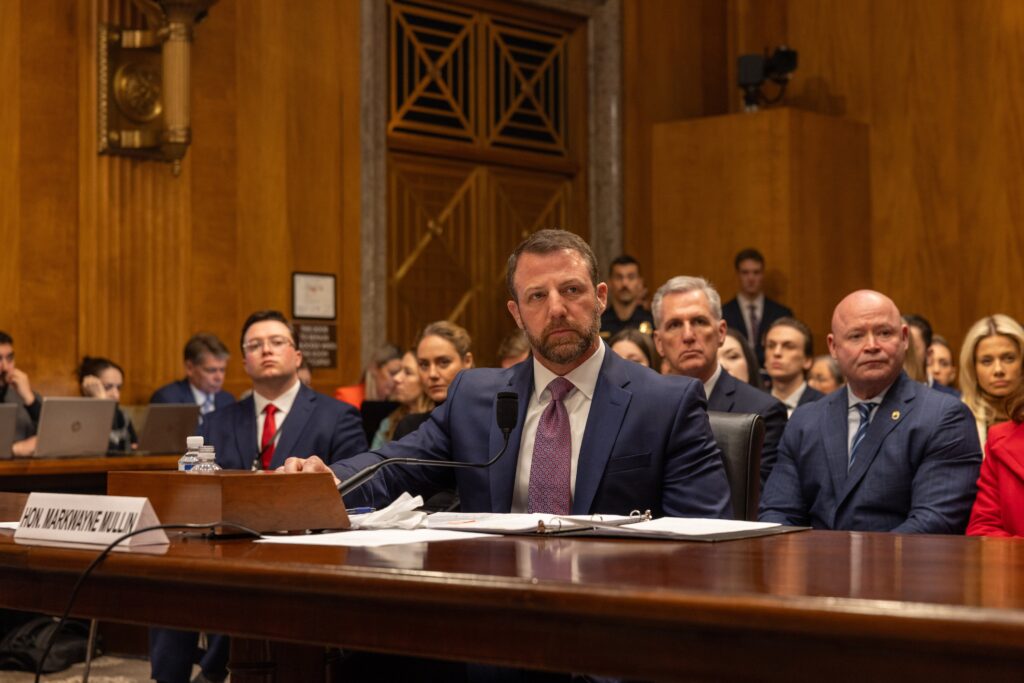
The Senate voted to confirm Sen. Markwayne Mullin as secretary of the Department of Homeland Security late Monday, installing the Oklahoma Republican at the embattled national security agency amid global instability and frustration over immigration enforcement.
The Senate voted 54 to 45 to confirm Mullin days after a Senate hearing in which he portrayed himself as an experienced lawmaker ready to restore DHS’s credibility after a surge in immigration enforcement escalated in January when federal officers shot and killed two U.S. citizens, Renée Good and Alex Pretti, in Minneapolis.
Mullin, 48, is taking over the agency created after the Sept. 11, 2001, terrorist attacks to safeguard the nation as the U.S. war in Iran is entering its fourth week and travelers are enduring hours-long waits in airport security lines because of a partial DHS budget shutdown that began Feb. 14. The Senate confirmed Mullin two weeks after President Donald Trump nominated him to become the ninth DHS secretary.
Mullin has emphasized that he will continue Trump’s immigration agenda, but in a streamlined way targeting criminals and people eligible to be deported. In written answers to Senate questionnaires, he said he would work to improve morale and workforce readiness at DHS and build a department “that runs on systems, not personalities.”
The vote was mostly along party lines. Two Democrats, Sens. John Fetterman (Pennsylvania) and Martin Heinrich (New Mexico), voted with Republicans to confirm him.
Sen. Rand Paul (R-Kentucky), the chairman of the Senate Homeland Security and Governmental Affairs Committee, and Sen. Gary Peters of Michigan, the committee’s top Democrat, both opposed his nomination. Both said he lacked the temperament and qualifications to lead the agency when it is facing scrutiny for excessive use of force.
In a speech on the Senate floor before the vote Monday, Peters said DHS has “broken trust with the American people” by cutting funding from counterterrorism and cybersecurity protections in favor of its “singular focus on indiscriminate immigration enforcement.”
“When the president nominated Senator Mullin to lead the department, I came into the process with an open mind. However, I do not believe that he is the right person for the job,” Peters said. “We need a Secretary who is a steady leader, who won’t rush to judgment without having all the facts, and who won’t add fuel to the fire when there is a crisis.”
Trump picked Mullin to replace Kristi L. Noem, a flamboyant former governor of South Dakota who leveraged social media to intensify the focus on civil immigration enforcement. She appeared in videos carrying a gun, threatening to “hunt” down and deport undocumented immigrants, and from inside a notorious prison in El Salvador after she executed a secret mission to deport immigrants to that facility.
During her 13-month tenure, DHS hired thousands of new immigration officers, reduced their training time, proposed gutting Immigration and Customs Enforcement’s body camera program and allowed officers to wear masks because they feared for their safety.
Noem said she was carrying out Trump’s agenda to make America safer by deporting immigrants who committed crimes and noted repeatedly that illegal border crossings had sunk to their lowest levels in decades. But public outrage over DHS tactics soared when immigration officers smashed windows, arrested people in their homes without warrants and tossed tear gas at crowds. Noem also drew criticism for defending the officers who shot and killed Good and Pretti, portraying demonstrators as a threat.
Trump ousted Noem amid frustration with the Minnesota raids and after she told a Senate committee that the president had signed off on a $200 million ad campaign that featured her.
Mullin had also defended the officers involved in the shooting deaths of U.S. citizens in Minneapolis, but at his Senate confirmation hearing last week, he struck a conciliatory tone, saying he regretted calling Pretti a “deranged individual.” Mullin said he would require officers to obtain judicial warrants before entering private residences in most cases, one of the demands by Democrats in ongoing negotiations to pass the DHS funding bill and end the partial shutdown.
Mullin also pledged to end Noem’s policy requiring her sign-off on DHS and Federal Emergency Management Agency contracts worth more than $100,000. Senate Democrats released a report earlier this month saying the policy had slowed the release of tens of millions of federal relief funds to victims of hurricanes and other disasters.
Mullin, a former mixed martial arts fighter who in 2023 challenged a Teamster to a fight during a Senate hearing, is a frequent defender of Trump’s agenda and a loyalist to the president who refused to acknowledge that Joe Biden won the 2020 election. He also faced questions during the confirmation hearing for appearing to side with a neighbor who attacked Paul in 2017 and for saying he had special assignments in the past that he said were classified.
His supporters describe Mullin as a pragmatic negotiator who works across party lines to build consensus and friendships. (The Teamster, Sean O’Brien, is now a friend.)
In his written answers to Senate questionnaires, Mullin said he would work with White House officials Stephen Miller and “border czar” Tom Homan to continue to enforce immigration laws and secure the border, but he signaled that he would take a broader approach than Noem and focus on strengthening critical infrastructure, making disaster support “faster and more accountable,” and promising “better stewardship of taxpayer dollars.”
Mullin, a married father of six children, served for 10 years in the House of Representatives before running for the Senate, where he has remained since 2023. He attended college on a wrestling scholarship but had to drop out for a time to help his ailing father with his plumbing business, building it into one of the largest in the state. He graduated in 2010 with an associate’s degree in construction technology and plumbing.
The largest number of people he has had work for him is 150.
Now he will helm an agency with more than 260,000 employees, the third largest in the United States after the Department of Defense and the U.S. Department of Veterans Affairs.
Approval for Trump’s immigration agenda has sunk in the polls spurring worries among Republicans that they will lose ground in both houses of Congress in the November mid-term elections and imperil the president’s agenda.
Paul, the chairman of the Senate Homeland Security and Governmental Affairs Committee, excoriated Mullin during his confirmation hearing last week for recently stating that he understood why Paul was assaulted by a neighbor in 2017.
“Tell me to my face why you think I deserved it,” Paul said during the hearing.
“His embracing of the violence, the political violence that happened to me without an apology — I think it means he’s unfit to be leading a large law enforcement organization,” Paul told reporters last week.
But Heinrich, the top Democrat on a Senate appropriations subcommittee that Mullin chairs, said he considers Mullin a friend and has been able to work with him even though they often disagree.
“I have also seen first-hand that Markwayne is not someone who can simply be bullied into changing his views, and I look forward to having a Secretary who doesn’t take their orders from Stephen Miller,” Heinrich said in a statement after he voted Sunday to advance Mullin’s nomination, referring to the White House deputy chief of staff for policy who is the architect of much of the administration’s approach to immigration enforcement.
The post Senate confirms Mullin as Homeland Security secretary appeared first on Washington Post.