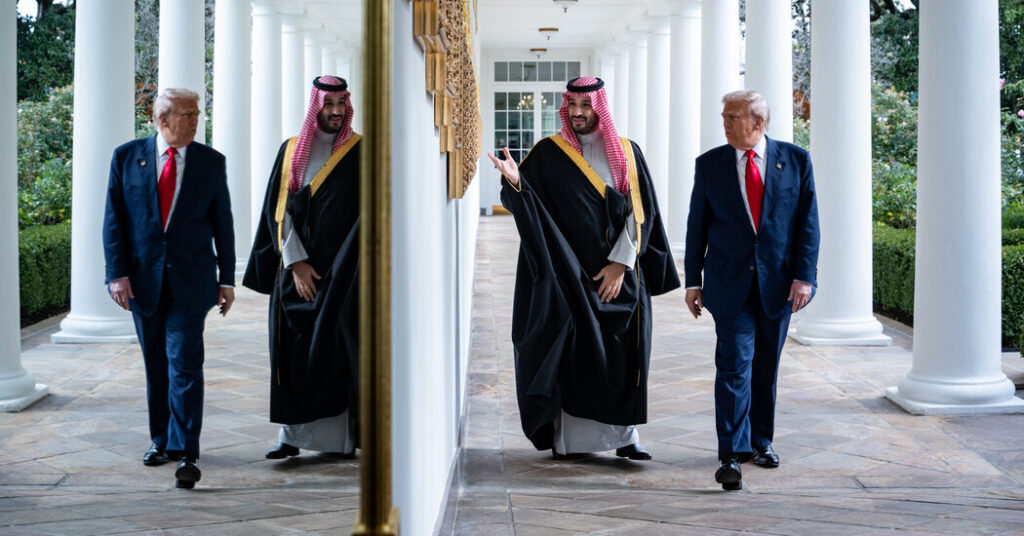
Saudi Arabia’s de facto leader, Prince Mohammed bin Salman, has been pushing President Trump to continue the war against Iran, arguing that the U.S.-Israeli military campaign presents a “historic opportunity” to remake the Middle East, according to people briefed by American officials on the conversations.
In a series of conversations over the last week, Prince Mohammed has conveyed to Mr. Trump that he must press toward the destruction of Iran’s hard-line government, the people familiar with the conversations said.
Prince Mohammed, the people familiar with the discussions said, has argued that Iran poses a long-term threat to the Gulf that can only be eliminated by getting rid of the government.
Prime Minister Benjamin Netanyahu of Israel also views Iran as a long-term threat, but analysts say Israeli officials would probably view a failed Iranian state that is too caught up in internal turmoil to menace Israel as a win, while Saudi Arabia views a failed state in Iran as a grave and direct security threat.
But senior officials in both the Saudi and American governments worry that if the conflict drags on, Iran could deliver ever more punishing attacks on Saudi oil installations and the United States could be stuck in an endless war.
In public, Mr. Trump has swung wildly between suggesting that the war could end soon and signaling it would escalate. On Monday, the president posted on social media that his administration and Iran had held “productive conversations regarding a complete and total resolution of our hostilities,” though Iran disputed the idea that negotiations were underway.
The consequences of the war for Saudi Arabia’s economy and national security are enormous. Iranian drone and missile attacks, launched in response to the American-Israeli assault on Iran, have already created huge disruptions in the oil market.
Saudi officials rejected the idea that Prince Mohammed has pushed to prolong the war.
“The kingdom of Saudi Arabia has always supported a peaceful resolution to this conflict, even before it began,” the Saudi government said in a statement, noting that officials “remain in close contact with the Trump administration and our commitment remains unchanged.”
“Our primary concern today is to defend ourselves from the daily attacks on our people and our civilian infrastructure,” the government added. “Iran has chosen dangerous brinkmanship over serious diplomatic solutions. This harms every stakeholder involved but none more than Iran itself.”
Mr. Trump has at times seemed open to winding down the war, but Prince Mohammed has argued that would be a mistake, the people briefed on the conversations said, and has pressed for attacks against Iran’s energy infrastructure to weaken the government in Tehran.
This article is based on interviews with people who have had conversations with American officials, and who described the discussions on the condition of anonymity because of the sensitive nature of Mr. Trump’s talks with world leaders. The New York Times interviewed people with a variety of views on the wisdom of continuing the war and of Prince Mohammed’s role in advising Mr. Trump.
Karoline Leavitt, the White House press secretary, said the administration “does not comment on the president’s private conversations.”
Prince Mohammed, an authoritarian royal who has led a sustained crackdown on dissent, is respected by Mr. Trump and has previously influenced the president’s decision-making. Prince Mohammed has argued that the United States should consider putting troops in Iran to seize energy infrastructure and force the government out of power, according to the people briefed by U.S. officials.
In recent days, Mr. Trump has given more serious consideration to a military operation to seize Kharg Island, the hub of Iran’s oil infrastructure. Such an operation, with airborne Army forces or an amphibious assault by Marines, would be immensely dangerous.
But Prince Mohammed has advocated ground operations in his conversations with Mr. Trump, according to people briefed by American officials.
The Saudi views of the war are shaped by economic factors as much as political ones. Since the war began, Iran’s retaliatory attacks have largely choked off the Strait of Hormuz, hobbling the region’s energy industry. The vast majority of Saudi, Emirati and Kuwaiti oil must pass through the strait to reach international markets.
While Saudi Arabia and the United Arab Emirates have built pipelines to circumvent the strait, those alternative routes have come under attack as well.
Analysts familiar with Saudi government thinking say that while Prince Mohammed probably preferred to avoid a war, he is concerned that if Mr. Trump pulls back now, Saudi Arabia and the rest of the Middle East will be left to confront an emboldened and furious Iran on their own.
In this view, they say, a half-finished offensive would expose Saudi Arabia to frequent Iranian attacks. Such a scenario could also leave Iran with the power to periodically close the Strait of Hormuz.
“Saudi officials certainly want the war to end, but how it ends matters,” said Yasmine Farouk, director of the Gulf and Arabian Peninsula project for the International Crisis Group.
A 2019 Iran-backed attack on Saudi oil facilities — which briefly knocked out half of the kingdom’s oil production — pushed the prince to reconsider his antagonistic approach to the Islamic Republic.
Saudi officials later pursued a diplomatic détente, re-establishing relations with Iran in 2023, in part because they realized that their country’s alliance with the United States offered only partial protection from Iran, Saudi officials have said.
Other countries in the region, including the United Arab Emirates, also pursued warmer relations with Iran in the past few years for similar reasons.
After Mr. Trump’s decision to go to war, against the advice of several Gulf governments, Iran responded by shooting thousands of missiles and drones at countries in the region, derailing their efforts to bring Iran into their fold, Gulf officials have said.
“What little trust there was before has completely been shattered,” Saudi Arabia’s foreign minister, Prince Faisal bin Farhan, told reporters last week.
Saudi Arabia has a large stockpile of Patriot interceptors that it is using to protect itself from the barrage of Iranian attacks that have rained down on its oil fields, refineries and cities.
But interceptors are in short supply globally. Drone and missile attacks in Saudi Arabia have already struck a refinery and the U.S. embassy, while fragments from intercepted projectiles have killed two Bangladeshi migrant workers and injured more than a dozen other foreign residents.
Since the beginning of the war, Mr. Netanyahu has pushed for military operations that could force the collapse of Iran’s government. U.S. officials have focused on degrading the country’s missile and naval capabilities and have been more skeptical that the hard-line government in Iran can be driven from power.
Though Israeli strikes have killed a large number of leaders, the hard-line government remains in control.
Saudi officials have long expressed concerns that a failed state in Iran poses a grave threat to them, analysts say. They fear that even if Iran’s government fell, elements of the military — or militias that could emerge in the power vacuum — would continue to attack the kingdom and are likely to focus on oil targets.
Some government intelligence analysts have told other officials that they think Prince Mohammed sees the war as an opportunity for him to increase Saudi Arabia’s influence throughout the Middle East, and that he believes Saudi Arabia can protect itself even if the war continues.
In conversations with Prince Mohammed, Mr. Trump has raised worries about the price of oil and the damage it is doing to the economy. The Saudi leader has assured him that is only temporary, according to people briefed by American officials.
But American and regional officials are deeply skeptical that oil markets will quickly recover from the war. Saudi Arabia cannot make up the shortfalls caused by the war because its overland pipeline can only carry a fraction of the oil that normally transits through the Strait of Hormuz, economists say.
While Saudi Arabia is better positioned than the other Gulf countries to weather the closure of the strait, it could face dire ramifications if the waterway is not reopened soon.
Even before the war began, Prince Mohammed was facing serious financial challenges as he approached the 2030 deadline he had set for himself to transform Saudi Arabia into a global business hub. His government is forecasting budget deficits for several years to come as ambitious megaprojects and vast investments in artificial intelligence strain the country’s limited resources.
A prolonged war with Iran would put all of that at risk. The prince’s success hinges on creating a secure environment for investors and tourists.
Asked last week whether the Saudi government preferred an immediate end to the war or a longer conflict in which Iran’s capabilities were degraded, Prince Faisal, the Saudi foreign minister, told reporters that the only thing that officials cared about was halting Iranian attacks on Saudi Arabia and neighboring countries.
“We’re going to use every lever we have — political, economic, diplomatic and else-wise — to get these attacks to stop,” Prince Faisal said.
Vivian Nereim in Riyadh, Saudi Arabia, and David E. Sanger in Washington contributed reporting.
Julian E. Barnes covers the U.S. intelligence agencies and international security matters for The Times. He has written about security issues for more than two decades.
The post Saudi Prince Is Said to Push Trump to Continue Iran War in Recent Calls appeared first on New York Times.