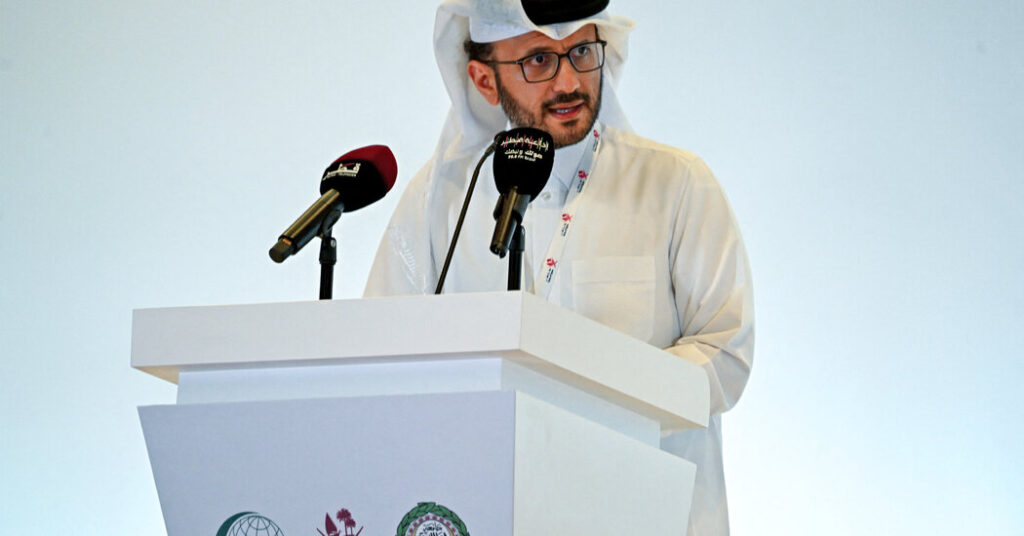
Qatar is not currently engaged in any mediation efforts between Washington and Tehran, the spokesman for the country’s Foreign Ministry said on Tuesday, marking a shift in Qatar’s willingness to engage with Iran diplomatically.
“Our focus at this time is entirely dedicated to defending our country and addressing the losses resulting from the various attacks that the State of Qatar has endured,” the spokesman, Majed al-Ansari, said during a weekly news briefing in Doha.
Mr. al-Ansari said there had been no new communication between his government and Tehran since a single telephone call between the Iranian and Qatari foreign ministers in the early stages of the war.
Qatar, a peninsula that juts out from the Arabian Peninsula into the Persian Gulf, has traditionally played a significant diplomatic and economic role in the region.
On Monday, President Trump said the United States and Iran were engaged in “very strong talks” to end the war and that he would postpone a deadline for a threatened attack on Iranian power plants. Iran, however, refuted that any negotiations were happening.
Mr. al-Ansari, for his part, said Qatar wasn’t involved in any talks, “if they exist.”
“I am not privy to the details of the current negotiations, but we stand ready to help, of course, if there is any role for Qatar,” he said.
Mr. al-Ansari said that Qatar and its neighbors in the Gulf Cooperation Council have seen their trust in Tehran dissipate.
“It’s now up to the Iranians, post this war of course, to decide how they’re going to rebuild the trust that was lost due to their attacks on our sovereignty,” he said.
Since the U.S. and Israel initiated a military campaign against Iran on Feb. 28, Tehran has retaliated by launching thousands of missiles and drones at Israel and several Persian Gulf nations, including Qatar.
During the June 2025 Iran-Israel war, Iranian forces fired missiles at Al Udeid Air Base in Qatar, which serves as the regional headquarters for the U.S. Central Command, in retaliation for the American bombing of Iranian nuclear sites. At the time, Qatar opted for restraint, successfully mediating a conclusion to the hostilities.
Recent strikes on Qatar’s Ras Laffan Industrial City, the world’s largest liquefied natural gas export plant, sent global gas prices soaring. Mr. al-Ansari said it could take up to five years to repair the damage.
He also emphasized on Tuesday that the countries of the Gulf Cooperation Council would need to re-evaluate and overhaul its collective defense protocols once the fighting stops.
“One of the most significant outcomes of this war is the shattering of the concept of a regional security system in the Gulf region,” Mr. al-Ansari said. “The regional security framework in the Gulf was based on certain axioms. Many of these axioms have been bypassed in the current war.”
Ismaeel Naar is an international reporter for The Times, covering the Gulf states. He is based in Dubai, United Arab Emirates.
The post Qatar Is Not Mediating U.S.-Iran Talks, Foreign Minister Says appeared first on New York Times.