Pakistan is emerging as an important intermediary between the United States and Iran.
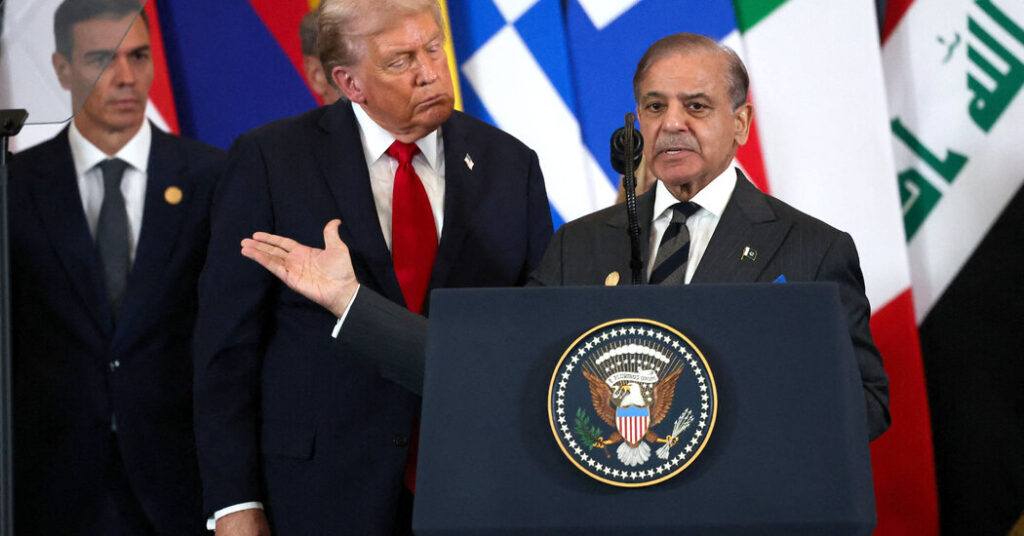
Prime Minister Shehbaz Sharif of Pakistan said on Tuesday that the country could host talks between the United States and Iran, its neighbor, as Pakistan’s government tries to capitalize on its standing with the leadership of both countries.
“Pakistan stands ready and honored to be the host to facilitate meaningful and conclusive talks for a comprehensive settlement of the ongoing conflict,” Mr. Sharif said in a post on X.
President Trump shared a screenshot of Mr. Sharif’s post on his platform, Truth Social.
And Pakistan’s army chief, Field Marshal Syed Asim Munir, has emerged as the key interlocutor between the United States and Iran.
The comments were a clear sign, amid growing speculation, of Pakistan’s eagerness to play a role as a mediator between the two countries, although no clear pathway to the talks has been detailed.
So far, Pakistan has mostly tried to stay above the fray. It has condemned the U.S.-Israeli strikes on Iran without naming the United States; vowed to defend Saudi Arabia under a mutual defense pact, but without retaliating against Iran; and maintained regular communications with Iranian officials, even as Iran’s strangling of the Strait of Hormuz has left the Pakistani economy battered.
Pakistan’s top government and military officials have nurtured a close relationship with Mr. Trump. They nominated him for the Nobel Peace Prize last year and offered partnerships with the United States on counterterrorism, critical minerals and crypto deals — what some Pakistani analysts have referred to as Pakistan’s “3Cs.”
That effort appears to have earned Mr. Trump’s good graces. Mr. Trump has referred to the army chief as his “favorite field marshal,” and U.S. military officials have called the counterterrorism partnership “phenomenal.”
While several countries have offered to serve as interlocutors with Iran, analysts say Pakistan brings several selling points as a potential mediator.
“They know Iran very well,” Mr. Trump said last year about Pakistan after a lunch with Mr. Munir at the White House in the midst of the 12-day war between Iran and Israel.
It is a non-Arab, Muslim country, like Iran, and it does not host a U.S. military base — sparing it from Iranian strikes, unlike countries in the Gulf. Pakistan shares a volatile, 560-mile border with Iran, and nearly a fifth of its 240 million people are Shiite Muslims, one of the largest Shiite communities outside Iran.
Pakistan has also managed to carefully balance its relationships in the Middle East during the conflict. The billions of dollars that Pakistani workers remit every year from Arab countries in the Gulf region are crucial for Pakistan’s economy. And with its economy heavily reliant on oil imports — 81 percent of which comes from the Gulf — it was among the first to provide military escorts for its ships through the Strait of Hormuz.
At the same time, Pakistani officials have indicated that they want to avoid a confrontation with Iran. Mr. Sharif has held regular calls and meetings with President Masoud Pezeshkian of Iran this year, according to Mr. Sharif’s spokesman, Mosharraf Zaidi.
Though no talks in Pakistan have been confirmed, even the speculation serves a useful purpose. Pakistan has sought to be perceived as a diplomatic power at the crossroads of Central Asia, South Asia and the Middle East. Shortly after it signed the defense agreement with Saudi Arabia, Pakistan renewed a long-term economic partnership with China.
While it seeks a larger diplomatic role, Pakistan is walking a fine line at home. Mr. Sharif’s government has faced criticism for wooing Mr. Trump, and protesters have in recent weeks demonstrated against the assassination of Ayatollah Ali Khamenei, chanting “Death to America.” On March 1, protesters tried to storm the U.S. consulate in Karachi, and 10 people were killed.
Pakistan is also engaged in a conflict with another neighbor, Afghanistan. Officials in Islamabad have been on high alert amid fears of an attack on the Pakistani capital in retaliation for Pakistan’s recent airstrikes on Afghanistan.
Elian Peltier is The Times’s bureau chief for Pakistan and Afghanistan, based in Islamabad.
The post Pakistan Offers to Mediate Between Iran and the United States appeared first on New York Times.