Pakistan’s government has embarked on a major push to reshape its image abroad, an effort now visible in how it’s handling the escalating conflict with Afghanistan.
The media offensive is part of a renewed push by Pakistan to position itself as a key partner to the West, including President Trump, and a diplomatic power in the region.
Over the past year, representatives of Pakistani security agencies have lobbied journalists to start state-friendly English-language news outlets, according to officials and journalists approached for the ventures. In October, Pakistan also relaunched its public broadcast channel, Pakistan TV. During a visit to the headquarters last fall, Prime Minister Shehbaz Sharif said the channel’s new digital department would counter foreign propaganda and promote Pakistan’s messaging abroad.
The new outlets have pursued two main targets — India and the Taliban government next door in Afghanistan. Their journalists have been highly critical of Pakistan’s archrival, India, and have framed a military campaign against the Taliban in terms that mostly echo the Pakistani military’s rhetoric — reinforcing claims that all strikes hit Afghan military targets, for example, despite evidence to the contrary.
“Pakistan has traditionally been far too shy and risk averse in shaping its own story,” said Mosharraf Zaidi, a spokesman for Prime Minister Shehbaz Sharif. “That is beginning to change.”
A Pakistani official involved in the effort said it was prompted by the military clash with India last May, when Pakistan became “overwhelmed” with pro-Indian content on social media, the official said.
Both Indian and Pakistani media amplified falsehoods during the conflict last year.
In response, the Pakistani official said, security agencies “motivated and requested” media executives to start new English-language channels to counter those narratives, in part by providing tax exemptions.
The appeal was patriotic, the official said, speaking on condition of anonymity to detail a plan not yet reported publicly. The official didn’t disclose how much funding the channels had received, but said that no English-language channel in Pakistan would be sustainable without state support.
In addition to Pakistan TV’s revamp, two new English-language channels were started shortly after the clash with India. At least two more are in the works, according to journalists approached for the ventures.
The channels are part of Pakistan’s larger diplomatic strategy. Since the military clash with India, Pakistan’s army chief, Field Marshal Syed Asim Munir, has forged a personal relationship with President Trump, who calls him his “favorite field marshal,” and wooed Mr. Trump’s allies with crypto and his administration with mineral deals.
Pakistan has also tried to be perceived as a diplomatic power at the crossroads of Central Asia, South Asia and the Middle East. It signed a defense pact with Saudi Arabia in September shortly after renewing a long-term economic partnership with China.
To back up its diplomacy, Pakistan is trying to replicate successful state-backed channels that amplify their countries’ messages and burnish their images abroad, like Turkey’s TRT or Qatar’s Al Jazeera.
“If you’re doing well diplomatically, if your economy is on track, you need a strong state broadcaster that can bring Pakistan’s vision to the world,” Adil Shahzeb, the head of the state broadcaster, Pakistan TV, said in an interview last fall.
Pakistan has a long history of starting television channels in the wake of conflicts with India. In the mid-2000s, three English-language news channels were started amid heightened tensions. But the initiatives, unprofitable, quickly folded.
Journalists said this new media push may face the same fate, because the funding and vision are nowhere near those provided by Qatar and Turkey.
“The problem is, these efforts pick up steam when a crisis flares up, but nobody is really trying to figure out what comes next,” said Arifa Noor, the host of an Urdu talk show on Dawn TV, one of the country’s few independent news outlets.
In recent months, Pakistan TV, the public broadcaster, has covered protests in neighboring India; a humanitarian crisis in Afghanistan; and Pakistan’s diplomacy, including three meetings between President Trump and Field Marshal Munir and Pakistan’s decision to join Mr. Trump’s Board of Peace.
But contentious domestic issues have remained mostly absent.
“The government thinks that it can fund television channels, directly or indirectly, that it will use as mouthpieces for easy communication purposes,” said Bilal Gilani, the executive director of Gallup Pakistan, an independent research institute.
It is unclear what funding mechanism, direct or indirect, Pakistan used for this effort.
Three Pakistani journalists said they had been approached by Sharjeel Inam Memon, a provincial information minister who is seen as a key intermediary for the state, to start one of the ventures. All three media executives said they declined the request. They spoke on condition of anonymity to describe the government’s methods.
Mr. Memon and Pakistan’s information minister, Attaullah Tarar, didn’t respond to requests for comment.
The Pakistani official involved in the state’s efforts said that journalists had been invited by the security agencies to devise the new ventures’ editorial strategy. He said he wasn’t sure how the new channels would keep operating after the initial round of funding.
The new outlets have had to contend with what the country’s leading editors’ organization has called the government’s “complete control” of Pakistani media.
Reporters in Pakistan have faced increased censorship and financial pressure, including frozen bank accounts and the suspension of government advertising; forced removal, arbitrary arrests and imprisonment, according to journalists and human rights groups. Several journalists have also been arrested under a law criminalizing “false and fake information.”
Dawn, the country’s most well-known newspaper, currently faces a financial crisis after the government choked off advertising revenue, in what the paper said is retaliation for its reporting.
Pakistan ranks 158th out of 180 countries in the press freedom index of Reporters Without Borders.
Some pockets of independence remain on YouTube and podcasts, said Ms. Noor of Dawn TV. “It allows a conversation to happen that the state wants to put an end to,” she said.
Two leaders of state-friendly news outlets say they intend to maintain their independence.
“We will try to be as independent as we can be as a state broadcaster,” said Mr. Shahzeb, of Pakistan TV. “I won’t just say ‘yes boss’ to those who’ve named me here.”
He said he wanted the channel to be “calm, credible, composed.”
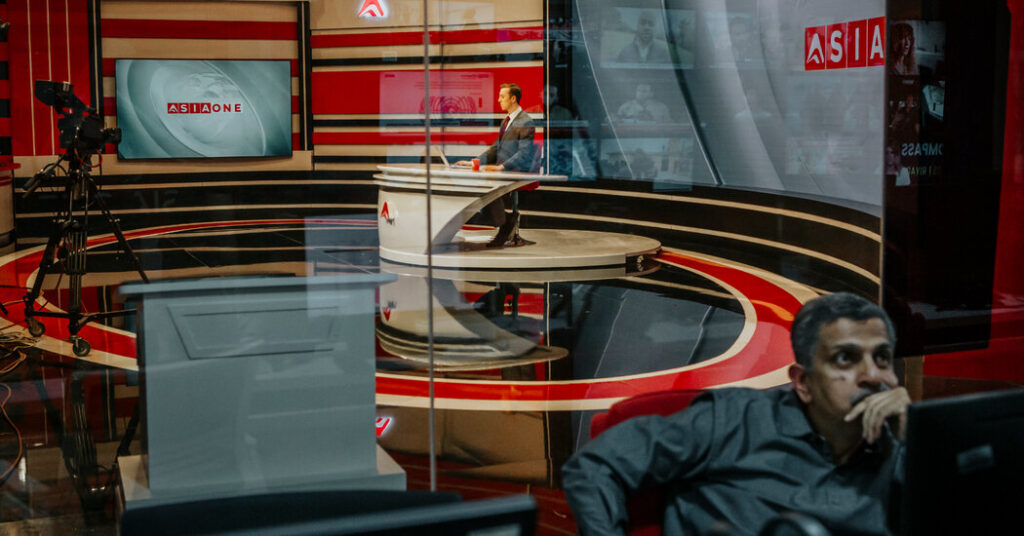
Asia One, one of the new channels, made its debut last summer in Karachi.
Naveed Qamar, Asia One’s director and a veteran journalist, said the channel had hired 250 employees, including on-air hosts who are primarily foreigners. Local journalists, Mr. Qamar said, lacked the broadcast-standard English required for a global audience.
“We want to show the world that a foreign journalist can be based in Pakistan and be safe here,” Mr. Qamar said.
During a visit to Asia One’s headquarters last fall, the newsroom hummed as dozens of journalists prepared news clips and bulletins.
But an Asia One employee, who requested anonymity to speak candidly, said the channel offered only temporary relief in an industry where jobs are scarce.
Shahzeb Jillani, the head of the Karachi-based Center for Excellence in Journalism, said the speed at which the new channels started running was “impressive,” but that they could collapse as quickly.
“I tell my students about those new channels, ‘Go there, learn, make money,’” Mr. Jillani said. “But be mindful of who you work for.”
Elian Peltier is The Times’s bureau chief for Pakistan and Afghanistan, based in Islamabad.
The post Pakistan Dials Up Its Information War appeared first on New York Times.