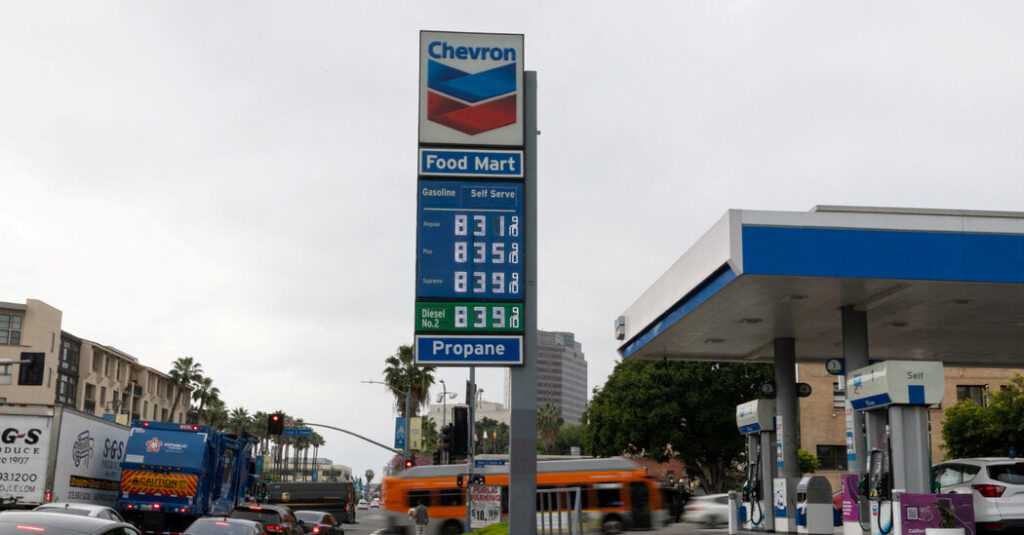
Average U.S. gasoline prices hit $3.98 per gallon on Tuesday, according to AAA, on the cusp of a level that was last hit when Russia invaded Ukraine in 2022.
The last month has seen the second-largest gas price spike in three decades, with average prices climbing more than 30 percent since the war in Iran effectively shuttered the Strait of Hormuz, a narrow waterway that conveys up to a fifth of the world’s oil.
Though there’s no hard and fast rule that dictates exactly what choices consumers make at $4, $5, and $6 per gallon, higher gas prices are already stressing household budgets. At $4 per gallon, more than half of Americans said they’d change their driving behavior, according to a 2022 survey by AAA. More recent data has also shown that Americans are delaying some forms of spending.
The energy shock has hit Asia hardest: The Philippines declared a state of emergency on Tuesday, and President Ferdinand Marcos Jr. said grounding planes because of a jet fuel shortage was a “distinct possibility.” South Korea is urging citizens to ride bicycles instead of driving.
Transportation, of course, is the single-largest source of planet-warming greenhouse gas emissions in the United States, and a big contributor globally. Here’s what we know about how a long period of high gas prices could change how willing people are to drive gas-powered vehicles, both here and abroad.
Driving less, window-shopping
Already, Americans are looking for ways to cut back. In New Orleans, drivers are lining up at gas stations with the best prices. Michele Tafoya, a Republican candidate for the U.S. Senate in Minnesota, encouraged people to take “one less trip to Starbucks.” The state of Georgia has implemented a fuel tax holiday, waiving a 33-cent-per-gallon tax.
When gas prices spike, drivers tend to respond by cutting out unnecessary trips, by car-pooling and using public transportation, according to AAA. Spending on discretionary expenses like plane tickets and restaurant meals has fallen, too, as transportation costs eat up a bigger share of household budgets.
Yet while plenty of people who own electric vehicles have been boasting about their fuel savings on social media over the last few weeks, gas prices would have to stay high for a much longer period of time to trigger a broader shift away from gas-powered vehicles, according to Stephanie Valdez Streaty, research and development director at Cox Automotive, a research firm.
Still, the war in Iran appears to have driven a modest uptick in E.V. curiosity among U.S. drivers, according to the car shopping site Edmunds. If high prices persist, more people may feel the urge to hop off what Jessica Caldwell, the head of insights at Edmunds, called the “gas price roller coaster.”
New E.V.s in the U.S. are still more expensive than gas-powered cars, but the gap is closing for used vehicles. In February, the average listing price for a used E.V. was $34,821, about $1,300 more than a gas-powered car, Valdez Streaty said.
Hundreds of thousands more used E.V.s could enter the market this year as leases expire, Valdez Streaty said. “Consumers are going to have a lot of good options at a lower price point,” she said.
The global E.V. tipping point
If you’re curious about buying whether the economics of buying an E.V. are in your favor, The Times has a calculator that can help. The math looks very different abroad, where gas price shocks have been more intense and E.V.s are often far more affordable than in the U.S.
The scales could tip fastest in countries with access to inexpensive Chinese E.V.s, like Brazil, parts of Asia and soon, Canada, wrote David Brown, the director of energy transition research at Wood McKenzie.
In Vietnam, for example, gas prices have risen by around 30 percent since the start of the conflict. But the increase coincides with a rapid increase in the share of electric cars sold each year as government incentives meet affordable options from local manufacturers.
In December, the Vietnamese E.V. maker VinFast broke records when it reported the highest monthly sales volume ever recorded by any automaker in the country. Its best-selling car last year, the VF 3, hit the market in 2024 at just under $13,000.
VinFast has begun offering discounts of 3 to 5 percent to people switching from gas-powered cars and scooters, Reuters reported.
Renewable energy
Trump administration to pay $1 billion to cancel wind farms
The Trump administration will pay the French energy giant TotalEnergies nearly $1 billion to abandon its plans to build wind farms off the East Coast, the Interior Department said on Monday at the CERAWeek energy conference in Houston.
As part of the deal, Total would invest that money in oil and gas projects in the United States, commit to producing more oil in the Gulf of Mexico, and the firm said it was developing some additional gas-burning power plants to meet rising electricity demand from data centers.
The deal is an extraordinary transfer of taxpayer dollars to a foreign company for the purposes of bolstering the production of fossil fuels, a main driver of climate change, while throttling offshore wind power.
The larger of the two wind farms would have generated enough electricity to power one million homes and businesses in New York and New Jersey. — Maxine Joselow and Brad Plumer
Quote of the day
“It will take some time to come back to the normal days we had before the war was started.”
That’s from Fatih Birol, the head of the International Energy Agency, speaking on Monday in Canberra, Australia, who had a grim assessment about how long the effects of the war in Iran would last.
He said the energy crisis caused by the Iran war was worse than the combined effect of the oil shocks in the 1970s. The I.E.A. recently coordinated the biggest release of stockpiled oil in history.
One last thing
How do you measure snow from space? First, climb a mountain.
At 4:30 a.m. on a recent Wednesday, three alpine scientists arose from fitful sleep in a chilly research lab in the Colorado mountains, 11,500 feet above sea level. They drank some grainy coffee, strapped into their skis and headed out into the moonlight, dragging a sled loaded with gear.
They had a satellite to meet.
The scientists were on an unusual mission. They needed to measure the depth of the snow at a particular mountaintop location just as a new satellite passed directly overhead. That satellite, equipped with powerful radar, has the potential to be the first one capable of estimating how much water is on the ground, in the form of fallen snow, from outer space.
It would be an extraordinary technological milestone, providing global data on snowpack, precipitation and how much water might be available to feed rivers and reservoirs downstream in spring and summer. But first, the satellite would need to be calibrated. — Sachi Kitajima Mulkey
More climate news from around the web:
-
In Africa, Reuters reports, the war in Iran is changing the cost of jet fuel so rapidly that it’s upending travel. “You fly to airports across Southern, West and East Africa and you negotiate prices on arrival,” one operator of a jet charter service in Africa said.
-
A flock of companies sent satellites into space to help fight climate change, but now find that scanning war zones pays better, The Wall Street Journal reports.
-
“The conflict in the Middle East appears to have forced some oil and gas companies to directly burn off more natural gas than usual as their facilities have come under attack or exports have been blocked,” Bloomberg writes.
Read past editions of the newsletter here.
If you’re enjoying what you’re reading, please consider recommending it to others. They can sign up here.
Follow The New York Times on Instagram, Threads, Facebook and TikTok at @nytimes.
Reach us at [email protected]. We read every message, and reply to many!
Claire Brown covers climate change for The Times and writes for the Climate Forward newsletter.
The post Life at $4 a Gallon appeared first on New York Times.