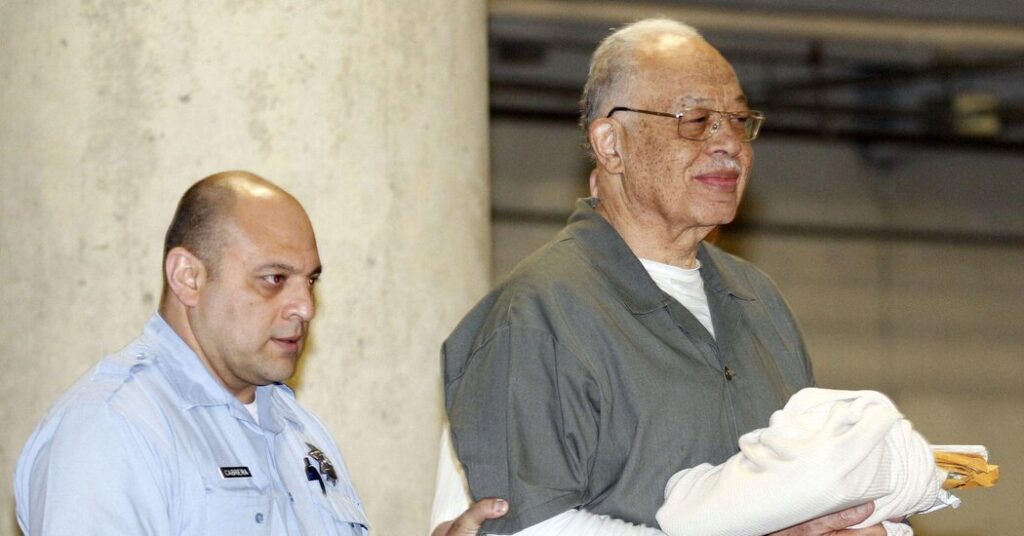
Kermit Gosnell, a physician who in 2013 was convicted of three counts of first-degree murder of babies who had emerged alive during late-term abortions, and whose trial included graphic and disturbing details that became a rallying cry for anti-abortion activists, died on March 1 in Huntingdon, Pa. He was 85.
The Pennsylvania Department of Corrections confirmed the death, in a hospital, on Monday, saying that he had been transferred there from Smithfield state prison, about 60 miles south of Pittsburgh, where he was serving a life sentence without parole. His death was not reported by the news media at the time.
At the abortion clinic that Dr. Gosnell ran, in West Philadelphia, prosecutors — calling it a “house of horrors” — said he had injected a drug to stop the fetal heartbeat while performing abortions often past 24 weeks of gestation, the legal limit for abortion in Pennsylvania. But the drug did not always work, they said.
If a baby jerked an arm or drew breath outside the womb, prosecutors said, Dr. Gosnell would cut its spinal cord at the neck with surgical scissors. One trial witness said that a baby killed by Dr. Gosnell had “made noises, a whine, like my baby.”
Dr. Gosnell and other workers at his clinic, the Women’s Medical Society, which mainly served poor, Black women, performed hundreds of such killings, according to a grand jury report. Most of the deaths could not be prosecuted because documentary or physical evidence was gone.
He “killed live, viable, moving, breathing, crying babies,” the grand jury report said.
The case, widely reported by the national news media, became a cause célèbre for anti-abortion activists, who insisted that it pointed up the humanity of an unborn fetus. If it is murder to end the life of an aborted baby outside the womb, they argued, why isn’t it murder to end its life before birth during a late-term abortion?
The activists called for widely banning abortions after 20 weeks of pregnancy, a standard that at the time — nearly a decade before the U.S. Supreme Court overturned the constitutional right to abortion in 2022 — was more restrictive than the prevailing one, which permitted abortions up to fetal viability, about 24 weeks.
“What we need to learn from the Gosnell case is that late-term abortion is infanticide,” Kristen Powers, a columnist for The Daily Beast, wrote.
Defenders of abortion rights argued that abortions after 20 weeks are very rare, and that Dr. Gosnell’s procedures that crossed the line into criminality were far outside what takes place at other clinics. They underlined that if additional restrictions were placed on abortion, more women would seek out dangerous, lawbreaking practitioners like Dr. Gosnell.
His clinic, according to the grand jury and his trial record, was filled with unsanitary, blood-soaked equipment; employed untrained and unlicensed staff to administer labor-inducing drugs; and falsified results of ultrasound procedures to show that a patient was less than 24 weeks pregnant, the legal limit.
One 17-year-old mother was almost 30 weeks pregnant when labor was induced. The baby was breathing and moving when Dr. Gosnell severed its spine, according to the grand jury. The doctor joked that the infant was so big, “he could walk me to the bus stop.”
Community groups in Philadelphia had stopped referring patients to Dr. Gosnell’s clinic because of its poor reputation. To remain in business, he had relied on desperate women from out of town. His staff members would induce a woman’s long, often painful labor during the day, and the doctor would arrive late at night to finish the procedure.
Pennsylvania oversight agencies, including the Department of Health and the Board of Medicine, failed to regulate Dr. Gosnell’s clinic despite complaints. His practice was exposed only when the police raided the clinic in 2010 after reports that he was running a so-called pill mill, illegally writing hundreds of prescriptions for OxyContin and other controlled substances.
The doctor, whose medical license was suspended after the police raid, was charged with seven counts of first-degree murder. The trial judge, Jeffrey P. Minehart, threw out three murder charges, and Dr. Gosnell was acquitted in a fourth death.
His lawyer, Jack J. McMahon, argued that none of the late-term abortions resulted in a live birth; the infants, he said, were already dead because of the drug that had been injected in utero to stop their hearts. Any movements outside the womb, he maintained, were involuntary spasms.
The jury did not buy it. After a five-week trial, it convicted Dr. Gosnell of first-degree murder of victims known only as Baby A, Baby C and Baby D.
Dr. Gosnell was also found guilty of third-degree murder of a patient who was given a painkilling drug during labor that resulted in her death.
The district attorney called for the death penalty but agreed to a sentence of life in prison without parole after Dr. Gosnell waived his right to appeal his convictions.
Dr. Gosnell’s wife, Pearl Gosnell, whom prosecutors identified as a partner in crime, was charged with lesser counts. She pleaded guilty to racketeering and performing one illegal abortion. She called her husband a coward for not testifying at his trial or apologizing. She was sentenced to up to 23 months in prison.
Four other clinic employees, including a phlebotomist and a receptionist, pleaded guilty to lesser counts.
Kermit Barron Gosnell was born on Feb. 9, 1941, in Philadelphia, an only child, and grew up in West Philadelphia. He graduated from Dickinson College in Carlisle, Pa., in 1962, and, in 1966, from Jefferson Medical College in Philadelphia, where he did his residency in gynecology.
A group of community activists recruited him to serve West Philadelphia’s Mantua neighborhood, which was beset by gang and drug activity and had no doctor, according to The Philadelphia Inquirer. There, Dr. Gosnell opened a methadone clinic and an abortion clinic in the late 1960s, both rarities in the city.
“He had an inclination to make some money,” a childhood friend told The Inquirer in 2011.
Dr. Gosnell was married two previous times. He owned several properties in West Philadelphia and a vacation house on the Jersey Shore. Information about survivors was not immediately available.
The Gosnell case was the subject of a 2015 documentary, “3801 Lancaster: American Tragedy” (the title referred to the clinic’s address), and of a 2018 feature film, “Gosnell: The Trial of America’s Biggest Serial Killer.”
Trip Gabriel is a Times reporter on the Obituaries desk.
The post Kermit Gosnell, Imprisoned Abortion Doctor Convicted of Murders, Dies at 85 appeared first on New York Times.