The Supreme Court on Tuesday appeared inclined to clear the way for the Trump administration to revive a policy that would allow agents at U.S. borders to block migrants from entering the country to seek asylum.
Such a ruling would leave intact a policy that began during the Obama administration on a small scale and expanded dramatically during President Donald Trump’s first term amid efforts to curb the flow of immigration.
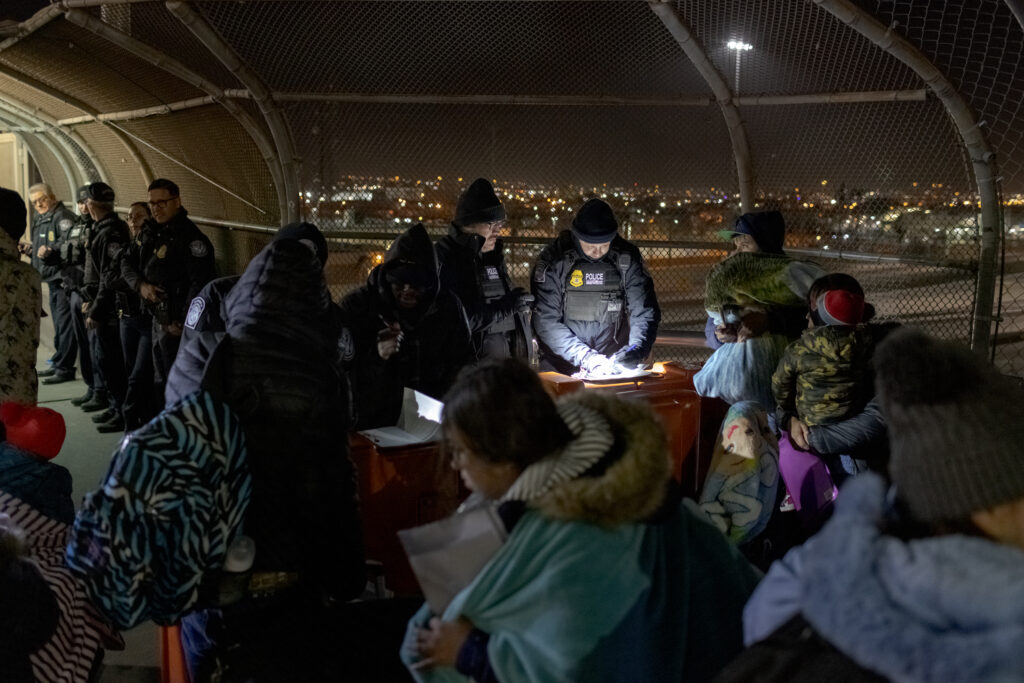
The case centers on how to interpret U.S. immigration laws saying that any noncitizen who “arrives in” the country must be allowed to apply for asylum. Under the policy at issue, called “metering,” federal border officials had been intercepting migrants approaching U.S. ports of entry and turning them back before they could reach American soil.
The government says the policy is consistent with the law, but a group of migrants suing the government say that migrants intercepted on the Mexico side of the border must be offered the opportunity to seek asylum.
Metering was part of a patchwork of policies under the first Trump administration that sought to slash the record number of people seeking asylum. Trump officials said those migrants were exploiting the system, while immigrant advocates said they were fleeing desperate conditions.
Tuesday’s case is one of an array of immigration clashes headed to the Supreme Court, as the political battle over the issue increasingly plays out in the judicial system. Next month, the justices will hear the administration’s challenge to birthright citizenship, the long-held understanding that the Constitution guarantees citizenship to anyone born in the United States.
In the dispute over metering, lower courts have sided with the migrants and blocked the policy. The Trump administration appealed, arguing it is a “critical tool” to address surges of migrants at the border.
Specifically, the justices are weighing whether a migrant stopped on the Mexico side of the border actually “arrives in” the United States and is thus entitled to an interview to prove they have a credible fear of persecution. The government argues there is no other way to read the law: A migrant must be physically inside the United States to have the right to make an asylum claim.
The migrants challenging the policy say it’s not that simple. They argue that, taken in context, the statute means that migrants in the process of seeking to enter the United States must receive an opportunity to apply for asylum, even if immigration officials manage to physically prevent them from coming in.
On Tuesday, several conservative justices suggested skepticism of the argument that a migrant can be said to “arrive in” the United States before crossing the border.
Justice Neil M. Gorsuch asked the immigrants’ attorney whether a migrant had “arrived” in the country if they were “on top” of a border wall or were at the “bottom” of it. He said he was just “curious” what “arrives in” meant under the plaintiffs’ theory.
Chief Justice John G. Roberts Jr. posed a hypothetical in which migrants waited in line at a port of entry at the border, seeking to be admitted. He asked whether only the first person in line “arrives in” in the country and those in the back of the line do not.
“Maybe I just don’t understand it,” he said. “It depends kind of on how long the line is, right?”
But some justices said the government’s reading of the law could reward migrants who dodge immigration officials by crossing into the country illegally, instead of through a legal port of entry. Justice Ketanji Brown Jackson asked “why on earth” Congress would create such an incentive.
In 2016, more than 150,000 migrants attempted to enter the United States through ports of entry along the U.S.-Mexico border, a 70 percent increase compared with two years earlier, according to court filings. The surge was driven by an uptick in Haitian migrants seeking refuge from dangerous conditions in their country caused by an earthquake there in 2010.
In response, U.S. border officials created a policy to restrict the flow of migrants. Officers lined up on the U.S. side of the border physically stopped migrants from stepping onto U.S. soil and turned them back to Mexico, according to former U.S. immigration officials and news reports at the time.
The first Trump administration in 2018 formalized that policy, which critics referred to as the “turnback” policy.
The practice led to a “humanitarian crisis” in Mexico, according to the plaintiffs. Those turned away started living in makeshift camps on the Mexico side of the border as they waited for an opportunity to apply for asylum. Some migrants attempted to cross into the United States illegally via the Rio Grande or the Sonoran Desert, the plaintiffs say. The Biden administration subsequently rescinded the policy.
In 2021, a federal judge in California ruled in favor of 13 asylum seekers who had filed a class-action lawsuit alleging the policy was unlawful. U.S. District Judge Cynthia A. Bashant, who was appointed by President Barack Obama, found that officers must process asylum seekers who are attempting to enter the United States — not just those who are physically inside its borders. The U.S. Court of Appeals for the 9th Circuit upheld the ruling.
The Trump administration appealed to the Supreme Court, saying the prior rulings strip the government of a tool to manage surges at the border and overcrowding at ports of entry.
It is unclear whether, if successful in the case, the Trump administration would reinstate the metering policy. Vivek Suri, the government attorney arguing the case, said officials would do so “when border conditions justify.”
Maria Sacchetti contributed to this report.
The post Justices seem inclined to revive Trump policy blocking migrants at border appeared first on Washington Post.