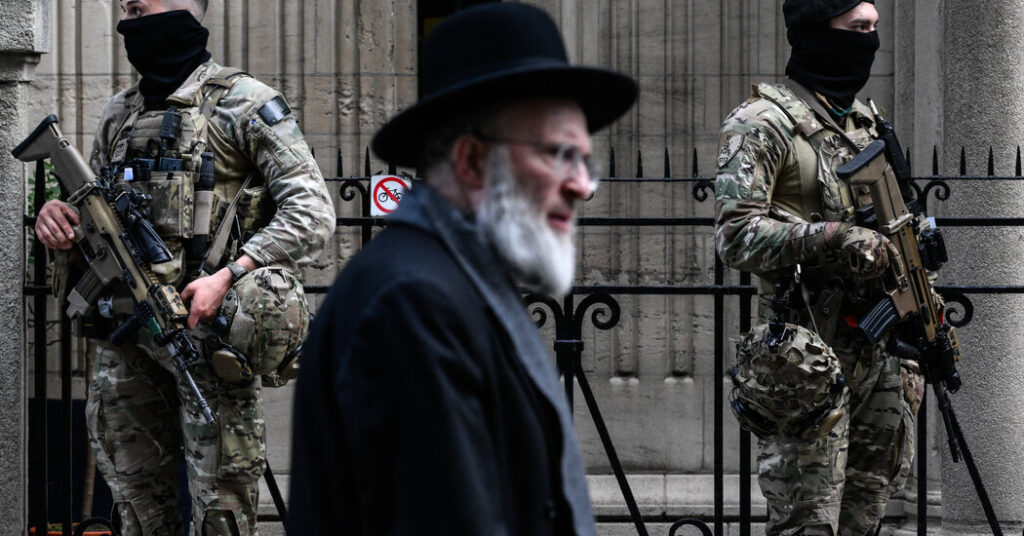
A string of attacks on Jewish institutions and property across Europe in the last two weeks have investigators trying to determine whether Iran or its proxies are behind the incidents, which are unnerving Jewish communities.
A previously unknown Islamist group that emerged March 9 has taken credit for attacks in London, Belgium, the Netherlands and most recently in the burning of a car Monday night in a Jewish neighborhood in Antwerp, Belgium.
Among the targets were two Jewish schools, an American bank and several ambulances run by a Jewish charity. The group promised future attacks if countries — particularly in Europe — did not distance themselves “from all American and Zionist interests, facilities, and what is affiliated with them.”
While the violence has not resulted in any injuries, the damage of buildings and vehicles has stoked a new wave of fear and anxiety for European Jews wondering if their communities will be targeted.
These attacks follow an already significant rise in antisemitic incidents that have left Jews on edge, particularly since the United States and Israel went to war with Iran just over three weeks ago.
“There’s no reason to believe this was the last attack,” said Julian Lanches, a fellow at International Centre for Counter-Terrorism, a research center in The Hague. “If we assume it’s a hybrid campaign, the goal is to create confusion, to get attention, and this is working perfectly.”
So far, investigators have not publicly implicated the Islamist group, known as Harakat Ashab al-Yamin al-Islamiyya, in any of the attacks, and there are questions about whether the group is a bogus front masking the involvement of Iran or one its proxies. The suspicions are growing because of the timing of the incidents — coinciding with the war with Iran — as well as Tehran’s longstanding use of proxies, its appetite for mounting operations in Europe and other clues.
The group’s initial claims of responsibility were posted on Telegram and X channels that are either affiliated with Iraqi pro-Iranian Shia militias or supportive of Iranian armed forces and proxies, according to a report published on Monday by Mr. Lanches.
“It’s without any question that they are heavily pro-Iran,” he said in an interview, referring to the four main Telegram channels that shared the group’s claims. They have a combined following of almost 2 million users.
Harakat Ashab al-Yamin al-Islamiyya’s logo is strikingly similar to that of Kataib Hezbollah, which is one of the most powerful Iranian proxies in Iraq, and it incorporates a symbol — a rifle held up by a right hand with writing along its barrel — that is also shared with the Iranian Revolutionary Guard Corps and its Quds Force branch, which carries out foreign operations.
A Kataib Hezbollah compound in Baghdad was hit with airstrikes on Feb. 28. The strike killed three people, including one of its commanders. About two weeks later, Kataib Hezbollah claimed responsibility for an attack on the U.S. embassy in Baghdad.
Kataib Hezbollah is a part of Iran’s so-called axis of resistance — a web of groups that carry out attacks on Israel. These proxy forces, which include Hamas, were supposed to serve as deterrents against Israeli attacks on Iran.
A U.S. intelligence official, speaking on the condition of anonymity because the investigation is ongoing, said officials in the U.S. are examining whether the attacks are linked to any group in Iraq. In addition, investigators are trying to determine if the attacks are being orchestrated, or if people are simply being encouraged or inspired to carry them out. They are also exploring why the targets are properties rather than people.
The circumstances of the attacks “strongly point towards Iranian-backed activity,” according to the Hague center’s research report.
The Iranian embassies in Britain, Belgium and the Netherlands could not be reached for comment.
In London, residents in Golders Green — a district known for its large Jewish population — were still reeling from Monday’s fire.
The police were searching for three people caught on camera setting fire to ambulances used by the nonprofit Hatzola service, which were parked next to a synagogue on a residential street. Residents were woken up by the sound of explosions as the oxygen canisters inside the vehicles combusted, smashing windows in nearby homes.
Debbie Paster, 51, said she had “heard the booms” from her home several streets away. “My daughter came banging on my bedroom door, and she said, ‘Mummy, there’s bombs falling; we need to get out,’” she said.
On Monday, Mark Rowley, the commissioner of the Metropolitan Police of London, addressed the Community Security Trust, a nonprofit that monitors antisemitism in Britain. He said that previous plots in Britain with ties to Iran had mainly targeted the Iranian diaspora, but that threats were “rapidly shifting.”
In Golders Green, some residents pointed out inconsistencies in the claim of responsibility issued by Harakat Ashab al-Yamin al-Islamiyya. The group’s video said its target was the Machzike Hadath Synagogue because it was a “bastion of support for Israel in Britain.”
But the police said video footage showed the perpetrators setting fire only to the ambulances, which have no connection to the synagogue other than using its parking lot.
The group’s credibility also came into question after it claimed responsibility for an attack on an unspecified “Zionist target” in Greece on March 11. That claim does not match any statements from the Greek police or news reports, Mr. Lanches said, and the footage used appeared to be from an unrelated fire in the Netherlands. It also claimed that it had attacked a “Zionist center and school” in the Dutch town of Heemstede on March 23, but the video posted did not show a fire. The local police said two teenagers had been arrested before an attack was carried out on suspicion “of taking preparatory acts to cause an explosion” with terrorist intent.
Investigators could also be getting closer to answers in Belgium, where two suspects were arrested after a car was set on fire Monday night in Antwerp’s Jewish quarter in yet another attack claimed by the same group on Telegram.
Kristof Aerts, a spokesman for the Antwerp public prosecutor’s office, said on Tuesday that two juveniles were “apprehended about 15 minutes after the fire.” The suspects have yet to be questioned and formally arrested, he added, and the authenticity of the footage posted by Harakat Ashab al-Yamin al-Islamiyya was still under investigation.
Jeanna Smialek and Koba Ryckewaert contributed from Brussels
Adam Goldman is a London-based reporter for The Times who writes about global security.
The post Investigators Seek Answers in Attacks on Jewish Sites in Europe. appeared first on New York Times.