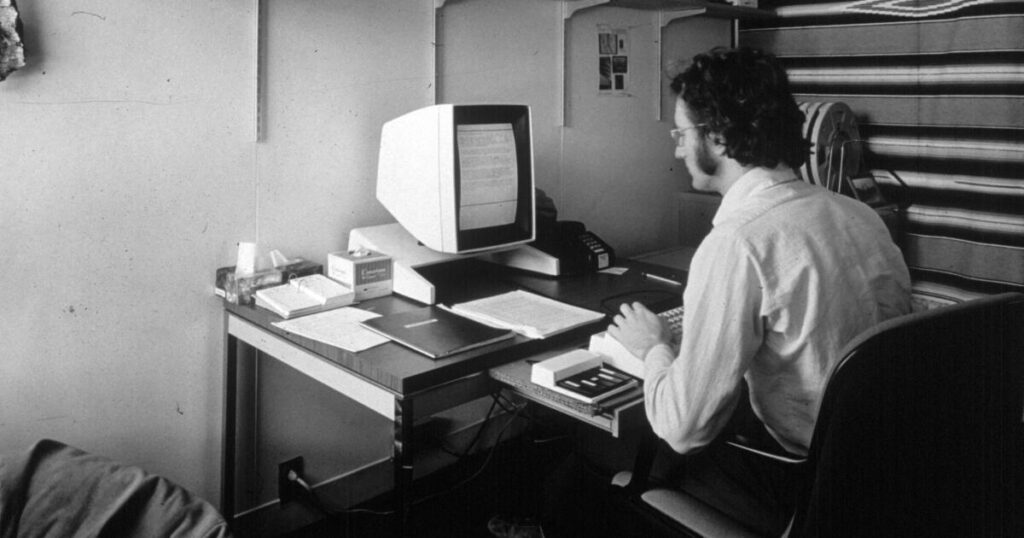
It’s one of the truly seminal events of the computer age.
In December 1979, Apple co-founder Steve Jobs led a delegation of his engineers into Xerox’s Palo Alto Research Center, the legendary PARC, for a demonstration of PARC’s most closely held inventions.
The research lab was already known to Silicon Valley cognoscenti for having invented a personal computer called the Alto and the precursor to the Ethernet networking system. But much more was going on under the surface.
As Apple marks its 50th birthday on April 1, it’s a timely moment to revisit the legendary Jobs demo.
As Jobs related later, he saw three things at PARC, but “I was so blinded by the first one that I didn’t even really see the other two.” Those two were object-oriented programming, embodied at PARC by a software program called Smalltalk, and a networked computer system, later to be known as Ethernet.
What engrossed him and his team was the Alto’s graphical display, which was destined to make the text-only displays of contemporary computers obsolete. Apple had been working on such a display for its prototypical workstation, the Lisa, which eventually would morph into the Macintosh. But they had run into problems that PARC plainly had solved.
Bill Atkinson, a brilliant Apple programmer, kept his eyes on the screen as though they were fixed there by a magnetic field. He was standing so close that while PARC scientist Larry Tesler conducted his assigned portion of the demo he could feel Atkinson’s breath on the back of his neck.
The Jobs demo was a centerpiece of my 1999 book about Xerox PARC, “Dealers of Lightning.” But it presented me with a unique research problem, for no anecdote from PARC’s rich history is burdened by so much contradictory testimony.
“The collective memory of the Jobs visit and of its aftermath,” I wrote, “is so vivid that some former PARC scientists are no longer sure whether they were there themselves, or just heard about it later.”
The demo inspired two federal lawsuits — one in which Apple accused Microsoft of copying the “look and feel” of the Macintosh to create the Windows display, and another in which Xerox accused Apple of stealing its own display technology from PARC. Both plaintiffs lost their cases.
So let’s unpack some of the mythology. Apple received not one demo, but two — the first a bowdlerized version showing mostly technologies that were already public such as the Alto, its mouse input (actually invented by Douglas Englebart at the nearby Stanford Research Institute) and Bravo, a word-processing program that would later develop into Microsoft Word. The second was a dazzling full-dress demo normally provided only to potential corporate customers.
The story began in April 1979, when Jobs offered Xerox a deal. He knew Xerox desired to invest in Apple, which would soon go public in one of the most eagerly anticipated stock offerings of the era. Jobs was willing to let Xerox in on the ground floor in return for access to PARC technology — just what technology, he was not yet quite sure.
He had been goaded into making the request by Jef Raskin, a talented computer engineer and artist who had joined Apple as employee No. 31 and had friends who worked at PARC and had clued him in on the amazing new technologies being turned out there. At his urging, Jobs told Xerox that he would sell the giant corporation 100,000 private shares at $10.50 each in return for an invitation to PARC.
The computer age was then in the nascent stage of an important transition. The technologies being developed at PARC were innovative, but addressed the corporate office equipment market that Xerox dominated with its 914 copier.
The “personal computers” of the day were hobbyists’ kits, contraptions that arrived in pieces, with output displays that were limited to blinking red lights. The general opinion at PARC was that Apple’s customers were not very sharp; they were self-taught schoolkids and their machines were toys.
Among the PARC scientists who saw things differently was Tesler. Rather than shun the growing underground of youthful hackers, he had been attending meetings of the Homebrew Computer Club, where young Altair and Commodore users met to trade their tiny software programs and swap lore.
Tesler also was familiar with Apple, having dated a woman who worked for the company. “I’d been to an Apple picnic as her date in 1978, when there were thirty employees,” Tesler told me. “It was at Marineworld in Redwood City and the entire staff, with kids, fit around four picnic tables.” He would later leave Xerox to join Apple.
On the other side was Adele Goldberg, who with her PARC colleagues Alan Kay, Dan Ingalls and Tesler, had been a key developer of Smalltalk. Goldberg, like others at PARC, was frustrated at the lack of understanding by Xerox brass how to exploit PARC’s innovations for corporate customers.
Focused on its massively lucrative copier franchise, Xerox hadn’t internalized the process of technology transfer for profit.
“Science becomes technology,” Goldberg told me recently, “technology becomes an asset that can be packaged as a product or service. Xerox didn’t understand what was in their hands.”
She saw the corporate demos as tools to awaken Xerox to the corporate value of the work being done at PARC.
In her eyes, however, Apple wasn’t a corporate customer but a potential competitor. PARC was then designing what became the Star, a workstation aimed at corporate users that would eventually reach market in 1981.
A magnificently designed system, the Star flopped, in part because of its price — a fully networked installation with multiple terminals could cost $250,000, more than even big corporations were willing to spend. Apple, meanwhile, was developing the Lisa, “which had exactly the same mission as the Star,” Goldberg recalls. (The Lisa also tanked.)
The order from Xerox headquarters to demonstrate its technology to Apple divided PARC staff. Tesler, who had all but given up on persuading Xerox to commercialize PARC’s output, saw no reason not to show Apple everything they had. Goldberg, who still hoped that they might yet bring Smalltalk to market, felt that disclosing PARC’s intellectual property to a team of engineers capable of understanding it and, worse, exploiting it commercially, would be a mortal error.
When Jobs returned to Apple after the first demo, he was crisply informed by Raskin that he’d been had — PARC had withheld from him most of its most innovative work. That produced an angry call from Jobs to his contacts at Xerox headquarters, resulting in an order to let the Apple group back in.
For the Apple team, the second demo was truly enthralling. A key moment occurred when Jobs, watching some text laboriously scroll up the Alto screen line by line in its normal fashion, remarked, “It would be nice if it moved smoothly, pixel by pixel, like paper.”
For Ingalls, that was a trivial request. He clicked the mouse on a window displaying several lines of Smalltalk code, made a minor edit, and returned to the text. Presto! The scrolling was now continuous.
The Apple engineers’ eyes bulged in astonishment. In any other system, the programmer would have had to rewrite the code and recompile a huge block of the program, maybe even all of it. The process might take hours. Thanks to its object-oriented modularity, in Smalltalk such a modest change never required more than a second or two.
“They were totally blown away,” Tesler recalled. “Jobs was waving his arms around, saying, ‘Why hasn’t this company brought this to market? What’s going on here? I don’t get it!” Meantime the other guys were trying to ignore the shouting. They had to concentrate and learn as much as they could in the time they were going to be there.”
Some at Apple would come to feel that the effect of the PARC demo has been overstated. Atkinson, for instance, related that what the demo gave him was the confidence that the problems he had run into designing a graphical display for the Lisa could be solved, if not necessarily the same way they had been solved at PARC.
“In hindsight I would rather we’d never have gone,” Atkinson told me. “Those one and a half hours tainted everything we did, and so much of what we did was original research.”
Yet there’s really no question about the influence that PARC exerted on Apple, and the design of computer interfaces that we live with today. Bill Gates acknowledged as much while he and Jobs were locked in a legal fight over who deserved credit for the Windows and Macintosh displays. Andy Hertzfeld, a charter member of Apple’s Macintosh development team, recalled being summoned to a meeting called by Jobs to upbraid Gates over Microsoft’s plans for the Windows display. (The two companies had entered into a software development deal.)
“You’re ripping us off!” Steve shouted, in Hertzberg’s recollection.
Gates responded, “Steve, I think it’s more like we both had this rich neighbor named Xerox and I broke into his house to steal the TV set and found out that you had already stolen it.”
The post Inside the 1979 Silicon Valley demo that made Apple what it is today appeared first on Los Angeles Times.