“Stop, Truck 1, stop!”
The desperate call from an air traffic controller late Sunday night came seconds before the first fatal collision at LaGuardia Airport in exactly 34 years.
The call came too late.
Two pilots were killed and dozens were injured when an Air Canada Express jet collided with a fire truck as it landed on a runway at LaGuardia Airport in Queens at 11:37 p.m. on Sunday. The force of the crash ejected a flight attendant, who was tossed from the plane and landed on the runway still strapped to her seat.
The collision shut down one of the busiest airports in the New York City region, exacerbating flight cancellations and delays across the country amid a partial federal government shutdown.
The fire truck had been responding to a problem with a United Airlines plane, Bryan Bedford, administrator of the Federal Aviation Administration, said at a news conference at LaGuardia on Monday afternoon.
Leaders of the National Transportation Safety Board were gathering at LaGuardia on Monday to begin the agency’s investigation. The cause of the crash has not yet been determined, but the F.A.A. is investigating whether an air traffic controller in the LaGuardia Airport tower became distracted at a critical moment by the issue with the United Airlines flight, a person briefed on the matter said.
Moments before the crash, workers on the fire truck requested permission to cross a primary runway at LaGuardia to respond to the United aircraft, whose crew had reported an issue with odor in the cabin, said Kathryn Garcia, executive director of the Port Authority of New York and New Jersey, which operates the airport. Flight attendants had reported feeling ill because of the odor, she said.
As Air Canada Express Flight 8646 descended through a light drizzle toward Runway 4-22, the flight tower approved the fire truck’s request to move forward, according to a recording of air traffic control communications posted on the LiveATC website. Moments later, the controller urged the driver to halt, repeating the word “stop” 10 times. “Stop, Truck 1, stop!” the controller said, according to the recording.
Several minutes after the collision, a controller at the airport told the pilot of a Frontier jet that LaGuardia was shut down because of an “incident in the field,” according to air traffic control audio that was posted on the site LiveATC.net and reviewed by The New York Times. The controller said, “We were dealing with an emergency earlier,” apparently referring to the United jet.
Forty-one passengers and crew members were taken to nearby hospitals, Ms. Garcia said, adding that 32 had been released by Monday morning and that some of the others had been seriously injured.
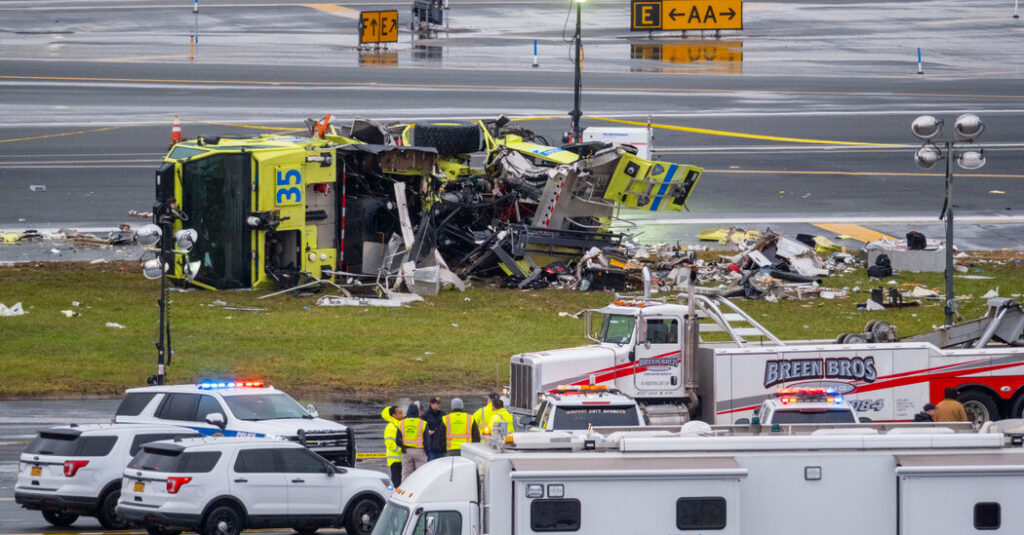
By late Monday morning, the jet remained on the tarmac where it had crashed, its tail resting on the ground and its nose cantilevered upward. The cockpit was mangled and partially sheared from the body, hanging in shreds at the front of the plane. Nearby, the damaged fire truck lay on its side.
Because the tail of the plane came to rest on the ground, with the nose high in the air, emergency responders had to cut a hole in the roof to access the cockpit voice recorder and the flight data recorder, Jennifer L. Homendy, the chairwoman of the National Transportation Safety Board, said at a news conference on Monday evening. Both were taken to the safety board’s headquarters in Washington, D.C.
The safety board plans to interview any air traffic controllers who were working at the time of the crash, said Ms. Homendy, who added that a controller involved in a crash would typically be removed from duty.
“Certainly, it’s pretty traumatic for that air traffic controller,” she said.
President Trump, speaking to reporters in Florida on Monday morning, appeared to confirm that the crash might have been caused by air traffic controllers.
“They made a mistake,” he said. “It’s a dangerous business. That’s terrible.”
The fire truck was operated by members of the Port Authority Police Department’s aircraft rescue firefighting unit. The occupants of the fire truck were Sgt. Michael Orsillo and Officer Adrian Baez, the Port Authority said. They were hospitalized in stable condition, Ms. Garcia said.
The Air Canada flight had left Montreal with 72 passengers and four crew members. The first sign of trouble came when the plane approached New York, said Rebecca Liquori, 35, a passenger who was sitting in Seat 19A, by an emergency exit. A flight attendant announced that if the plane made an emergency landing, passengers should not take any luggage with them, Ms. Liquori recalled.
The landing was rough and the plane braked hard, said Ms. Liquori, a nurse who lives in Baldwin, N.Y.
“A few seconds after that, you hear the collision and we just got jolted,” Ms. Liquori said. “We got thrown forward. And everybody’s screaming.”
There were no instructions to evacuate, Ms. Liquori said. Fearing that the plane might burst into flames, she opened an emergency door. Passengers around her were bleeding and bruised. Passengers clambered onto the wings of the plane and then jumped down onto the tarmac, she said.
Only when they were outside the plane did the passengers realize the scale of the crash, Ms. Liquori said.
The plane, a Bombardier CRJ-900, is not equipped with emergency evacuation slides because the cabin floor is low to the ground, said Nathalie Scott, a spokeswoman for MHI RJ Aviation Group, a subsidiary of Mitsubishi Heavy Industries Ltd., which maintains such planes.
The crash was “a terrifying moment,” said another passenger, Jack Cabot, 22. “The plane landed pretty hard, you heard a loud bang and suddenly everything was out of control.”
After the plane came to a stop, passengers evacuated quickly, he said.
“No one really knew what was happening,” Mr. Cabot added, “just that it was time to get off the plane.”
When the plane and the fire truck collided, a flight attendant named Solange Tremblay was flung from the cabin still strapped to her seat, said the woman’s daughter, Sarah Lépine. Ms. Tremblay was discovered dozens of feet from the fuselage by emergency crews and transported to the hospital, Ms Lépine said in an interview with TVA Nouvelles, a Quebec broadcaster. Ms. Tremblay has a broken leg and will require surgery, her daughter said.
After the accident, the airport closed until 2 p.m. on Monday afternoon, and nearby roads were closed for hours. The airport was operating at limited capacity because the crash wreckage had not been cleared yet, Sean Duffy, the U.S. secretary of transportation, said at the afternoon news conference.
Debris from the crash remains littered across a wide swath of the runway and nearby taxiways, Ms. Homendy said. To do their work, investigators will need much of that debris to remain in place, so it will be days before the runway can reopen and airport operations can return to normal, Ms. Homendy said. The airport’s other main runway is open.
Mr. Duffy denied rumors that staffing inside the control tower at LaGuardia was down to a single air traffic controller at the time of the crash. The airport has 33 air traffic controllers, he said, with seven more controllers in training.
“We are a couple controllers short in total, but it is a very well-staffed airport,” he said.
Two controllers were working in the LaGuardia tower at the time of the accident, according to two people who were briefed on the matter, both of whom spoke on the condition of anonymity because they were not authorized to speak publicly.
The jet that crashed was operated by Jazz Aviation LP, Canada’s largest regional airline. It operates flights under the Air Canada Express brand, under an agreement with Air Canada.
LaGuardia is one of three major airports serving the New York City area. It does not have a separate international terminal, but it does receive flights from Canada, Mexico and the Caribbean. The airport is a major hub for the busy Northeast Corridor, with nearly 900 departures and arrivals each day, according to the Port Authority.
The closure of LaGuardia added to the chaos and confusion that rippled across the nation’s airports on Monday. Even before the crash, many travelers said they were stranded at LaGuardia because their flights had been delayed or canceled two or three times. Many of the cancellations were caused by a shortage of Transportation Security Administration officers, thousands of whom are working without pay amid a partial government shutdown. The shortage caused long security lines at New York City airports on Sunday.
The security workers at LaGuardia and other airports were augmented Monday morning by hundreds of Immigration and Customs Enforcement agents, armed with handguns.
Also on Monday morning, all flights were temporarily canceled at Newark Liberty International Airport because of reports of a burning smell from an elevator in an air traffic control tower, according to the F.A.A. Flights resumed before noon.
The crash at LaGuardia, the incident in Newark and the long security lines at airports around the country all combined to make it difficult for about 25 staff members from the National Transportation Safety Board to travel to New York and begin their investigation, said Ms. Homendy, who said she had arrived in New York by driving from Washington.
The safety board’s expert on air traffic control operations was stuck in a security line for three hours on Monday, trying to board a flight from George Bush Intercontinental Airport in Houston to New York. Securing her travel required a phone call from the board’s leaders “to beg to see if we could get her through” security, Ms. Homendy said.
Federal investigators will be joined by the Transportation Safety Board of Canada and the accident investigation team of the Air Line Pilots Association, the world’s largest airline pilots’ union.
Investigations by the National Transportation Safety Board can take months, and sometimes more than a year. The first steps of the investigation will include reviewing video footage of the collision and all voice recordings from the cockpit and the air traffic control, said Jeff Guzzetti, a former accident investigator for the F.A.A. and the N.T.S.B.
Fatal accidents at LaGuardia Airport are rare. The most recent fatal crash there happened exactly 34 years before Sunday’s collision, on March 22, 1992, when a USAir flight crashed because of ice on its wings. Of the 51 people onboard, 27 were killed.
Reporting for this article was contributed by Sarah Maslin Nir, Liam Stack, Christine Chung, Stella Raine Chu, Patrick McGeehan, Vjosa Isai, Dakota Santiago, Karoun Demirjian, Anushka Patil, Emmett Lindner, Ian Austen, Rylee Kirk, Niraj Chokshi, Claire Moses, Ceylan Yeğinsu, Jin Yu Young, Hurubie Meko, Yan Zhuang, Mike Ives and Max Kim
Christopher Maag is a reporter covering the New York City region for The Times.
The post In LaGuardia Crash That Killed 2, Call to ‘Stop!’ Came Too Late appeared first on New York Times.