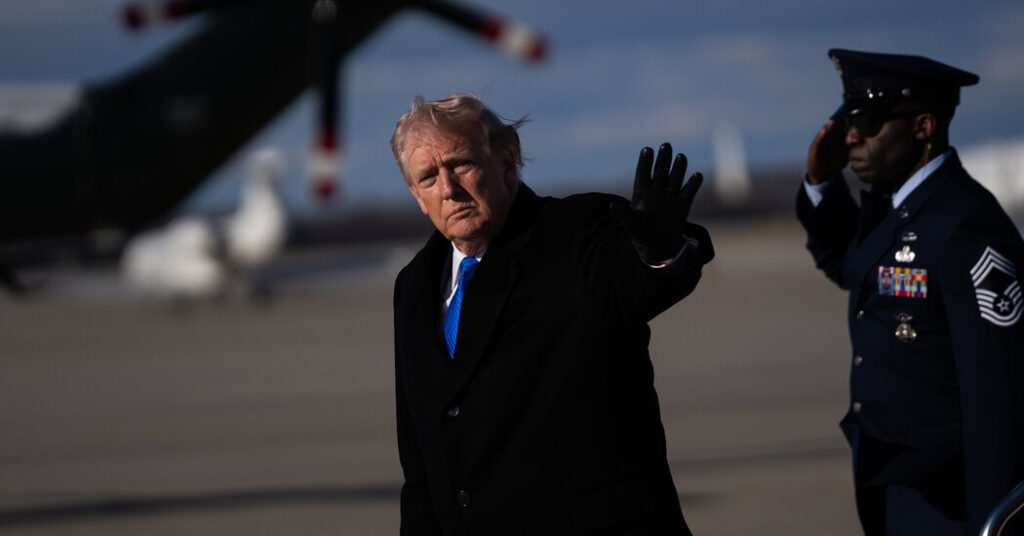
As the war with Iran began to send oil and gas prices soaring around the world, President Trump shrugged off the fallout as a temporary setback for the U.S. economy.
“When this is over,” he told reporters earlier this month, “oil prices are going to go down very, very rapidly.”
In the end, it may not be so simple.
Even if Mr. Trump were to cease hostilities with Iran before his new, self-imposed Friday deadline, it may still be weeks, if not months, before American families and businesses see a true break in their spiraling energy costs, economists and industry executives say.
An end to the war would abate a geopolitical crisis and most likely help to reopen clogged shipping lanes in the Middle East, nudging down oil and gas prices from their recent highs. But any relief would arrive gradually for most consumers — and probably not fast enough to undo the damage to the U.S. economy.
By midday Tuesday, the markets seemed downbeat about the odds of a swift and easy resolution to the war. The price of a barrel of Brent crude, the international benchmark, hovered around $100, up nearly 40 percent since the war started. An average gallon of gasoline also topped $3.97 nationally, according to AAA motor club, which reflected a roughly one-dollar jump from a month ago.
Mark Zandi, the chief economist for Moody’s Analytics, said the prospect of sustained high costs affirmed a well-worn adage in the energy industry: “Prices rise like a rocket, fall like a feather.”
If the war were to end soon, he predicted that it would still take about six to eight weeks for oil production and shipments to normalize. At that point, oil could settle around $80 per barrel of Brent crude, higher than before the bombing began. Prices at the pump would probably fall slowly, too.
The exact timeline will depend on many factors, including the extent of the damage to the energy infrastructure in the Middle East and the fate of the Strait of Hormuz, a major oil and gas thoroughfare that has been all but closed for weeks. The trajectory for prices will also vary by fuel type: The war has strained the global supply of diesel and jet fuel, in particular, meaning those prices could stay higher for a longer period.
Such spikes tend to ripple across the economy in myriad, lasting ways. Groceries could become more expensive because of higher shipping costs, for example, while airfares in the summer travel season similarly could rise. In an early, ominous sign, the top executive of United Airlines warned Bloomberg Television on Tuesday that it could raise ticket prices by 20 percent if the war with Iran continued to bog down jet fuel.
“We don’t have any idea where the price is going to go,” said Mike Sommers, the chief executive of the American Petroleum Institute, which represents the oil industry. “We don’t know what the condition of the assets are going to be. We don’t know how long it’s going to take us to get the production that’s come offline, how long that’s going take to get back up and going.”
Asked about the administration’s economic projections, Taylor Rogers, a White House spokeswoman, maintained in a statement that prices would drop “rapidly” once the war concluded.
“President Trump has been right about everything and he will be right again when these short-term disruptions are past us,” she said.
The ever-shifting economic variables only add to the stakes for Mr. Trump, as the U.S.-led war with Iran now stretches into its fourth week. Even as experts continue to raise alarm about the consequences of a protracted conflict, the president has maintained that his war is worth the cost — and will yield substantial benefit by delivering a more stable Middle East.
“Our economy was fantastic,” Mr. Trump said on Monday, as he sought to make the case for why he had to “stop and make a little journey into the Middle East and eliminate a big problem.”
In fact, the U.S. economy had been showing signs of strain before the war began, evident in persistently high consumer prices and a recent rise in the nation’s unemployment rate. Those stresses had helped to contribute to sense of frustration among Americans, many of whom blamed Mr. Trump for their financial woes in recent polling ahead of the midterm election.
Many analysts have warned that the nation’s trajectory could worsen considerably if the Iran war sustains sky-high oil prices into next month or beyond, raising the risks that the United States could slip into a recession. But an early glimmer of relief arrived on Monday, after Mr. Trump said he would suspend his threat to escalate the bombing — by attacking Iranian energy facilities — so that the two sides could begin early discussions about an end to the conflict.
Within hours, however, leaders in Washington and Tehran offered competing assessments about the scope of the negotiations and their progress. That put an end to the optimism that touched off a brief rally in oil and financial markets around the world.
Michael Pearce, the chief U.S. economist for Oxford Economics, said the market response reflected the reality that it “takes two to tango.”
In a report Friday, his firm predicted that persistently high oil and gas prices could push up the cost of groceries and other goods, causing inflation to “rise sharply” in March and April. The resulting hit to consumers, the firm found, could contribute to a slowdown in the economy, which they said would grow by 2.4 percent this year, down from their previous 2.8 percent projection.
Even if Mr. Trump can broker a faster end to the conflict, however, Mr. Pearce said there would not be a “sudden switch” that brings energy costs back to their prewar levels.
Once the Strait of Hormuz is opened, the traffic may not return immediately, and the risk of traversing a recent war zone may keep prices elevated for some time, analysts say. It may also take time to restart energy production in countries including Saudi Arabia, which have halted some of their operations in recent weeks as storage tanks have filled up in the face of drone attacks and mounting security risks.
“How quickly that production can actually come back online is an uncertainty that we’re going to have to deal with as we go forward,” Mike Wirth, chief executive of Chevron, said Monday at an energy conference in Houston, CERAWeek by S&P Global. “It’s going to take some time to come out of this.”
The comments have offered a stark contrast with Mr. Trump’s oft-repeated claim that energy prices would plummet once the hostilities conclude. To help prevent even further price shocks, the administration in recent days has released oil from the nation’s strategic stockpile and moved to lift some sanctions on adversaries, including Iran, in the hopes of boosting global supply.
Any decline in gasoline, in particular, would happen only gradually: By Mr. Zandi’s calculations, every $10-per-barrel increase in oil corresponds with a 25-cent increase in gas prices. Given the time it takes to process crude into gasoline, the pain at the pump may not dissipate as quickly as Mr. Trump has suggested.
“The administration may want oil prices and gas prices to drop very quickly, but they are likely to be confronted by the laws of gravity in the energy markets,” said Neale Mahoney, a top economics professor at Stanford University who previously served at the White House under former President Joseph R. Biden Jr.
Mr. Mahoney pointed to the price shock that followed after Russia invaded Ukraine in 2022, which constrained the global supply of energy and left consumers reeling at the gas pump. Then, he said, “prices shot up during the spring, then there was a slow drift down of prices in the summer and into the fall of 2022.”
This time, Mr. Mahoney said the dynamic in the Gulf was much different, given the reduced output of the region. But he said the impact of those sustained higher prices would be acute, since “history tells us those get passed” to consumers.
Tony Romm is a reporter covering economic policy and the Trump administration for The Times, based in Washington.
The post High Oil and Gas Prices Could Outlast Trump’s War With Iran appeared first on New York Times.