It’s nearly impossible to go into “Giant,” the Broadway play that opened on Monday at the Music Box Theater, without knowing what will happen. I suppose that the devoutly spoiler-averse might watch it knowing only the bare minimum — that it stars John Lithgow, or that it won three Olivier Awards in London, or that the playwright Mark Rosenblatt has written a portrait of the children’s book author Roald Dahl. But, and I say this wearily, is it possible to be surprised anymore? Tell me you’re drafting a play about a great man, and I bet I can finish the sentence.
The trouble this time is antisemitism — clearly documented, and, in certain moments in “Giant,” quoted verbatim. We don’t need to quarrel over “was he or wasn’t he”: Dahl’s family apologized in 2020, 30 years after he died, for “lasting and understandable hurt.” As a result, Rosenblatt’s task in his psychologically deft, if dramatically blunt, play is to imagine the moment of discovery of his prejudice. I kept thinking of one of those cutaway diagrams of an oil well that shows how crude oil is forced out of the bedrock and into the air. Was there anything that could keep that ooze in the ground?
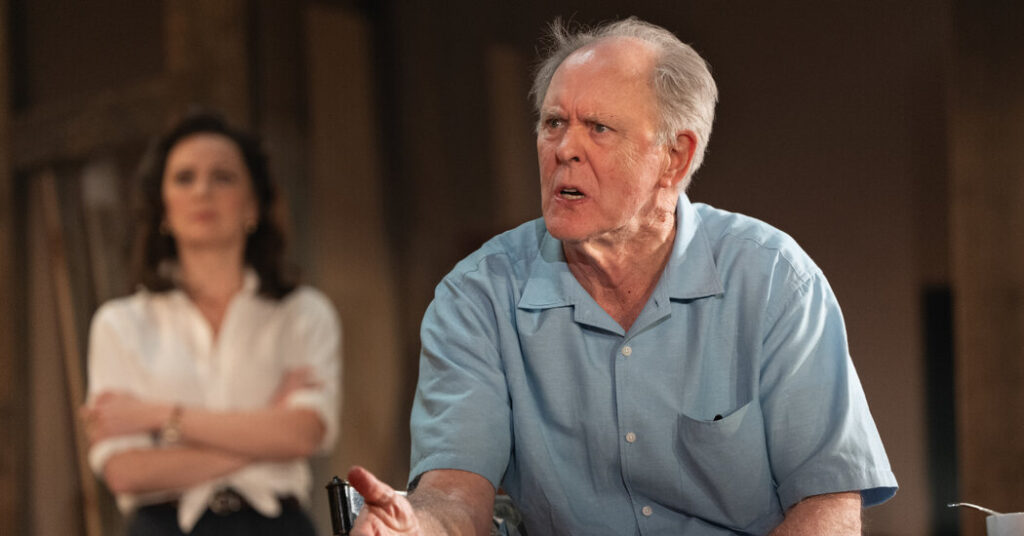
Over the course of a summer afternoon in 1983, Dahl shifts from one persona — a cantankerous but lovable author — to another self, one kept deeper down. As Dahl whines entertainingly, or pluckily rubbishes a threatening crank caller, Lithgow’s face gleams like an apple; he seems young, even hobbling across the stage with his cane. But, particularly interlaced with his acidic outbursts, Dahl’s use of baby talk grows increasingly galling. By the time the 66-year-old author is crooning, “More more. Yum yum. Plum plum,” to his cook, Hallie (Stella Everett), over his sorbet, the cutesiness has stopped being sweet-old-man-ish. It’s chilling.
Dahl’s classic novels are themselves adorable little horror narratives. Those vigorous, smiling masterpieces, with their Dahl-fangled words like “scrumdiddlyumptious,” often revolve around how frightening it is to be small when everything else is very, very big. And no one is bigger than Dahl.
In Rosenblatt’s play, he is a BFG (Big Fractious Giant): The real man was 6-foot-6, while Lithgow is 6-foot-3. The director Nicholas Hytner keeps Dahl’s height in reserve, almost as if it’s a special effect. When the curtain rises, Lithgow is seated. He stands only after an eight-page scene at his dining-room work table, in which Dahl banters tetchily with his British publisher Tom Maschler (Elliot Levey) and fiancée, Liccy (Rachael Stirling), about contractual this and unimportant that.
Dahl’s English country house in Great Missenden is under construction, swathed in tarps, and alive with the sounds of far-off bangs and drilling. On Bob Crowley’s set, the mostly empty dining room seems to go on forever — the back wall has been replaced with sheets of filmy plastic, and we glimpse the greenness of a garden beyond. But, as Rosenblatt writes in a stage direction, when Dahl unfolds to his full height, we realize “how small he makes the room feel.”
He certainly looms over his lunch guest, Jessie Stone (Aya Cash), a sales director from his American publisher, sent on a crisis-management trip to Dahl’s home. The star children’s author has reviewed a book about the Israeli military’s 1982 bombings of Lebanon, and, after explaining his horror at civilian (and child) casualties, Dahl has — in a shocking and deliberate elision — called all Jewish people a race of “barbarous murderers.” His publishers now need him to apologize … so that bookstores will continue to carry his books.
Reluctant to name just what Dahl’s done, the American marketing expert, his British publisher and his fiancée all try to manage him, and then try to mollify him whenever he perceives the managing. Stone is Jewish — Dahl vituperatively calls her “Stein” after insinuating her family has changed their surname — and one wonders why her boss felt that she should have been the one sent to persuade him. (Rosenblatt has borrowed the other main characters from real life; Jessie is a creation from raw clay, with the thumbprints of her maker still on her.)
Dahl wears his vulnerabilities openly, like his sorrow over his own children’s tragedies, but he also has an insistent, “debate me” attitude; one of his favorite weapons is to ask what someone else thinks, in as aggressively discomfiting a method as he can. He prods at Tom, who, they both explain breezily, was once a Jewish child being evacuated from the Holocaust. So, asks Dahl, is his longtime friend saying he’s a Nazi?
“Giant” is Rosenblatt’s first play, and his inexperience sometimes emerges in the way he choreographs dialogue. At the table, two characters whose motivations should be to interrupt and intervene (Liccy and Tom) mainly look on, as the lunch goes irrevocably to hell. Characters who have every reason to leave the room do not; sometimes the plot gears grind. And in writing four-character scenes in which two characters do almost all of the speaking, Rosenblatt requires Hytner to find some awkward staging solutions. The director keeps Tom on his feet for nearly the entire first act, for instance, as if showing us that “this guy wants to get out” will also communicate pace, vector and verve.
On its surface, “Giant” looks like an acerbic drawing-room comedy, but its undercarriage is an Ibsen play: a talky, oppositional drama, though it has only one three-dimensional combatant. Jessie does the required shouting, but her character’s behavior makes so little sense that even her most righteous statements seem to come from a clockwork doll. Tom — Levey is impressive at being recessive — has a gorgeous speech in the second act, when he describes the slurs he faced on the playground. He stares across at the man-child he’s there to cosset and dismisses British antisemitism: “Mostly it’s boys finding good sticks to whack each other with.” (Dahl responds, later, “If I’m an antisemite, then what are you, Tom? A house Jew, I suppose.”)
For the most part, though, Lithgow’s Dahl is the sole repository of Rosenblatt’s perception, which is shifting and multivalent and, even in moments of extremity, sympathetic. He weaves in insight after insight. He hints at the way adolescent misogyny might have shaped Dahl’s nastiness, and the way that our deference — to the elderly, to the famous, even to the loved — can accelerate their radicalization. Audience members should therefore attend with their mental cudgels poised, prepared to be the opposition that Dahl doesn’t really encounter onstage. I found Lithgow’s performance a fascinating study in monstrosity, but I found myself more engaged by the conversations I’ve had since seeing “Giant”: They are the necessary third act to this two-act play.
Rosenblatt started writing “Giant” before the deadly Hamas-led attacks on Israel on Oct. 7, 2023, before Israel waged war on Gaza, and certainly long before Israel’s current bombing campaign in Lebanon. The play seems, in some way, to have predicted the ugliness of our current public discourse in this one private lunch. Rosenblatt takes pains to gesture to the wider world, while still taking care to show us how Dahl is unlike the common man, how his towering stature is, in some ways, the thing that makes him crash.
The implication in “Giant” is that Dahl, unchecked by those closest to him, oversteps — and when a giant oversteps, he crushes lives. In moments of narcissistic preening, he says things that he thinks are clever (he uses the word “naughty”), but that are in fact beyond the pale. He appears to be making reasoned arguments, but his status and much-catered-to prickliness means that he never hears the other side. The moment he states an actual position, we can perceive how poisoned and contradictory his “thinking” is.
Is this what Dahl was really like? Did his regressive boyishness really infuse his grown-up toxicity? We have no way of knowing. But versions of this wrecking-ball phenomenon are all around us. The dread in the play, which is its main motive engine, is the seemingly unstoppable development from Dahl’s I’m-no-racist jokes to his cornered ironic foulness to a merry, almost gleeful bigotry. If you think I’m so bad, wait’ll you see this, he seems to say. And we turn around, and we do see it, everywhere we look.
Giant Through June 28 at the Music Box Theater, Manhattan; gianttheplay.com. Running time: 2 hours 20 minutes.
Helen Shaw is the chief theater critic for The Times.
The post ‘Giant’ Review: As Roald Dahl, John Lithgow Is a Study in Monstrosity appeared first on New York Times.