OPEN SPACE: From Earth to Eternity — the Global Race to Explore and Conquer the Cosmos, by David Ariosto
Space ain’t the place. The cosmos is a fascinating subject for scientific investigation, but there’s currently no plausible argument for sending large numbers of people to live and work in space. Two of the three worlds nearest our own, the moon and Mars, are desolate hellscapes of radiation and toxic dust; the third, Venus, is blanketed in a crushingly thick atmosphere that keeps its surface hot enough to melt lead.
The rest of the solar system is no more hospitable, and other stars are simply too far away. But to the modern space barons like Elon Musk and Jeff Bezos, these are pesky details. They insist that our fate lies in the stars. And there is no shortage of media to promote this message — both the science fiction that Bezos and Musk, like a lot of us, were raised on, as well as reporting that uncritically repeats the views of these oligarchs and their business competitors.
A new entry in this latter category is “Open Space: From Earth to Eternity — the Global Race to Explore and Conquer the Cosmos,” by David Ariosto, a journalist, media consultant and co-host of a podcast for SpaceNews. The book bills itself as “a front-row seat to the future,” with “unprecedented access.” Ariosto has certainly interviewed many people for this book and visited some interesting places. While he didn’t snag Musk or Bezos themselves, he did speak with other billionaires, as well as engineers and scientists working in space programs (both private and public) around the world.
But it’s easy to see why so many people agreed to speak with him. He asks questions and dutifully reports the replies, adding only the most cursory analysis of his own. When that analysis does come, it’s often couched in strained prose: “If we are to bask and safeguard ourselves from the many benefits and dangers of operating in orbit, we’ll need a global framework that bares the teeth of enforcement.”
By failing to cast a skeptical eye on the space industry, he becomes a cheerleader for it. “I have come to believe that humans are capable of engineering just about anything,” he declares in the prologue, dismissing doubts about going to space as contrary to “our natural explorer instincts.”
The book’s disjointed narrative starts out by tracing international efforts to return to the moon, which Ariosto frames as a race without considering whether that framing is apt. This section culminates in 2024, with the first private space mission to land a probe on the moon mostly intact, a genuinely impressive feat that Ariosto gives curiously short shrift. After that, he turns his gaze farther afield, first to Mars and the rest of the solar system, then to the stars. Along the way, with minimal skepticism, he platforms schemes that range from the contested and implausible (A.I. data centers in space, colonizing the moon and Mars, nuclear fusion-powered rockets) to the wholly impossible (faster-than-light spaceships and endless free energy).
If the lack of critical assessment were its only problem, “Open Space” might still be worthwhile for a behind-the-scenes look at the space industry. Unfortunately, the book’s credibility is fatally undermined by a cavalcade of errors. Ariosto claims that in the rural reaches of southern South America, “the Andromeda galaxy burns so brilliantly that it can make an amateur astronomer out of just about anyone.” In reality, the faint Andromeda Galaxy is barely visible that far south. Elsewhere, Ariosto confuses an image of the Pinwheel Galaxy with our own Milky Way, which is rather like confusing a distant photo of the Chicago skyline with a street-level picture of Times Square.
He repeatedly suggests that quantum entanglement could be used for faster-than-light communication, an infamous canard among physics students. In an endnote, he mistakes a NASA satellite for an asteroid 15 times farther away. He even manages to confuse the liqueur fernet with the mixed drink fernet con coca.
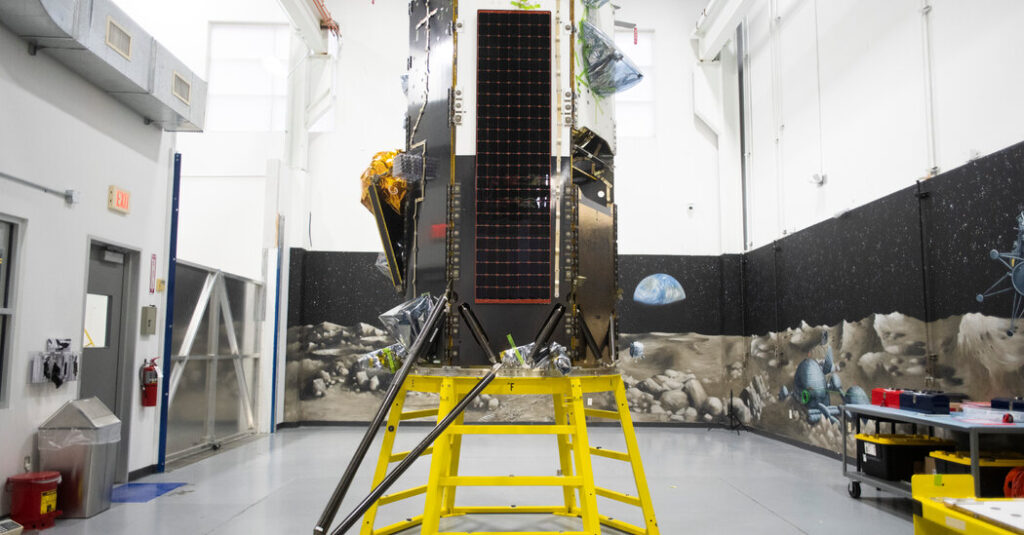
These are just some of the things he gets wrong — all of which a Wikipedia search or phone call to an expert could have set him straight on. Are there other, less obvious missteps? We can’t know, because we don’t have access to his sources. This brings us back to that moon lander, which is featured on the cover of the book. Ariosto claims that this lander, dubbed Odysseus, was the victim of a human error made shortly before launch, when a crucial tool, the laser range finder, wasn’t taken out of safety mode. That, he writes, ultimately led to the craft failing to land upright, instead coming down at a bad angle on uneven terrain and losing at least one of its landing legs.
Yet the next lander built by the same company had a problem with the same piece of equipment and suffered a similar fate. I don’t know what actually happened. Maybe nobody does, but it prompts the question: Can we be sure human error is to blame, or did Odysseus and its successor have a genuine engineering issue?
For someone with a professed belief that engineering has no limits, Ariosto is surprisingly incurious about such problems. His book presents engineering as a font of miracles setting us on a predestined track to the stars. But the uncomfortable reality is that we must forge our future out of myriad unknown possibilities, without any magic to help us along the way.
OPEN SPACE: From Earth to Eternity — the Global Race to Explore and Conquer the Cosmos | By David Ariosto | Knopf | 372 pp. | $35
The post Data Centers in Space? Faster-Than-Light Spaceships? Big Dreams Abound. appeared first on New York Times.