Costa Rica said on Monday it had agreed to take up to 25 deportees a week from the United States, as the Central American nation seeks a closer alliance with the Trump administration.
The deal is part of President Trump’s efforts to find nations willing to take migrants who have been detained in the United States. Many of the people who have already been deported come from countries in Africa, Eastern Europe and Asia, where the U.S. authorities cannot easily send them back. Many migrants also can’t legally be returned to their home countries for fear of persecution or abuse.
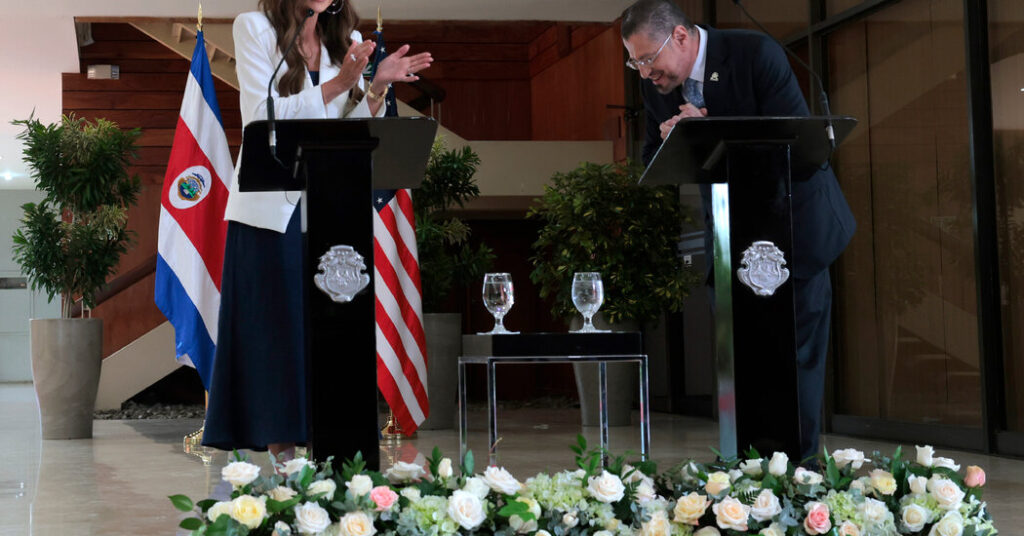
President Rodrigo Chaves of Costa Rica and Kristi Noem signed the deal, with Ms. Noem visiting the country as Mr. Trump’s special envoy for the Shield of the Americas coalition against drug trafficking, following her recent ouster as U.S. homeland security secretary.
Mr. Chaves said the deal is voluntary and nonbinding, allowing Costa Rica to decide which deportees to accept or reject, including the choice of specific nationalities. Under the agreement, the U.S. government provides financial support and the International Organization for Migration, a United Nations agency, covers the costs of deportees’ housing and meals, the Costa Rican president’s office said in a statement.
The International Organization for Migration and the U.S. Department of Homeland Security, which handles deportations, have not immediately respond to requests for comment.
On Tuesday, Costa Rica’s president-elect, Laura Fernández, who will succeed Mr. Chaves in May, told reporters that the deal was a gesture of reciprocity toward the Trump administration, which Mr. Chaves has tried to woo through a series of unprecedented concessions.
“We have an alliance,” Ms. Fernández said, adding that the U.S. government has conducted joint security operations with Costa Rica and provided equipment and training to the country’s police, among other actions aimed at weakening criminal groups. “And when you are in an alliance, it is understood that you receive support from your ally and also provide support to them.”
While the agreement sets the transfer of deportees to 25 a week, that limit can be adjusted by Costa Rica, according to the statement. Officials did not release a copy of the agreement.
The Costa Rican government said the migrants will be processed under its immigration law and given temporary legal status while their long-term status is decided. Under this same policy, the government last year allowed deported migrants to claim asylum, leave Costa Rica or live with a special designated status — though only after confining them for months.
“These deportees would enter the country against their will, brought in by official authorities, without having committed any offense in Costa Rica,” said Mauricio Herrera, a former Costa Rican minister who filed a habeas corpus last year to challenge the detentions.
“If Costa Rica agrees to bring them in,” he said, “the migrants must be released as soon as they set foot on national territory.” Authorities should also provide translation services, food, health care and education for children, he added.
Last year, the Costa Rican government agreed to receive 200 deportees from the United States, including 81 children, who had come from as far away as China, Afghanistan, Russia and Azerbaijan.
That group traveled in buses for several hours to a temporary shelter near the border with Panama. There, guards collected their passports and crowded them into barracks, up to five families per room, several deportees told The New York Times in early February. Medical care was spotty, even as people lost weight and got sick, two families still living in Costa Rica said.
Omer Badilla, the director of Costa Rica’s migration authority, disputed the claims, some of which were documented by human rights groups.
“They were offered a country where they could enter and enjoy every corner of our land,” he said in an interview last month, “so that they might become a part of us.”
Costa Rica’s ombudsman issued a scathing, critical report on the deportees’ treatment. The Constitutional Court later found their detention to be arbitrary and illegal. Costa Rican authorities released the migrants and gave them the option to stay or leave.
Of the 200 migrants expelled to Costa Rica, 110 returned to their home countries and 34 sought asylum there, Mr. Badilla said. The rest received a special immigration status, which allowed them to find jobs and move freely within Costa Rica.
But Mr. Badilla acknowledged that the government had lost track of nearly all the migrants who had not immediately returned to their home countries, suggesting that some may have left the country.
Some critics called on the government to stop the agreement.
“Our call to the government is that it reconsiders this decision and does not implement it,” said Marcia Aguiluz Soto, a Costa Rican human rights lawyer with the American Friends Service Committee who assisted some of the deported families.
“It is a concession that stems from a transactional policy,” she added, “that does not benefit the country, our reputation, our citizens or the people who will come to Costa Rica.”
David Bolaños contributed reporting from San José, Costa Rica.
Emiliano Rodríguez Mega is a reporter and researcher for The Times based in Mexico City, covering Mexico, Central America and the Caribbean.
The post Costa Rica Agrees to Take Migrants Deported by the Trump Administration appeared first on New York Times.