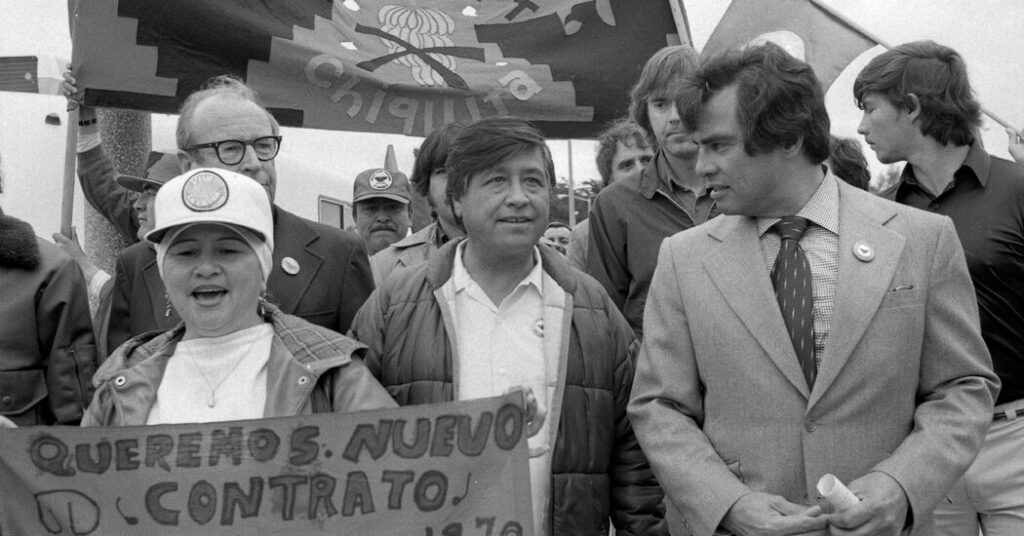
Miguel Sandoval’s ninth graders in Los Angeles were learning about the Delano, Calif., grape strike, organized by agricultural workers in the 1960s, when a student asked about Cesar Chavez, a major figure in the yearslong labor action.
“A student asked me, in front of all the students, ‘Hey, did you hear about Cesar Chavez?’” Mr. Sandoval said.
The student was referring to a New York Times investigation published March 18 that revealed that had Mr. Chavez sexually abused two young girls and also raped Dolores Huerta, who co-founded the United Farm Workers union with him.
Mr. Sandoval had read the Times investigation the morning it appeared, but he said that he had to pause and think about how to answer his student.
“Do I say the thing, the truth, in a room full of ninth graders?” Mr. Sandoval said. The answer was yes, “because it’s just true.”
In the days since the article about Mr. Chavez, The Times connected with educators and school administrators across the country who are reckoning with how they will now teach the history of Mr. Chavez, the allegations against him and the Latino civil rights movement as a whole.
Mr. Sandoval, who teaches high-school ethnic studies, said that he had not settled on long-term adjustments to his curriculum. After the Times article emerged, he said, he had received guidance from his district to focus on the 1960s labor movement as a whole, and not just on an individual.
“Heroes are elevated, and then the everyday people, the background player, or even the women who are the backbone of the movement, aren’t always talked about,” Mr. Sandoval said. “There’s something there for ethnic studies and history teachers to think about, which is: How do we move away from the sort of purification of individuals?”
The Times investigation on Mr. Chavez drew on interviews, internal records and firsthand accounts to document years of abuse of girls in the movement. It also included a new allegation from Ms. Huerta, who said Mr. Chavez assaulted her decades ago. Ms. Huerta, now 95, said she had kept the accusation private, fearing its impact.
In a statement, Ms. Huerta said Mr. Chavez’s actions had not reflected the values of the movement and she expressed deep sorrow for others who she believes had suffered in silence for years.
For some educators, also, the news about Mr. Chavez was personal.
Diego Frias, a Mexican American social studies teacher in the Houston area, said Mr. Chavez inspired him and some of his students, many of whom are Latino or Black.
“I was disappointed, hurt and angry at what Chavez did with the power and trust he was given by his community,” Mr. Frias said.
Like many teachers, Mr. Frias said he plans to focus on “the movement, not the man.”
“This new understanding will hopefully help my students to see that they should never put their trust blindly in anyone, no matter their cause or charisma,” Mr. Frias said. “If my students come to understand that, the next generation of civil rights leaders will be all the better for it.”
In Texas, Aaron Kinsey, the chairman of the State Board of Education and a Republican, said he is seeking Mr. Chavez’s removal from the state’s public school curriculum. The board sets the standard for curriculum and instruction materials.
In a letter to the education commissioner, Mr. Kinsey called the revelations about Mr. Chavez “horrific” and said the civil rights leader should no longer be included in required lesson plans.
“Americans across the political spectrum are disgusted by the facts that have come to light about the sexual abuse committed by Cesar Chavez,” Mr. Kinsey wrote in a letter first reported by The Texas Bullpen.
The Texas Education Agency, which is led by the education commissioner and implements state policy, did not respond to a request for comment about the fallout of the revelations about Mr. Chavez.
Diego Bernal, a Texas state representative and Democrat who is vice chair of the legislature’s public education committee, said that the news about Mr. Chavez should prompt conversations about how to teach him in school.
“You can’t leave things as they are, right?” said Mr. Bernal, a Democrat. “There’s erasure, which is on one end, and the other is full disclosure, full context.”
Karma Chavez, a professor in the Mexican American and Latina/o Studies department at the University of Texas at Austin, said The Times story was sobering. As chairwoman of the department, she said her department shies “from great man perspective on history,” because movements are not built on one individual.
Ms. Chávez said she anticipates having students read The Times story and Ms. Huerta’s response, and to discuss hero worship, sexism and how movements can “be more ethical.”
The reckoning is not limited to high schools and colleges. Elise DeFazio, who teaches sixth grade in the San Francisco Bay Area, said that for some age groups, topics such as sexual abuse are “heavy.”
“When it’s something that you have to teach and you kind of can’t get around, I think you just have to address it,” Ms. DeFazio said. “And you have to acknowledge it, and that conversation definitely looks different at different age groups.”
Patricia Orozco Palagi, a high school teacher in Southern California, had started to shift away from educating her classes about Mr. Chavez years ago.
After watching a documentary on Ms. Huerta a few years ago, Ms. Orozco Palagi said, she had felt a “little embarrassed” to have downplayed her contributions to securing better wages and conditions for farm workers. Ms. Orozco Palagi said that she had grown uncomfortable with Mr. Chavez’s leadership, his treatment of Ms. Huerta and how he interacted with Filipinos, who played a crucial role in the Delano grape strike.
“We have a tendency in history for ‘great man’ history, and it’s so much more complex than that,” Ms. Orozco Palagi. “And at least as a history teacher, I want my students to think critically about everybody and everything, including Cesar Chavez.”
Still, processing the news about Mr. Chavez has not been easy, Ms. Orozco Palagi said.
“We have so few heroes that it is really painful for us to see someone exposed like this,” she said.
Over the past week, some elected officials have asked for more lessons focused on Ms. Huerta. But Ms. Orozco Palagi, Mr. Sandoval and others feel that simply removing Mr. Chavez from street signs and textbooks is reductive.
“We need to acknowledge the reality, and what happened, and include the voices of the people that were hurt by it, and make that a part of the story,” Mr. Sandoval said. “It has to be a part of the story where we acknowledge that this happened — not just a removal.
“Keep him in the story, but then tell the truth,” he said.
Lauren McGaughy and Jennifer Medina contributed reporting.
Jesus Jiménez is a Times reporter covering North Texas. He is based in Dallas.
The post Chavez Revelations Force Teachers to Rethink How They Teach His Legacy appeared first on New York Times.