Digital-to-Analog Converters, long-range radios, LED arrays, mini projectors, and air sensors. Click around in the Community Innovation Program forum of Finnish mobile company Jolla, and you’ll find all manner of weird and wonderful ideas for swappable back covers for its upcoming Jolla Phone. Enough to make even the wildest MagSafe accessories look a little safe and boring.
It’s also the return of an old idea, which might now be bang on time—the company originally introduced “The Other Half” (TOH) modular back covers for the Jolla Phone in 2013. Like Jolla, smartphone makers are increasingly teasing modular phone concepts at trade shows like Mobile World Congress, which suggests we may be on the cusp of a mini mobile revolution.
We’ve seen modular accessories come and go in the smartphone world over the past two decades. Google’s much-hyped Project Ara modular phone may never have made it out of concept land, but Motorola’s Moto Mods pushed the bar with magnetic camera modules, projectors, and speakers, though the company only stuck with the idea for about four years.
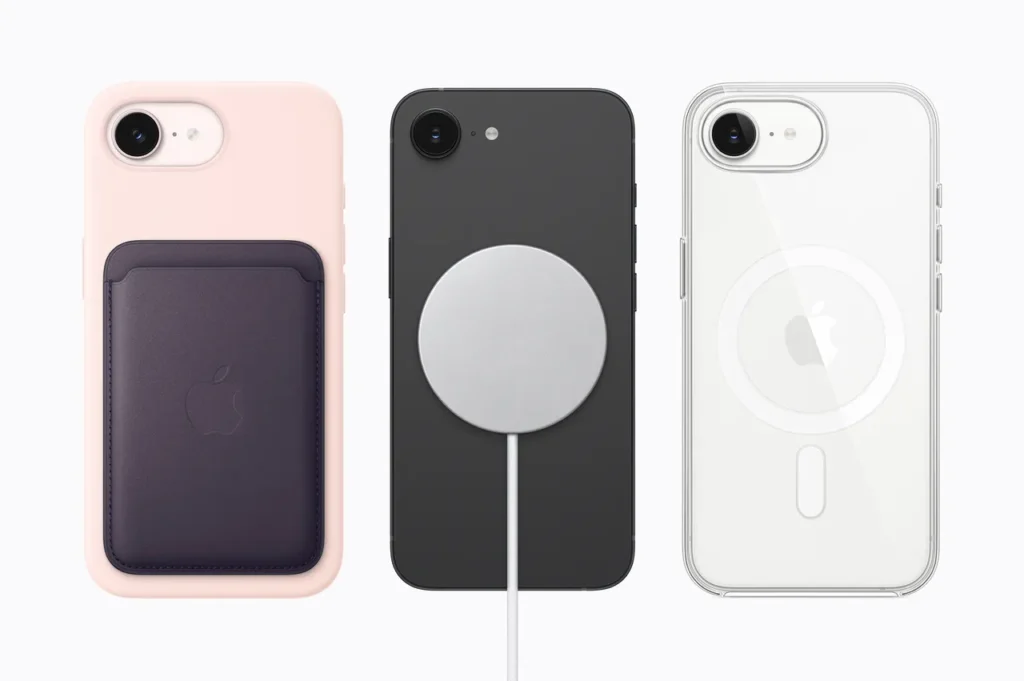
Apple has been the most successful with its MagSafe magnetic accessory system since the launch of the iPhone 12 in 2020. The company hasn’t been as creative with its own first-party accessories, but there’s a wealth of third-party mods you can slap to the back of the iPhone, from camera grips and mini tripods to notepads and power banks.
Other than improving wireless charging speeds, Apple hasn’t advanced the technology past its limitations—for example, in larger data-transfer capabilities—but MagSafe has sparked renewed interest in accessory-level modularity. “MagSafe is a good technology for wireless charging and low-bandwidth connections like NFC, but too difficult to support high-speed use cases,” says Jeff Fieldhack, a research director at Counterpoint. That might be changing.
Magnet Evolution
What’s emerging now might help expand on what MagSafe introduced—accessories that attach externally and expand what the smartphone can do with data transfer, not just magnetic strength, according to Eric Co, director of global product management at accessory maker Belkin.
He points to the modular concept phones we saw at the Mobile World Congress 2026 conference in Barcelona earlier this month: magnetic camera modules, batteries, and gaming accessories that snap onto thin smartphones. Co says it “suggests the industry is exploring modularity again, but this time through accessories rather than replacing core hardware.”
Something like Tecno’s 4.9-mm concept phone design at MWC is perhaps more likely to remain vaporware. But it uses both magnets and pin connectors for connecting the phone to add-ons. It’s designed to work with 10-plus modules, including a game controller, and pushes further into Moto Mods territory than souped-up back covers.
Predating the launch of Moto Mods in 2016, the first batch of Jolla The Other Half concepts included back covers with an extra E Ink display, an infrared camera, and an Angry Birds tie-in that activated themes and ringtones. But probably the most popular was a Blackberry/Nokia Communicator-style slider keyboard made and sold by two entrepreneurs from the original Jolla community. That trend is back in—at CES 2026, accessory company Clicks showed off a magnetic keyboard accessory you can slap on the back of any Qi2 or MagSafe smartphone, though it uses Bluetooth for connectivity.
Quite a bit has changed in what’s achievable, not least more bandwidth, more capability, and more accessible, high-quality 3D printing. “We have seven pogo pins [on the Jolla Phone] which give you the capability to get power out and power in,” says Jolla CEO Sami Pienimäki. “So you can do maybe wireless charging, and you can power external circuit boards.” Pienimäki imagines E Ink interfaces or low-bandwidth radios on the back of its upcoming phone—it has an I3C interface, which delivers bit rates up to 12 megabits per second, allowing data to flow between the phone and the mod, enabling new kinds of smarter modular accessories.
Jolla has promised to release the final phone specifications by the end of the month, with shipping due for the first preorder customers at the end of June. Pienimäki teases that it’s “tempting” for him to release one of Jolla’s own internal concepts for a TOH back cover even earlier as “a showcase of what you can actually do.” (The Jolla Phone doesn’t have FCC approval in the US, but the company is considering a US launch in the future.)
With more than 10,000 preorders since December 2025, Jolla is back in business but still far from mainstream. So why, despite plenty of internet hype over the years, did truly modular phones never quite take off?
“During the LTE days, there was thinking that these devices would morph into ‘cloud phones,’ where the rest of the phone could be cost-optimized,” Fieldhack says. “Swappable parts and lower costs, as most of the compute would be done in the cloud.”
But things changed as flagship phones went from costing $350 to around $1,000. Both the camera and media production and consumption became much more important: “Great displays, great cameras, multiple cameras, more memory, better sound and mics, as well as more elegant and thin devices—this is not easily done on a modular smartphone,” Fieldhack says. “There are huge compromises, and phones are thicker and heavier with less performance. Then, agentic AI, on-device for lower costs and better security, made modular design even less optimal.”
Repairable Modules
One strong and emerging argument for true hardware modularity is repairability. Another European smartphone maker, Fairphone, has been making that case for over a decade. “It’s about thinking about how do we group the actual phone itself into modules?” says Fairphone chief technology officer Chandler Hatton. The latest FairPhone Gen 6 smartphone is made up of 12 modules. A customer sitting at the kitchen table with a single T5 screwdriver (included) and a guitar pick can repair the phone quickly, easily, and cheaply.
“We don’t want someone to have to buy half a phone, should they have a problem with a very specific component,” she says. “On the other hand, nobody wants to replace a component that’s so small, they’re doing it with tweezers, right?” Hatton says a recent repair to the ultrawide camera on her Fairphone took her just seven minutes.
Fairphone has also, in the past year, unveiled a range of screw-in, swappable back plate accessories for the Gen 6. These include a finger loop, a cardholder cover, and a lanyard attachment, which repurposes the screws themselves—mods the company believes can lengthen the phone’s lifespan.
“If I can support my customer base by doing something exciting in the accessory space that’ll rekindle excitement in the product or just physically protect the phone better, and that can prevent them from going out and purchasing a whole new phone, with all of the components and all of the CO2, then that’s fantastic,” she says.
Fairphone’s system doesn’t use magnets and doesn’t support data transfer—similar to what Nothing’s sub-brand CMF introduced with its budget smartphones. But now that the Qi2 wireless charging standard is starting to pick up some speed—it’s available in Google’s Pixel 10 smartphones, and several Samsung devices can take advantage of it with a magnetic case—Hatton says Fairphone is “watching and thinking about” Qi2.
“The Qi2 accessories market has roughly tripled in the past 12 months,” says Faraz Medhi, a managing director at Anker, a popular accessory maker.
Belkin’s Co says the interoperability of a standard like Qi2 could lead to more than just better charging and more flexible accessories, enabling new categories like advanced camera tools, gaming peripherals, or battery-powered modules. Back to Jolla’s pin-connected The Other Half, Pienimäki is quite content to let the community make whatever it likes to upgrade the latest Jolla Phone, even the ideas that surprise him—like a mod that adds the 3.5-mm headphone jack.
“This dear old analog headset connection; we just couldn’t fit it in the new product, so it features only USB-C,” he says. “People are now asking for a digital-audio converter, like a Hi-Fi style back cover, which would feature the missing jack. We were a little bit surprised at how important that would be. Yeah, I’m happy to enable that.”
The post Can Modular Phone Accessories Finally Evolve Beyond MagSafe? appeared first on Wired.