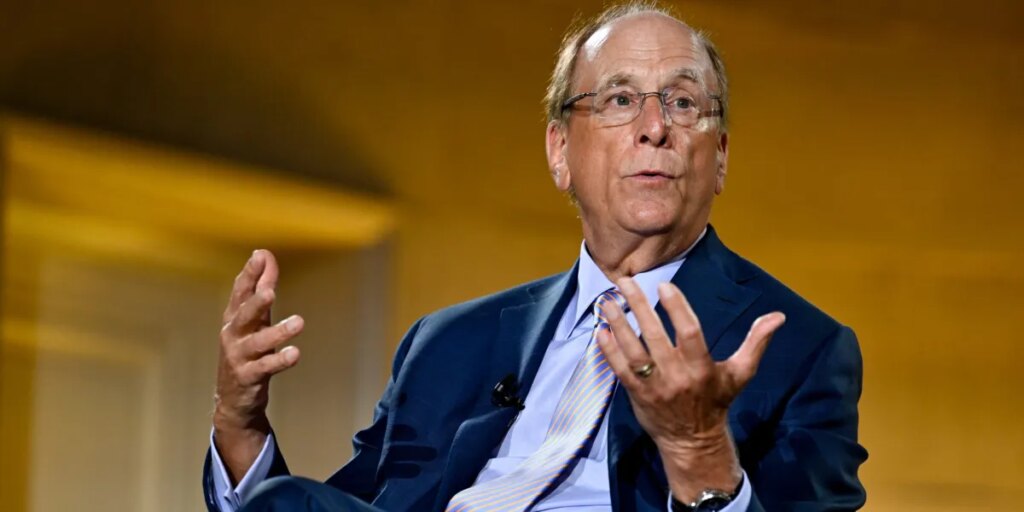
A specter is haunting the world of white-collar work: the specter of white-collar job loss. But one of Wall Street’s “Masters of the Universe,” asset management billionaire Larry Fink sees another ghost in the machine.
Writing in his annual letter to BlackRock shareholders, the CEO identified a much greater threat from technological progress to the Fortune 500. Fittingly, for the man who played a major role in the index-fund revolution, his mind was on assets and who owns them—or doesn’t. Inequality and overall wealth is the real threat.
With asset values soaring in recent decades as salaries largely stagnate, wealth inequality will only get worse, warned Fink, who has been beating this drum often of late. AI threatens to concentrate wealth not only with those who have assets, he explained, but those who use this technology.
“The vast majority of wealth has flowed to people who owned assets, not to people who earned most of their money by working,” Fink wrote in his annual letter to shareholders on Monday.
“Now AI threatens to repeat that pattern at an even larger scale—concentrating wealth among the companies and investors positioned to capture it.”
Research from the Federal Reserve has found America’s haves and have-nots have rarely been this far apart. In the third quarter of last year, the gap was the widest it’s been since 1989, when the Fed began tracking household wealth divergence. The top 1% held 31.7% of U.S. wealth, comparable to all wealth owned by the bottom 90%. With most high-income wealth held in assets from stocks to real estate, it’s become increasingly inaccessible to a growing segment of Americans. And with the speeding growth and corporate adoption of artificial intelligence, that trend risks accelerating, according to Fink.
Uneven returns
AI-driven productivity might potentially raise wages across the board, but most evidence so far suggests AI adoption has raised wages in a relatively small pool of jobs, while excitement surrounding the technology has boosted stock markets. Fink wrote that since 1989, median wages in the U.S. have lagged stock market returns by a factor of 15.
Now, AI looks most likely to lengthen that trend rather than reverse it—at least in the short term. For people not directly exposed to its benefits, the wealth gap might soon look a lot wider.
“When market capitalization rises but ownership remains narrow, prosperity can feel increasingly distant to those on the outside,” Fink wrote. “This is where much of today’s economic anxiety comes from: a deeper feeling that capitalism is working—just not for enough people.”
In his letter, Fink described AI as the most significant technology since at least the computer, but nonetheless risks putting inequality on steroids. He warned that AI could concentrate massive wealth primarily among a handful of companies and investors best positioned to capture its value. It could accelerate “K-shaped outcomes” for the economy, he added, where firms and investors with greater access to capital benefit from faster growth, while those less exposed to rising asset valuations stagnate, driving inequality even further.
“Transformative technologies create enormous value—and much of that value accrues to the companies that build and deploy them, and to the investors who own them,” he wrote. “The companies with the data, infrastructure, and capital to deploy AI at scale are positioned to benefit disproportionately.”
The data so far seems to support Fink’s argument. The U.S. is increasingly mired in an economy supported by wealthy consumers, according to Moody’s chief economist Mark Zandi. Spending from high-earners has surged in recent years, while low and middle-income households have seen their discretionary spending slow or even plateau.
The trend grows more worrisome with the use of this new tech, as AI-driven gains in the stock market are a big part of high-income confidence, Oxford Economics CEO Innes McFee recently told Fortune. While the technology has led to a 7% rise in U.S. wealth, that benefit is almost entirely contained to high-earning households, he said. While AI could “absolutely” even out wealth inequality eventually, it is more likely to maintain the U.S. economy’s K-shape until at least 2035, McFee said.
The same trend is visible in jobs. So far, AI-related productivity boosts are mostly reserved for workers whose jobs demand AI-related skills, roles that can expect a wage premium as high as 43%. But for most jobs, AI has yet to translate to significant productivity or wage gains, and might actually be leading to larger workloads for employees tasked with managing AI.
A long run equalizer?
Over the long term, AI-driven efficiency could lead to higher wages and job growth among low-income professions in sectors such as agriculture and manufacturing, potentially reducing inequality in countries heavily reliant on those sectors, according to modeling last year by PwC. And some experts, including analysts at the Urban Institute, have argued for a universal basic income program drawing royalties from AI companies as a measure to lessen inequality.
But for the moment, benefiting from AI requires working in a role requiring AI skills or being financially invested in its growth story. With nearly 40% of Americans not exposed to the stock market at all, a sizable portion of the population could be caught on the outside looking in.
The post Billionaire Larry Fink says you’re wrong to think that AI stealing your job is the big problem—it’s really about what it’s doing for his class appeared first on Fortune.