The oil shocks of the 1970s have become a go-to reference point for the worst kind of global energy crisis. Nothing has quite compared to them — until now.
By some metrics, the crisis provoked by the Iran war is already worse. It’s so bad that President Trump, who attacked Iran last month, eased sanctions not just on Russia but also on Iran itself to try to keep prices from rising further. And it could get worse still.
Today I write about the 2026 energy crisis, and how it’s already affecting millions of people around the world in very concrete ways.
Short showers and no elevators
If you live in South Korea, the government has just asked you to take shorter showers and use the washing machine on weekends only. In Nepal, your family might be eating their dinner cold because of an acute shortage of cooking gas. And if you’re organizing a funeral in Pune, India, you can’t have a gas cremation — gas is being rationed for the living.
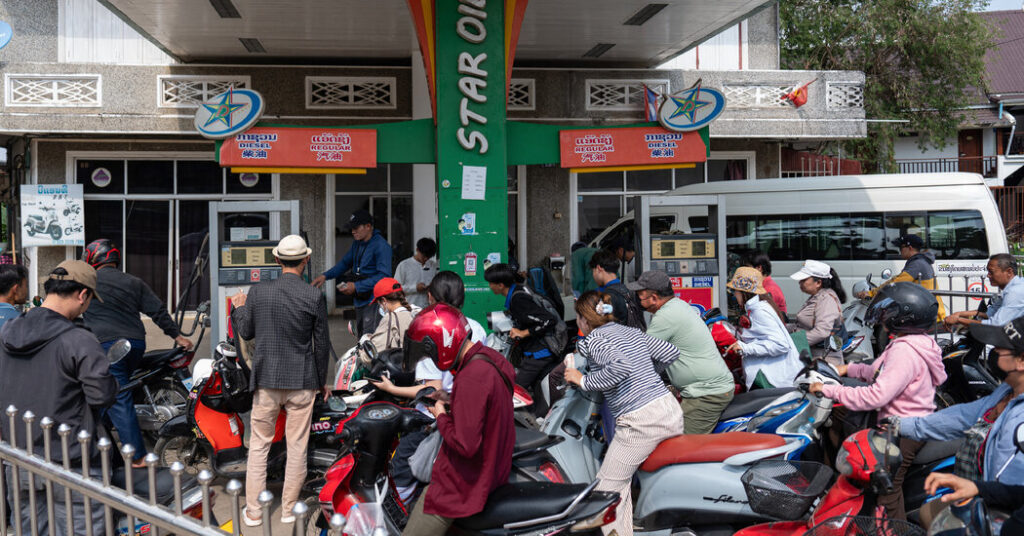
In Laos, over 40 percent of gas stations are closed. Thai public servants have been told to take the stairs instead of using elevators. Sri Lanka just made Wednesdays a public holiday, forcing factories, shops and schools to close.
There is no country in the world that has not been affected by the oil price spike prompted by the war on Iran. From American gas prices to European heating bills, the cost of living is going up.
But in many countries, the impact goes beyond inflation: In Asia, a region heavily dependent on energy exports from the Persian Gulf, precariously low gas and oil reserves are already upending daily life.
In the Philippines, which declared a national emergency yesterday, one newspaper published a column with a particularly pointed headline. “Nation on brink: This oil crisis may destroy everything we built.”
Not a quick fix
The sheer scale of the shock is worth pausing on. Last week, the head of the International Energy Agency told The Financial Times that the war in Iran was the biggest threat to global energy security in history. He said more oil had come off the markets all at once than in the 1973 and 1979 oil shocks combined.
I spoke to my colleague Rebecca F. Elliott, who covers energy. She told me that much of that is because of the effective blockade of the Strait of Hormuz, the narrow shipping lane along Iran’s southern coastline that handles about 20 percent of the world’s oil supplies and substantial amounts of natural gas.
This traffic has been all but halted during the war. As a result, oil and gas prices have shot up, and countries thousands of kilometers away are finding themselves running down their energy reserves.
Reopening the strait is its own very intractable problem. But we’re now in a stage of the war where getting exports flowing again is no longer just about getting tankers moving.
Both sides have targeted energy infrastructure. Iran depends on energy revenues to keep its government running. The U.S. desperately wants to bring down oil prices, which are a politically sensitive topic at home.
Dozens of oil refineries, natural gas fields and other energy sites have been damaged in nine countries, a New York Times analysis found.
A case in point: After Israel attacked the Iranian part of a giant offshore natural gas field that Iran shares with Qatar, sending gas prices soaring, Iran attacked Ras Laffan Industrial City in Qatar, home to the world’s largest liquefied natural gas facility.
Ras Laffan accounts for roughly a fifth of the global supply of liquefied natural gas. Iran damaged about 17 percent of it, Rebecca said. Operators of other energy facilities have been reluctant to disclose how much damage they’ve taken.
If the strait reopened tomorrow, and shipping companies could be persuaded that the journey was safe, it would still take weeks or months for energy flows to approach pre-war levels, Rebecca said.
Repairing the energy infrastructure itself? That could take years.
What could come next
It could get worse before it gets better.
“We’re already seeing one of the worst-case scenarios for global energy markets play out in real time,” Rebecca said. “The longer the Strait of Hormuz remains closed, and the more damage the energy infrastructure sustains, the worse it will get.”
And there is plenty of potential for both sides to escalate further, she said.
Trump has threatened to target Iranian power plants. Iran could hit Ras Laffan again or strike major oil refineries that have so far been left untouched.
For the moment, all this is playing out in the form of a growing list of daily hardships around the world. But there are signs that things could spiral. In the Philippines, a coalition of transportation workers has called for mass protests later this week. There have already been protests in Thailand. Many of the countries most affected have limited ability to cushion their citizens from the worst of the shock. Should this go on, the political consequences could grow, even for governments with no capacity to influence how the fighting unfolds thousands of kilometers away.
As the president of the Philippines, Ferdinand Marcos Jr., said this month: “We are victims of a war that is not of our choosing.”
Other developments:
-
The Saudi crown prince, Mohammed bin Salman, is pushing Trump to continue the war against Iran, according to people briefed by U.S. officials on their recent conversations.
-
Trump said that negotiations to end the war were still taking place and that the Iranians would like “to make a deal.” Follow our live updates.
-
Iran appointed Mohammad Bagher Zolghadr, a former commander in the Islamic Revolutionary Guards, as its new national security chief.
-
Israel’s military plans to expand the territory under its control in southern Lebanon.
-
My colleague David Sanger looked at the state of play after Trump threatened to attack Iran’s power stations if its leaders fail to open the Strait of Hormuz. Watch the video below.
Top of The World
The most clicked link in your newsletter yesterday was about which countries depend the most on Persian Gulf oil and gas.
MORE TOP NEWS
NASA firms up plans to build a moon base
After years of talking about a lunar outpost, NASA has rolled out plans for a moon base to be built in the coming decade.
Jared Isaacman, the NASA administrator, said yesterday the agency would invest about $20 billion in the project over the next seven years and build the base through dozens of missions. The goal is to build an outpost that would allow a continuing human presence on the moon. Next week, NASA hopes to launch astronauts around the moon and back for the first time since the end of its Apollo program in 1972.
OTHER NEWS
-
Danes voted in a closely contested parliamentary election that has been shaped in part by Trump’s obsession with Greenland.
-
The Times visited a village in Ecuador where the U.S. and Ecuador said they had destroyed a drug trafficker’s training camp. Residents said it was actually a dairy farm.
-
The E.U. and Australia agreed on a trade deal that would improve access to aluminum, lithium and other critical minerals for Europe.
-
Afghanistan freed an American researcher, Dennis Walter Coyle, who had been held there for over a year.
-
Pakistan has rebooted its state media. But independent outlets face repression.
-
Australia has allowed psychiatrists to treat post-traumatic stress disorder with the psychedelic compound MDMA. Researchers said the early results were striking.
SPORTS
Football: Mohamed Salah will leave Liverpool at the end of this season.
World Cup: A football fan group filed a formal complaint at the European Commission over ticket prices.
POLLINATOR OF THE DAY
The grey-headed flying fox
— Some 91 million Australian trees owe their existence to these large fruit bats, according to new research. They spread pollen while roosting and feeding on trees, and they spread seeds when they defecate midair. Authorities once considered them to be pests and used napalm to kill their colonies, which can contain hundreds of thousands of bats.
MORNING READ
The Scottish writer and actor Richard Gadd found success by sharing his trauma in the show “Baby Reindeer.” Now he’s exploring male pain in a new way.
His new series, “Half Man,” which premieres next month on HBO, is about a decades-long, mutually destructive friendship between two men. On “The Interview,” he discussed how both shows explore sexual confusion, tortured masculinity and emotional abuse (with some dark laughs thrown in). Watch him here.
AROUND THE WORLD
Therapeutic tango
Tango is the national dance of Argentina, known for its passion, precision and heart.
In a hospital in Buenos Aires, it has another purpose — as a therapy for patients with Parkinson’s disease. The program, which began 15 years ago, uses tango movements to help patients address issues of balance, stiffness and coordination.
Parkinson’s patients can struggle with the stop-and-start motions of walking and can benefit from practicing the “slow, short steps” and pauses of tango, a neurologist said.
There’s also an emotional boost from moving to music. Sometimes, patients who come to class using canes gain such confidence that they leave without them. Take a look at the dance therapy.
RECOMMENDATIONS
Relax: A family in Kerala, India, wanted their vacation home to reflect their roots. Take a look.
Download: Here are some useful local apps for your next trip.
Declutter: Let go of sentimental objects with this guide to spring cleaning your life.
RECIPE
Dirty rice is a classic one-pot dish that Black Americans in Louisiana and other parts of the South have been preparing for generations. This meatless version uses vegan meat, to stay true to the original essence of the dish.
WHERE IS THIS?
Which pedestrian-friendly city is this?
TIME TO PLAY
Here are today’s Spelling Bee, Mini Crossword, Wordle and Sudoku. Find all our games here.
You’re done for today. See you tomorrow! — Katrin
We welcome your feedback. Send us your suggestions at [email protected].
Katrin Bennhold is the host of The World, the flagship global newsletter of The New York Times.
The post Asia’s Energy Crisis Stings appeared first on New York Times.