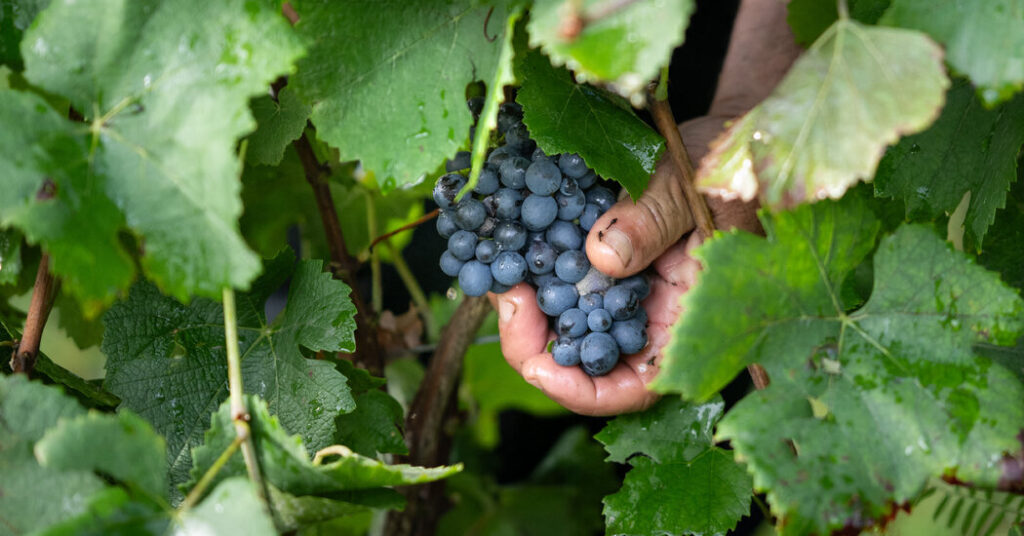
Humans have been drinking wine for thousands of years. Paintings from ancient Egypt show the harvesting of grapes and the making of wine. Mesopotamian murals illustrate elites raising a glass of what some scholars think is wine. And Roman frescos depict Dionysus luxuriating in the drink.
But how much has wine changed over the millenniums? And what role did humans play in the evolution of grapes and their varieties?
Scientists are answering those questions using ancient DNA preserved in grape seeds found at archaeological sites. A new study presents an in-depth genetic analysis of ancient seeds, called pips, found in France, one of the world’s cultural and geographic centers of the winemaking tradition.
Humans in France were domesticating grapes for making wine by 650 B.C., around the time when Greek settlers founded the port city of Marseilles, according to the study, published Tuesday in the journal Nature Communications. And the true date could be even earlier, the authors said.
The study also examined how grape varieties changed, or didn’t, over centuries. Lineages like pinot noir and Folha de Figueira, a Portuguese white wine, remained essentially unchanged for hundreds of years or more, thanks to careful propagation efforts.
“It’s mind blowing to think that we humans have cultivated this same exact genetic clone of a plant for almost 1,000 years,” said Jazmín Ramos Madrigal, who studies evolutionary genomics at the University of Copenhagen and was not involved in this research. It’s a notable effort especially when compared with other domesticated crops.
“The varieties we grow are only a few generations away from the initial domestication, which is very unlike what happens in other crops,” said Michele Morgante, a geneticist at the University of Udine in Italy who also was not involved in the study. “Take current maize hybrids. They’re thousands of generations away from where they started. Here, with wine, we’re only five to 10 generations away.”
The earliest domesticated grapes came from the mountainous region between the Black and Caspian Seas. Eventually, France and other European countries developed flourishing vineyards and wineries, sourcing grapes from all over Europe and the southwestern Middle East.
People were turning those grapes into wine at least 8,000 years ago, based on a wine jar of that age uncovered in Tbilisi, Georgia.
Over thousands of years, as civilizations and trade expanded, people transported domesticated grapes westward, where they mingled with local, wild varieties that didn’t have much appeal on their own.
Eventually, France and other European countries developed flourishing vineyards and wineries.
But researchers have more to learn about when grape varieties were first created, how they were cultivated and how grape diversity changed over time with human interference.
“When it comes to France, every single question is wide open,” said Ludovic Orlando, a geneticist and evolutionary biologist at the University of Toulouse who led the new study. “There is a lot that’s known from history and archaeology, but there are a lot of ideas to be tested in terms of genetic data.”
Previous studies of grapes relied either on the size and shape of grape pips or on partial genomic analyses to reconstruct diversity and cultivation over time. There were also big gaps in the record, particularly before the Iron Age and in the late Middle Ages, that left the timing of domestication uncertain.
Dr. Orlando and his colleagues collected more than 150 preserved wild and domesticated grape pips from archaeological sites around France. He focused on France partly because of the cultural importance of wine there, and partly because of its relatively central location in Europe.
The earliest sample was from around 2250 B.C., during the Bronze Age, extending the record back by almost 1,000 years. The most recent was from around A.D. 1450, at the end of the Middle Ages, about 300 years later than previous studies had covered.
Of all the pips, 49 had enough well-preserved DNA that they could be analyzed.
Dr. Orlando sequenced the pips’ whole genomes and then compared them with one other. He was looking for similarities that could reveal when wild and domesticated grapes mixed, how and whether humans cultivated specific grape varieties and how varieties changed or remained the same over time.
The oldest samples, from the Bronze Age, were wild. Around 625 B.C., in the early Iron Age, domesticated varieties that would have been imported from the East and plants that appeared to be wild-domestic hybrids appeared in the genetic record. Wild plants continued to exist, but after that point, France’s grape pips have a clear signal of cultivation.
“The biggest contribution of this paper is that it puts a more precise date on when the first fully domesticated varieties appear,” Dr. Morgante said.
Besides the relatively unchanged pinot noir and the Folha de Figueira, a modern sauvignon blanc was a clone of a 900-year-old seed, according to a previous paper by Dr. Ramos Madrigal of the University of Copenhagen.
The longevity points to intentional propagation with cuttings, which creates clone plants but doesn’t build genetic diversity. That likely reflects efforts to create grapes better adapted to Europe’s warmer and wetter climate, as well as taste preferences.
“We like our wine,” Dr. Ramos Madrigal said. “Once you find something you like, you want to keep it. You keep growing it. And it seems like ancient civilizations were good at that, and we have them to thank.”
Having more completed grape genomes will allow researchers to find traits that could help modern grapes survive in a changing climate, as most European grapes came from places with hotter, drier weather.
Dr. Orlando is looking to extend the timeline even further back and keep filling in temporal gaps in France’s history of grapes. He would like to see similar studies carried out in more regions, with more grapes, to get a more complete picture of diversity, cultivation and movement over time.
“We really want to understand the whole co-evolutionary history of us and grapes, and how that circles back to culture,” Dr. Orlando said.
One unlikely next step: drinking facsimiles of ancient wines.
There’s only a slim chance scientists could use this ancient grape DNA to recreate the wines the Romans were drinking. Wine is much more than growing grapes — it involves climate, harvest time, microbes and aging.
And ancient humans did all the work of cultivation for a reason, Dr. Morgante pointed out.
“I’m not sure the wine of the Romans was better than what we have today,” he said. “So why should we go back?”
The post Ancient Grapes Reveal Long History of Modern Wines appeared first on New York Times.