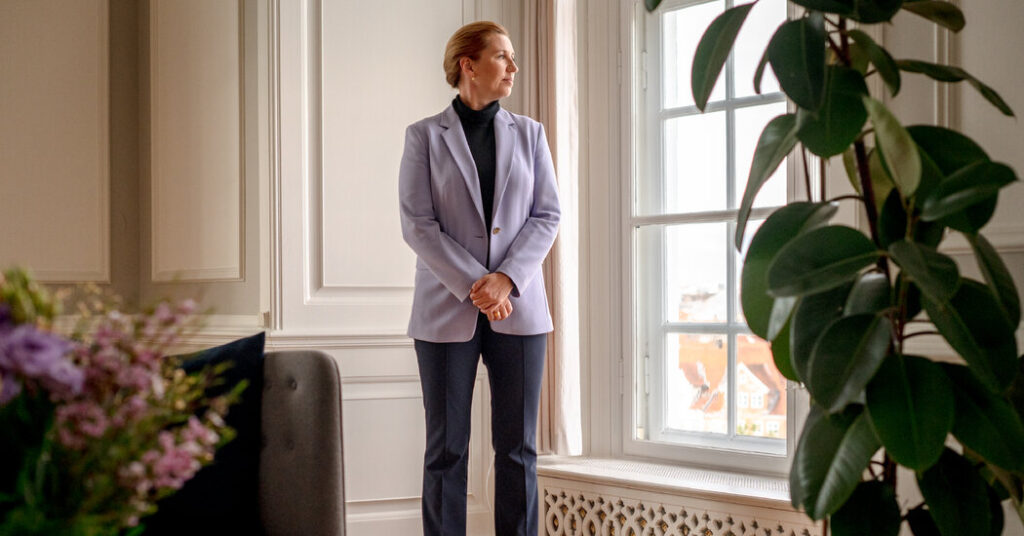
The center-left party of Mette Frederiksen, Denmark’s prime minister, was leading in parliamentary elections on Tuesday but fell far short of a majority, potentially setting her up for a grueling battle to form a new government.
With all the ballots counted, Ms. Frederiksen’s Social Democrats came out ahead but won less than a quarter of the vote in a highly fractured political field. The result was about what had been expected, and analysts said it left her in the best position to try to forge a new governing coalition.
But it was still her party’s worst performance in more than 100 years, according to Danish media outlets, and indicated that the woman who gained notoriety for standing up to President Trump over Greenland may now have to wage political battles closer to home.
Ms. Frederiksen has been the dominant force in Danish politics — a third term could make her Denmark’s longest-serving leader since World War II. After so many years on the scene, she is vulnerable to voter fatigue, and the results signaled that a new term could prove challenging.
“Voters are quite simply tired of Mette Frederiksen,” said Johannes Andersen, a political scientist at Aalborg University. “The way she says she is not afraid to take power or set directions for how people should behave — that is not many voters’ cup of tea.”
“That’s something other parties, especially on the extremes, have been playing to and are capitalizing on,” he added. “It reflects a moment of frustration.”
It was still mathematically possible for a band of other parties, possibly from the right, to scrape together enough support to form a government without her. But analysts said that seemed unlikely for now and that Ms. Frederiksen may look to left-leaning parties to hammer out a new coalition over the next several weeks.
Bent Winther, one of Denmark’s leading political analysts, said in an interview that the results were “a major setback” for the prime minister’s party. “But given how Parliament is likely to be composed,” Mr. Winter said, “it’s very difficult to see a government without her.”
Ms. Frederiksen, 48, campaigned as an exemplar of the new left: hawkish on foreign policy, tough on immigrants, but big on social welfare.
She earned a lot of points back home for taking on Mr. Trump, who was insisting on snatching Greenland, an enormous Arctic island that has been part of Denmark for more than 300 years. She called in European allies to back her up, and the Danish military even laid plans to blow up airfields in Greenland to prevent American troops from landing.
But it was domestic issues that voters seemed most concerned about, according to polls, and Ms. Frederiksen’s centrist flexibility could not satisfy everyone.
Environmental matters and the question of how strictly to regulate Danish farmers was one big issue. Another has been a potential wealth tax that the heads of Lego and many other Danish companies opposed and which detractors called a “jealousy tax.” Ms. Frederiksen and the left-leaning parties supported it; the right did not.
Ms. Frederiksen has been steeped in working class values from the beginning. Her father was a union leader, and she grew up in Aalborg, a factory town in the Jutland region near Denmark’s northern tip.
Friends back home remember her being strident about her political opinions since she was young. In high school, she was punched in the face by a skinhead for standing up for immigrant children.
She entered Parliament at 24, going on to become Denmark’s youngest prime minister at 41. Her tenure has been shaped by crisis — from the Covid-19 pandemic to Russia’s invasion of Ukraine — as well as by her increasingly acrimonious clashes with Mr. Trump.
In more recent years, she’s demonstrated how she can form alliances with politicians of different stripes, and analysts say her government’s harsh rules on asylum seekers are markedly different from what she believed in when she was young.
She is now likely to need the help of her foreign minister, Lars Lokke Rasmussen, the leader of a more moderate political party, which is actually called The Moderates.
A former prime minister, Mr. Rasmussen is widely seen as likable and reliable and the ultimate swing vote. His party won about 8 percent of the vote, but its support could be key to forming a majority in Parliament.
Parties on the extreme left and right also performed relatively well, giving them a potential role in forming the next coalition.
Ms. Winther, the political analyst, said Ms. Frederiksen will likely have to make difficult concessions to politicians either on the right or the left to win their support.
“This could take time,” he said. “Possibly weeks, even months.”
Her party tried to put the best face on the results.
“I am satisfied that we remain Denmark’s largest party,” said Christian Rabjerg Madsen, a spokesman for the Social Democrats. “Now the task is to see whether we can negotiate a government — one that is operational and acts decisively — and move Denmark in a more just direction.”
Jeffrey Gettleman is an international correspondent based in London covering global events. He has worked for The Times for more than 20 years.
The post After Standing Up to Trump Over Greenland, Denmark’s Prime Minister Leads in Election appeared first on New York Times.