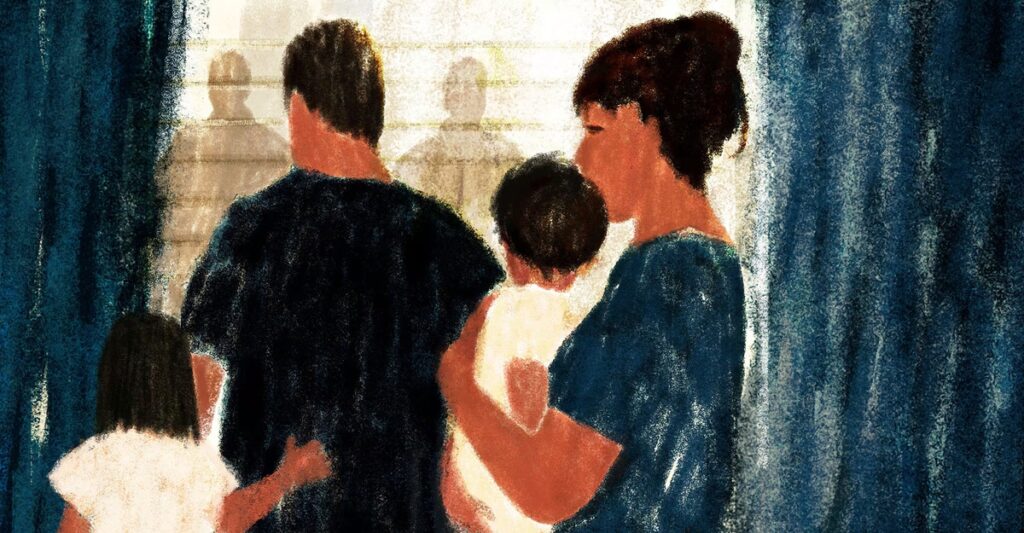
While bombs and drones explode across the Middle East, in Pakistan an Afghan family is hiding from the police. Saman; her husband, Farhad; and their two small children never leave their room, never see sunlight. They’ve been living as refugees in Islamabad since fleeing Afghanistan four years ago. Both Saman and Farhad (they requested pseudonyms for their safety) served in the Afghan special forces; because of their association with the American war in Afghanistan, and because each belongs to an ethnic minority targeted by the Taliban, in 2022 they were granted priority status in the United States refugee program. Extensively vetted, medically cleared, interviewed three times, the family was about to be resettled in this country when Donald Trump, J. D. Vance, Stephen Miller, and Kristi Noem came to power last year and barred the door to virtually all refugees, including those Afghans who have an urgent claim on American rescue.
So the same people whose policies led to the killings of Renee Good and Alex Pretti in Minneapolis now have Saman and her family on the run in Islamabad, one mistake away from deportation. If the couple stepped foot in Afghanistan, they would be recognized at the border by their biometric data as enemies of the Islamic Emirate. The children would be taken away. The parents would be sent to prison—and possibly executed.
I’ve written about Saman periodically since 2022, when we were put in touch by an American Army captain who helped Saman and Farhad escape from Afghanistan after they were threatened by the Taliban. The captain and a small group of other Americans have been providing support for the family, and for several other ex-military Afghan women in Pakistan. I’ve corresponded with many refugees since the fall of Kabul, but something about Saman’s story has a special grip on me.
She and Farhad are in their mid-20s. In pictures they look young, lovely, and hopeful. They were born into the generation of Afghans who were given a glimpse of freedom during the American war. They enlisted in the military to fight for their future and, in Saman’s case, to show that a woman could defend her country. But they had hardly begun to live when, with the Taliban victory in 2021, the world they had known collapsed and they had to leave the remnants behind.
[George Packer: No one can offer any hope]
Any thought of seeing their families in Afghanistan again vanished in July 2024, when Farhad’s brother was arrested and put in prison, where he’s remained ever since. A letter from the Taliban director general of intelligence to a provincial prosecutor made the reason clear. “His arrest is directly related to the activities and military background” of Farhad, it read. “According to available information, if the aforementioned individual returns to the country or is identified, he must be arrested without delay and placed under serious security investigation.”
The couple’s children—a 4-year-old daughter, born in Kabul and named Victoria, after the American Army captain who helped them, and a 2-year-old son, born in Pakistan, named Yusuf—are growing up isolated and afraid in a hostile city under self-imposed house arrest while the family waits for the delivery of a promise that America will never keep.
For months, Pakistan and Afghanistan have been fighting a low-grade war, and it recently escalated. To punish its neighbor, Pakistan is deporting Afghan refugees en masse—almost 1 million in 2025, and the pace has only increased this year. Any encounter with the police, even if a refugee has a valid visa, is risky.
On January 7, Saman wrote me that two of her Afghan neighbors had just been arrested and sent to a deportation camp that was rumored to be filthy, cold, and overcrowded. Early on the morning of January 30, while Saman and her family were still asleep, police officers knocked loudly on the door and demanded entry. They searched everywhere, even inside a wardrobe, as if someone might be hidden there, and left with a warning: Unless the family renewed their visas, which were due to expire in a week, they would be deported. But Pakistan was no longer renewing Afghans’ visas, even for the extortionate prices that Saman and Farhad had always paid—not unless the family returned to Afghanistan and presented their passports at the Pakistani embassy in Kabul.
Forcibly sending refugees back into danger has a formal name: refoulement. It’s illegal under international law. No one in a position to help seemed to care. Saman had written to the Pakistani embassies of every country she could think of and never received a reply. Now time was running out.
“I am begging you from the bottom of my heart,” Saman wrote me, “if you know any strong, trustworthy people or any possible options in another country, please help us so that we can be freed from the problems we are facing here in Pakistan. I cannot fall into the hands of the Taliban. They have no mercy, neither for women nor for children.”
The message made me fear for the family, but I was also afraid for myself. She was asking me to take on a responsibility that I neither wanted nor believed I could fulfill. But if I couldn’t find an answer, they were doomed. In a sort of panic, I started looking for a way to get them out.
A retired German diplomat informed me that, after admitting nearly 1 million refugees in 2015, his country was essentially closed to asylum seekers—across Europe, the politics of immigration had changed utterly. A journalist in Lisbon couldn’t get anywhere with the Portuguese authorities. A woman at a Brazilian organization said that resettlement had paused for almost two years, and now the waitlist for Afghans was three years long. I asked a friend’s sister in Alberta—a Christian who had done years of humanitarian work in Afghanistan—if she knew people who could sponsor the family in Canada. After several weeks of looking, she reported apologetically that Alberta had taken in so many Ukrainians, it was full up.
Rumor of an exit ramp to Rwanda or Uganda turned out to be wrong, and India was a name, according to Saman, whose very mention in Pakistan could get you arrested. A few last-chance countries, such as Tuvalu, Comoros, and Haiti, issue visas upon arrival to Afghans, but Saman told me that Pakistan would never let them board a plane without one. Afghanistan’s passport ranks as the weakest in the world.
Last summer, a few Trump-administration officials with military connections began a quiet effort to compile a list of about 100 Afghans who’d been vouched for by American veterans or active-duty troops. The key to getting on the list and possibly admitted into the U.S. was the concept of moral injury: America’s failure to accept these Afghans would cause emotional harm—a sense of personal shame and dishonor—to a member of the U.S. military. With the support of the Army captain, I managed to get Saman and her family on the list. The effort’s success seemed to require that no one in the White House—certainly not Miller—could be aware of its existence. If the first try worked, there might be a second.
Then, on November 26, in downtown Washington, D.C., a mentally unstable Afghan asylee allegedly shot two members of the West Virginia National Guard, killing one of them, a 20-year-old woman. Immediately, the Trump administration announced the end of any visas for Afghans. Those already approved would be canceled and those printed would be destroyed. No Afghan nationals, not even those who had worked as interpreters for Americans and gone through the yearslong process of obtaining a congressionally mandated Special Immigrant Visa, would be allowed into the United States. Afghans already here, including with asylum, a green card, or even U.S. citizenship, could have their cases reviewed and might face deportation.
The backdoor resettlement effort died as quietly as it had lived. The moral injury to U.S. service members remains unhealed.
I kept thinking of Evian—the French spa town where 32 nations held a conference in the summer of 1938 to discuss what to do about German and Austrian Jews. The conference was President Franklin D. Roosevelt’s idea, perhaps an attempt to deflect criticism from the American failure to meet even its tiny annual quota for immigrants from Germany. Evian ended in ignominy, with just one country—the Dominican Republic, later joined by Costa Rica—agreeing to increase the number of Jewish refugees from Nazi persecution that they would receive. The conference was one of the last chances for the world to save the Jews of Europe.
Four months after Evian, the assassination of a German diplomat in Paris by a Jewish youth whose family had just been expelled from Germany became the pretext for the Nazi pogrom known as Kristallnacht.
Last year, the Dominican Republic deported more than 100,000 Haitians back to their disintegrating country. Costa Rica received two planeloads of 200 deportees from the United States and sent them to detention centers. As for the country that convened the Evian Conference—the one that went on to create the most generous refugee-resettlement program in the world, and that fought a 20-year war in Afghanistan—that country has made it impossible for Afghans to come here and hard for those already here to stay. The shooting in downtown Washington gave the Trump administration an excuse to lock the door. For practical purposes, the global refugee system is dead—killed by a worldwide plague of nationalism.
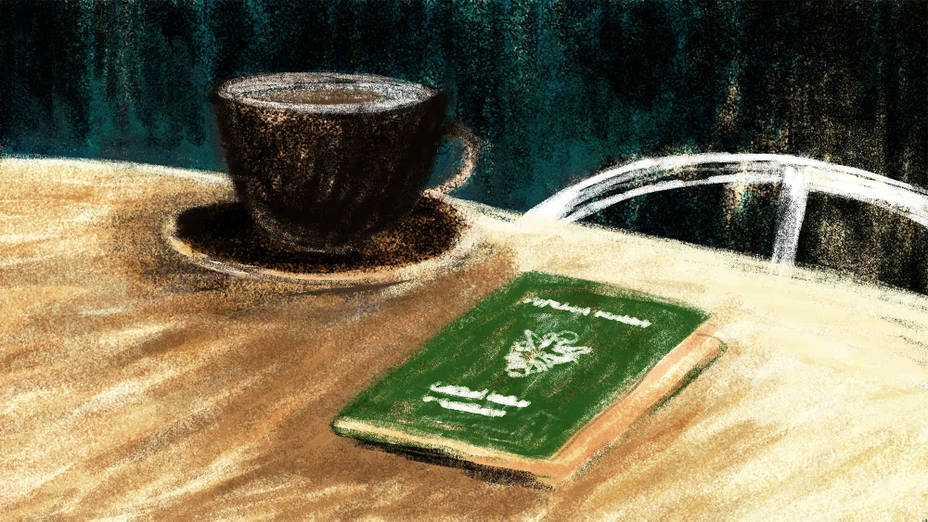
On February 6, Saman’s and Farhad’s visas expired. The family was now illegal in Pakistan, and the police knew where they lived. Whenever Victoria heard a knock on the door, she grabbed her mother and cried, “Mama, don’t answer! It’s the police!” The hunt for refugees in Islamabad was growing intense, with house-to-house searches and checkpoints in the streets. Banners went up around the city offering a $35 reward for “patriotic” Pakistani citizens who reported the presence of Afghans in their neighborhoods, while police, using mosque loudspeakers, threatened imprisonment for Pakistanis who rent to Afghans. The government, recognizing that America was now closed, announced that it would expel all 19,973 Afghans with pending U.S. immigration cases.
“Unfortunately, it feels as if there is no such thing as human rights in today’s world,” Saman wrote me. “And if there is an office called ‘Human Rights,’ it seems its employees have closed their eyes and ears, only taking their salaries while innocent people suffer.”
On February 9, a Pakistani friend of Farhad’s with police connections warned that a raid on their building was imminent. The family spent most of the day and night in a nearby park, returning to their room only long enough to pack up and flee after midnight. Their landlord—who sympathized with the family because he was a Pakistani Shia, a co-religionist of Saman—drove them to a hotel in a different part of the city. But after a few days, the hotel began receiving visits from the police, and the family had to move several more times, always in the middle of the night. Finally, they found shelter in two rooms of a house owned by a friend of their former landlord.
The family never goes outside. They keep the door to their rooms locked, their voices down, their windows shut and curtains drawn, to prevent neighbors from hearing or seeing anything that could reveal their presence. Without natural light to go by, they lose track of day and night. Once a week, they pay their former landlord to buy food and supplies. On March 3, Victoria turned 4 without any celebration.
When Saman looks back at her life, she feels as if it has all been unreal. She tries to keep sane with a schedule of yoga, reading, writing, and endless cups of tea. “If tea could solve everything,” she wrote me, “I would already be the calmest person in the world!” And she spends hours and hours playing with the children: “I sometimes think no child in the world has ever experienced this much playtime with their mother.”
Saman and I exchange messages almost every day, as she keeps me apprised of practical difficulties and new threats, her sadness and hope, politely prompting me with questions about any chances of refuge. My attachment to this family I’ve never met eludes my understanding. Every American should have a bad conscience about Afghanistan, but my obsession with getting them to a safe place doesn’t feel like atonement. I can’t escape the fact that they have no one else—that their lives are at stake. And I keep hearing Saman’s voice in her messages, a distinctly human sound from halfway around the world.
When Kabul fell, my husband and I went to the airport. We spent days and nights at the airport gates, even sleeping there, trying desperately to reach the American forces. Unfortunately, due to the extreme crowds and chaos, we were unsuccessful. At that time, I was also pregnant, so I had to be very careful. My greatest fear was losing the child in my womb. In the final days, we managed to get very close to the airport gate, but then an explosion happened. We lost consciousness. When I opened my eyes, I found myself lying in muddy water. Those were some of the darkest and most painful days of our lives.
What hurts most is not only what we lost—our home, our work, our dignity—but the feeling of being unwanted by a world that once promised protection. To hear that even those who found safety may now be forced back into danger breaks my heart. It feels like justice itself is being undone. Still, despite everything, I try to hold on to hope. Hope that truth still matters. Hope that kindness like yours still exists. Hope that one day my children will live in a world that sees refugees not as a burden, but as human beings who survived the unimaginable.
We are only searching for a place where we can live without fear. But sometimes it feels as if safety is something that is sold at a very high price, and not easily given to people like us.
I try to hide my tears so that Victoria does not see them. We tell her that one day she will run freely in parks without looking over her shoulder. We hold on to that image as our hope.
[George Packer: Condemning millions for one man’s crime]
At last, a glimmer of good news: An acquaintance of mine who runs an international humanitarian organization spoke to a senior official in a European government about Saman and her family. Of two dozen long shots, this one made something move. I was told to have Saman send an application for asylum, with all the documentation she could gather about her case and the danger her family faced. A week later, she received an appointment for an interview at the country’s embassy in Islamabad. She and Farhad gathered visa photos, copies of their military IDs, a letter of support from me, and the record of their long and futile encounter with the U.S. refugee program.
The diplomatic quarter in Islamabad is heavily guarded, and no one can enter without an invitation. On the way, Victoria asked her mother where they were going and why. Saman’s answer filled the little girl with excitement, but whenever they passed a checkpoint, she said, “Mama, tell the driver not to stop near the police.” At the embassy, all of the other families in the waiting room were Pakistani—none was Afghan. The embassy officer asked Saman how she had managed to get an interview so quickly, when other refugees waited months or years. The Dari word for “connections” is wasita, and Saman didn’t conceal the truth. At the end of the interview, she was told to go home and wait for an answer that could take weeks. But Saman and her family are experts at waiting.
Now their fate is in the hands of a consular officer at the embassy in Islamabad, or a bureaucrat behind a desk at a ministry in a European capital. I would like to sit across from that person and look them in the eye. I would say that giving Saman and Farhad and their children asylum will make little difference to the other 42 million refugees who have nowhere safe to go, or to a world sunk in profound injustice. But it will make all the difference to this family.
I remind Saman that the chances are slim, and she reminds me that she knows this. Still, I can’t let myself believe that it won’t happen. I imagine meeting the family inside a gleaming airport. We exchange smiles and hugs, and walk out into the sunlight, and sit down somewhere to tell stories over cups of tea.
The post Abandoned by America appeared first on The Atlantic.