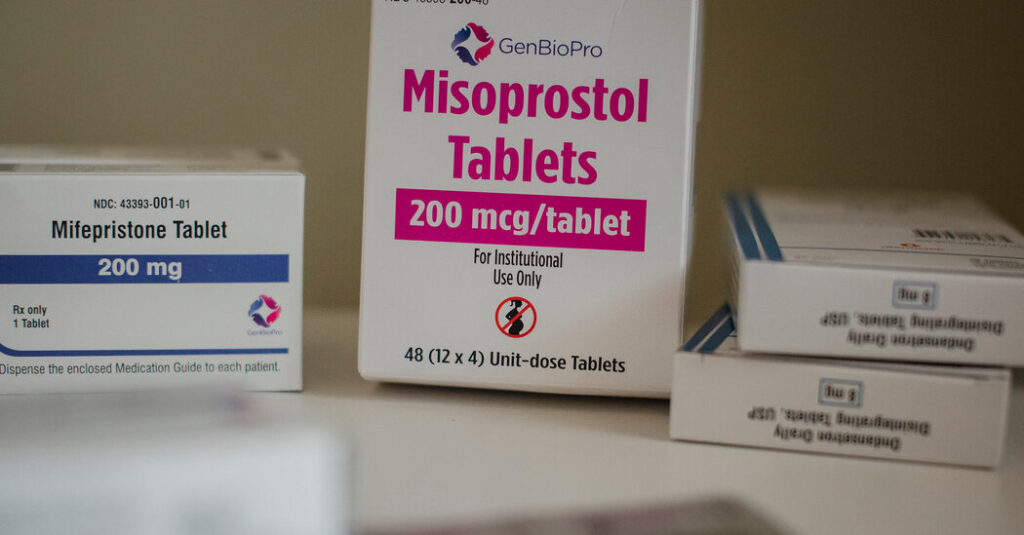
A 31-year-old pregnant woman was rushed to a Georgia hospital on Dec. 30, complaining of severe abdominal pain, law enforcement officials said. She told doctors and nurses she had taken medication she bought online to induce an abortion. She then went into labor, delivering a girl apparently in the second trimester of development. The newborn was declared dead within about an hour.
Two months later, the police arrested the woman, Alexia Moore, on a murder charge. In the warrant, investigators said she had “unlawfully and with malice aforethought caused the death of Baby Girl Moore.”
But in court on Monday, a state judge expressed deep skepticism about the charge and set Ms. Moore’s bail at just $1, clearing the way for her release after being jailed for roughly two weeks.
“I think that charge is extremely problematic,” Judge Steven G. Blackerby of State Superior Court said during the hearing. “That is going to be a hard charge to convict upon.”
The case has highlighted the complications of the fractured reproductive health landscape that has emerged in the nearly four years since the Supreme Court overturned Roe v. Wade.
In Georgia, as in other states with some of the most severe restrictions on abortions, lawmakers have long avoided criminally punishing women who seek to terminate pregnancies, instead focusing on prosecuting providers and others who help facilitate access to the medication or procedures.
Still, Ms. Moore’s case reflects one of the rare circumstances in recent years in which those seeking abortions have ended up exposed to prosecution.
In the hospital, according to court documents, Ms. Moore expressed her frustration with how difficult it was to obtain an abortion in Georgia. The state bans abortions after cardiac activity is detected, which is typically about six weeks into a pregnancy, often before women are aware they are pregnant.
So instead, she bought medication online. She told investigators, according to the documents, that she did not know long she had been pregnant but believed it had been less than 14 weeks. After she gave birth, doctors determined that she had been about 22 to 24 weeks into her pregnancy.
In states where abortion is legal, abortion pills can typically be taken through the first 12 weeks of pregnancy. For pregnancies that are further along, terminations are done with a surgical procedure. The vast majority of abortions occur within the first 13 weeks, or first trimester, of pregnancy.
How prosecutors will proceed remains unclear. Ms. Moore has not yet been indicted on the murder charge. In the hearing on Monday, Keith Higgins, the district attorney overseeing the case, said that his office “didn’t advise” the police on arresting Ms. Moore on the murder charge and that he was not steeped enough in the full details of the case to discuss it more extensively.
Mr. Higgins did not oppose the low bail amount, telling the judge, “Whatever bond the defendant can make that will allow her to get out of jail is appropriate.”
In brief interviews on Monday, Ms. Moore’s relatives acknowledged the uncertainty that has gripped her family since the arrest. “I’m just praying,” Teresa Soh, her grandmother, said. Still, they said they were relieved that she would be able to leave jail. Ms. Moore’s total bond was $2,001, including for two other lesser charges that she faces related to drug possession.
In a statement after the hearing, the Georgia Public Defender Council, whose lawyers represent Ms. Moore, said the outcome was a success.
“Today’s decision is a reminder that justice is not served by accusation alone,” the statement said. “Our system works best when courts carefully weigh the facts, uphold constitutional protections, and safeguard the rights of every person who comes before them.”
Ms. Moore was arrested in early March in Kingsland, Ga., a small city on the southern Georgia coast. According to court records, she told doctors and nurses that she had taken about eight pills of misoprostol, a typical dose of a drug that induces contractions. She also took oxycodone for the pain, the records said.
The charges against Ms. Moore did not specifically cite Georgia’s abortion ban, although the affidavit supporting the warrant did include language that echoed aspects of the ban, including saying that “the baby was well beyond six weeks of conception.” But the affidavit said that she was charged with murder because “the victim became a person at the moment of live birth.”
In most states, murder charges can be filed for the intentional killing of a newborn baby. But legal experts said the circumstances in Georgia did not appear to fit that description. Ms. Moore is accused of taking actions that were intended to terminate a pregnancy and happened before the child was born, said Mary Ziegler, a law professor and abortion expert at the University of California, Davis.
“It would be a really big deal to prosecute a woman for murder for abortion, which is what this amounts to,” Professor Ziegler said.
Misoprostol is a widely available drug that can be used for several conditions, including stomach ulcers and to help induce labor. In the typical medication abortion regimen, patients first take another drug, mifepristone, and then take misoprostol 24 to 48 hours later to induce contractions to expel the fetal tissue.
Misoprostol can be used on its own to terminate pregnancy, although that approach is considered somewhat less effective and more likely to cause side effects like nausea.
Mifepristone has been the focus of recent lawsuits filed by states with abortion bans, seeking to force the Food and Drug Administration to sharply restrict access to that pill. Misoprostol has not typically been highlighted in those lawsuits, partly because it has a range of other medical uses.
There have been cases in other states in which women who seek abortions have faced charges. Last November, a South Carolina woman was charged with attempted murder and unlawful neglect of a child. The police said she took a drug to induce contractions when she was 27 weeks pregnant. After the baby was born, the authorities said, she left it in the toilet while a family member called 911 and emergency responders took the infant, who was in critical condition, to the hospital. The case is ongoing.
In January, prosecutors in Kentucky announced that they had charged a woman with fetal homicide, saying that the she took abortion pills and buried the remains of what police described as a “developed male infant” in her backyard. Prosecutors later dropped the fetal homicide charge, saying that Kentucky’s law prohibited filing that charge against women seeking abortions. The woman continues to face charges of concealing the birth of an infant, abuse of a corpse and tampering with physical evidence.
The arrest records in the Georgia case said that the bottle of misoprostol that the police examined did not list a prescription number or a doctor’s name. That appeared to be the reason that Ms. Moore was also charged with misdemeanor drug possession. But an assistant public defender, Kelly Turner, said on Monday that the misoprostol was prescribed by a licensed physician and dispensed by an online licensed pharmacy.
Ms. Moore also faces a felony drug possession charge for also having oxycodone, which the arrest records said she also obtained without a prescription.
Kirsten Noyes contributed research.
Rick Rojas is the Atlanta bureau chief for The Times, leading coverage of the South.
The post A Murder Charge in Georgia Exposes Complexities of the Abortion Debate appeared first on New York Times.