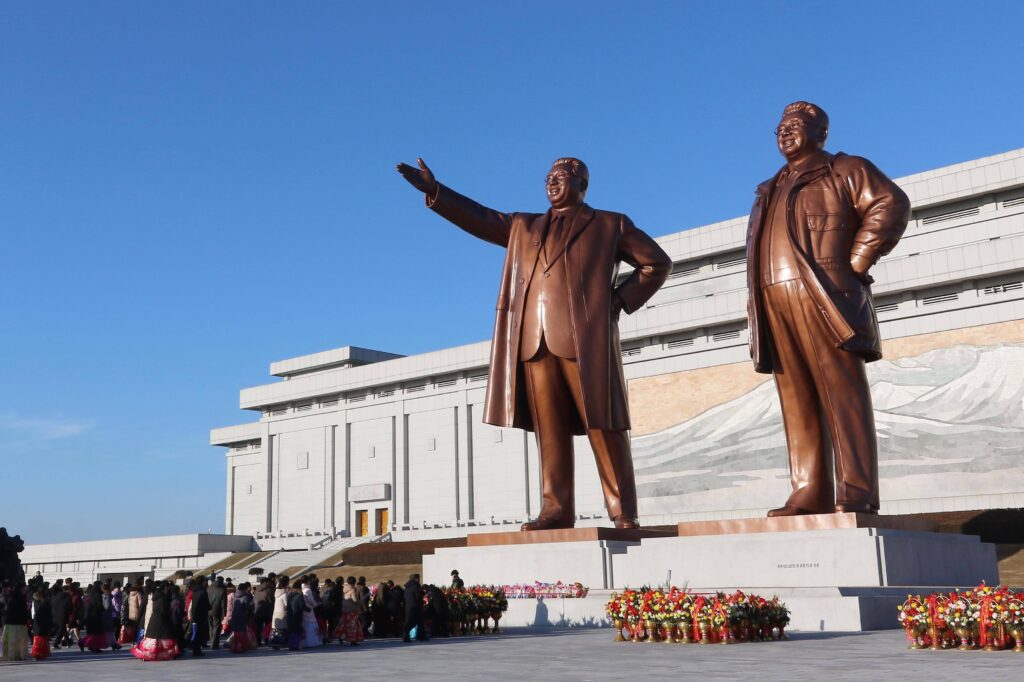
Early in March came the surprising news that North Korea had unveiled the first known statue of its “supreme leader,” Kim Jong Un — surprising because I had assumed North Korea would be strewn with Kim statues. Such is the veneration a dynasty demands.
Visiting North Korea twice, in 1997 and 2011, I got a rare glimpse of the Kim personality cult firsthand. Kim Il Sung Square, named after the founding leader. Kim Il Sung University. Various murals of the father and his son Kim Jong Il. Every book on display in the hotel bookstore was written by one of the Kims.
Of all the recurring features of authoritarianism I’ve seen, from Africa to Asia to the Middle East to post-Soviet Europe, none is more bizarre — or revealing — than the personality cult. Autocrats plaster their name on highways, airports, bridges, stadiums, entire towns. They put their face on the currency. They stare down from ubiquitous portraits in offices and from giant posters in public spaces. Media outlets are filled with minutiae from their daily activities.
Epitomizing the extreme of brutal buffoonery was dictator Mobutu Sese Seko of Zaire, now the Democratic Republic of the Congo. On my first visitto the capital, Kinshasa, I turned on the evening state-run news in my hotel. The intro to the broadcast was an image of Mobutu’s head, adorned with his trademark leopard skin hat, descending from the clouds to the beat of African drums and voices praising him and exhorting viewers to “follow the guide!”
Even his full name was meant to evoke otherworldliness; it roughly translated to “the all-powerful warrior who, because of his endurance and inflexible will to win, goes from conquest to conquest, leaving fire in his wake.”
Kenya, where I lived from 1991 to 1994, was ruled for 24 years by “Big Man” authoritarian president Daniel arap Moi. A major downtown Nairobi street was named Moi Avenue. A sculpture in Nairobi’s Central Park displayed what appeared to be a replica of his fist, clutching his characteristic “rungu” baton, bursting through the top of Mount Kenya. His face graced every banknote and coin. One day in October, I was planning to run errands but found all the banks and offices closed; I didn’t realize it was “Moi Day,” a national holiday.
While living in Kenya, I traveled to Ivory Coast and visited the Yamoussoukro basilica that strongman Félix Houphouët-Boigny built with his own likeness in a stained-glass window kneeling at the feet of Jesus. Turkmenistan’s dictator built a 50-foot-tall gold-plated statue of himself atop a larger monument that rotated 360 degrees every 24 hours so he always faced the sun.
All the iconography serves a real utilitarian purpose, underpinning the edifice of autocracy. A personality cult is a way to demand fealty through fear, and a theatrical way to enforce conformity. When everyone is expected to wear a Kim lapel pin, not wearing one can cost you your head. Iraqi military commanders sported the same Saddam Hussein-style mustache in obsequious imitation, all terrified to do otherwise. Forced public praise, to the point of idiotic excess, also makes it impossible for collaborators to later claim they were dissenters all along.
And even autocrats are aware of their own mortality, especially as they age in office. Erecting vanity statues, stamping their names and faces across stadiums and cultural centers is a way of trying to cement their legacy. Often, quite literally, with cement.
But nothing lasts forever, no matter how sturdily built. When the regimes finally crumble — and they eventually do — those statues and portraits become the first, most visible targets of suppressed rage. Think of the statue of Saddambeing pulled down in Baghdad. In Basra, southern Iraq, after the regime fell, I saw one giant poster of Saddam dressed in a traditional kaffiyeh, with his mouth shot out.
Across Syria after the December 2024 revolution, statues of Bashar al-Assad and his father, Hafez al-Assad, were reduced to rubble. In the Philippines, a giant likeness of the late dictator Ferdinand E. Marcos carved out of a mountainside was later blown up with dynamite. When Mobutu fell in Zaire, the locals carved his face out of the banknotes.
President Donald Trump , a real estate mogul with a clear edifice complex, seems drawn to the temptation to leave a mark. He has hung giant banners of his face on the Justice Department and other government buildings, added his name to the Institute of Peace and the Kennedy Center, even requested that Washington Dulles International Airport be renamed after him in exchange for federal funds. It’s mostly corruption and vanity at work, rather than coercion and terror. No one is adopting comb-overs and cheap spray tans, yet. Though members of his Cabinet, who lavish him with excessive praise, are being nudged to wear ill-fitting black shoes, often with blue suits — a crime against fashion meant to both cow and demean.
Leaders come and eventually go, and many of their garish tributes to themselves end up on history’s junk pile — or become lasting monuments to their ridiculousness. Trump will be no different.
The post Why autocrats have an edifice complex appeared first on Washington Post.