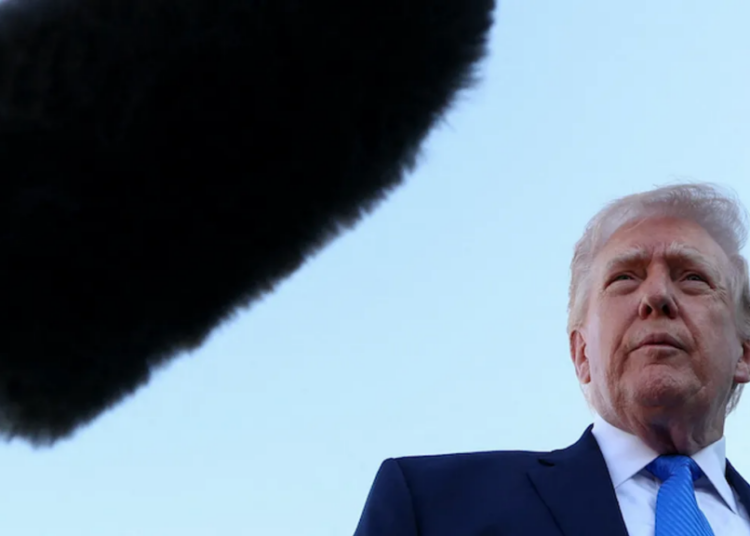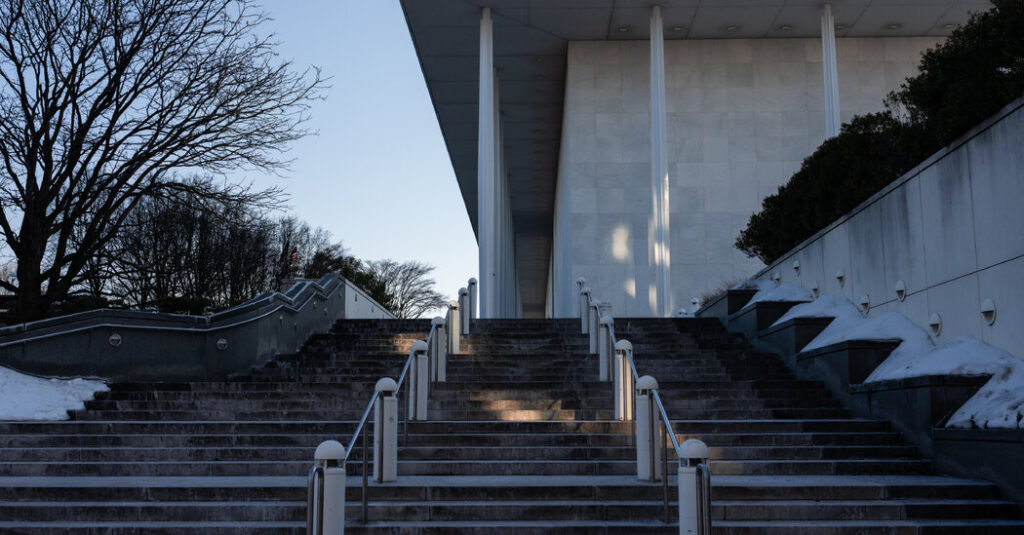
It took an act of Congress to create the John F. Kennedy Performing Arts Center. It may take two federal lawsuits to stop President Trump from remaking it with his name attached.
There is no guarantee that either lawsuit will succeed, nor three others challenging Mr. Trump’s plans to build a championship-level golf course in the nation’s capital, erect a 250-foot arch next to the Arlington National Cemetery and append a ballroom to the White House.
In his second term, President Trump has returned to his identity as a real estate developer, teeing up pet construction projects and monuments to himself among, and sometimes on top of, other historic sites in Washington’s crowded landscape.
Now, legal challenges are mounting to try to stop the bulldozers, forcing federal judges to reckon with novel questions about the president’s power to unilaterally control the federal government’s real estate portfolio. It will be for the judiciary to decide what authority Congress holds over federal land and institutions and whether the president can invite allies instead of taxpayers to finance his projects.
David A. Super, a professor at Georgetown’s law school, said the law is not clear in every instance, and Mr. Trump has been quick to exploit that, “filling in gaps, addressing things that Congress hasn’t spoken to.”
“But with many of these things, and above all, the Kennedy Center,” he added, “Congress has been quite specific and quite directive about what it is, and he’s simply ignoring that.”
Ultimately, he said, the question is the extent to which the president can act alone, given that the Constitution grants Congress the role of disposing of and regulating federal holdings.
On Monday, a coalition of eight prominent cultural and architectural preservation organizations filed a new lawsuit challenging Mr. Trump’s emerging vision for the Kennedy Center.
The groups behind the new case included the National Trust for Historic Preservation, the nonprofit chartered by Congress that is also leading a lawsuit against the 90,000-square-foot ballroom Mr. Trump has proposed to replace the demolished East Wing of the White House. Others included the American Institute of Architects, the D.C. Preservation League and the American Society of Landscape Architects.
In their complaint, the coalition’s lawyers wrote that none of Mr. Trump’s moves to take over and close the center to execute a disruptive multiyear rebuild were authorized by the law. They asked that a federal judge require the Trump administration to complete environmental reviews and “secure express congressional approval” before attempting to remake the site.
“The intent of the board of trustees and Mr. Trump is clear,” they wrote, referring to the center’s governing board. “To fundamentally alter this iconic property without complying with bedrock federal historic preservation and environmental laws, and without securing the necessary congressional authorization. And the harm is imminent.”
Another suit challenging the Kennedy Center was already pending. That one, brought by Representative Joyce Beatty, Democrat of Ohio, challenged the renaming of the building after Mr. Trump, and subsequent efforts by the president to mold its future after filling its board of trustees with loyalists.
Across the cases, Mr. Trump has argued that his proposed changes are mere “alterations” or modernization projects, which he has said the president has the right to undertake despite the language of the constitution. Existing spaces, he has argued, are insufficiently grand and in some cases, run down and embarrassing to a great nation like the United States.
Because he is funding the projects through his donor network, he has asserted that Congress has lost its oversight authority over them and lawmakers cannot impose restrictions that they might have if they were financed through congressional appropriation. He has also argued the projects will benefit the city without costing taxpayers money.
All of those assertions will be challenged by the series of lawsuits.
In February, two Washington residents joined the D.C. Preservation League in suing to block a championship-level golf course Mr. Trump has proposed building over a public one at East Potomac Park. The East Potomac Golf Links, which has occupied the space for more than 100 years, ranks among the cheapest public courses in the region.
A week later, a group of Vietnam War veterans also sued to stop a 250-foot triumphal arch Mr. Trump has planned for Memorial Circle, in the line of sight between the Lincoln Memorial and Arlington National Cemetery. The lawsuit cites a 2002 prohibition passed by Congress on new construction “on any reservation, park or public grounds of the federal government in the District of Columbia without express authority of Congress.”
When asked in October whom the arch would be built to honor, Mr. Trump succinctly told a reporter: “me.”
In the case over the ballroom, the National Trust has asked Judge Richard J. Leon of Federal District Court in Washington, a George W. Bush appointee, to declare the project beyond Mr. Trump’s authority to carry out without approval. Judge Leon has said he would likely reach a preliminary decision by the end of March.
The East Wing of the White House was demolished within days, and much of the resulting rubble was dumped — along with 30,000 cubic yards of dirt — in East Potomac Park. Groups suing over the Kennedy Center have pointed to the East Wing demolition to ask that judges step in to block Mr. Trump’s plans swiftly, before he can take steps that would be irreversible, including razing the building.
So far, judges have been reluctant to issue sweeping bans on presidential construction. Particularly at the White House, the government argued that holding up work on the open ground where the East Wing once stood could constitute a national security risk.
Judge Leon twice postponed ruling on the ballroom, asking lawyers on both sides to distill down their arguments. More recently, he has criticized the government for repeatedly changing its stance on what authority actually underpinned the project.
“Perhaps Mr. Roth is an alchemist,” he said of Yaakov Roth, a government lawyer, on his shifting positions during a hearing on Tuesday.
How the judges will rule is not yet clear, but as they consider the president’s power over federal land, they have appeared distressed by Mr. Trump’s actions.
Throughout most of the hearing last week, Judge Leon expressed disbelief about several of the government’s central claims, including that the project should be legally treated as a routine “alteration.”
“That takes some brazen interpretation of the laws of vocabulary,” he said.
Judge Leon, worried that there was “no track record of anything like this ever happening before.”
“This isn’t just any national park; this is a special place,” he said of the White House. “This is an iconic symbol of this nation.”
At a separate hearing on March 13, Judge Christopher R. Cooper appeared to grow more skeptical about the president’s yet unreleased plans for the Kennedy Center, which Congress established to serve as a living memorial to the former president.
“I’ve got to say, this is a pretty big deal,” Judge Cooper, an Obama appointee, told a Justice Department attorney. “A major renovation of the nation’s premier performing arts center would strike me as something you need advance notice on.”
The cases also introduce constitutional questions about Mr. Trump’s funding model. Already, Mr. Trump has raised more than $350 million from donors to finance the ballroom project. He has said the arch will be privately funded as well.
Congress occasionally authorizes arrangements that allow the use of private money for presidential projects in specific and limited circumstances, including the privately financed construction of presidential libraries, experts said.
But Mr. Super said there was no “general purpose authority” that broadly allows presidents to raise private funds for government use. And judges have increasingly pressed the government to explain what law gives Mr. Trump the authority to raise donations from individuals and corporations with business before the federal government.
In several of the suits, groups suing to halt construction have suggested that judges should require Mr. Trump to seek congressional approval before turning more dirt.
On Tuesday, Thaddeus Heuer, a lawyer representing the National Trust, told Judge Leon that the Trump administration has had every opportunity to consult lawmakers about his projects but had instead chosen to proceed on its own.
“They have forgotten the proverbial first law of holes,” he said. “When you find yourself in one, stop digging.”
Zach Montague is a Times reporter covering the federal courts, including the legal disputes over the Trump administration’s agenda.
The post Trump Is Digging Up Washington. Can Lawsuits Stop the Bulldozers? appeared first on New York Times.