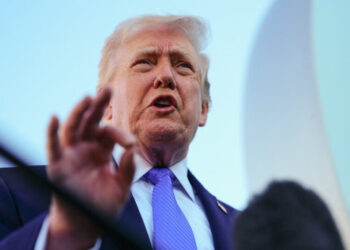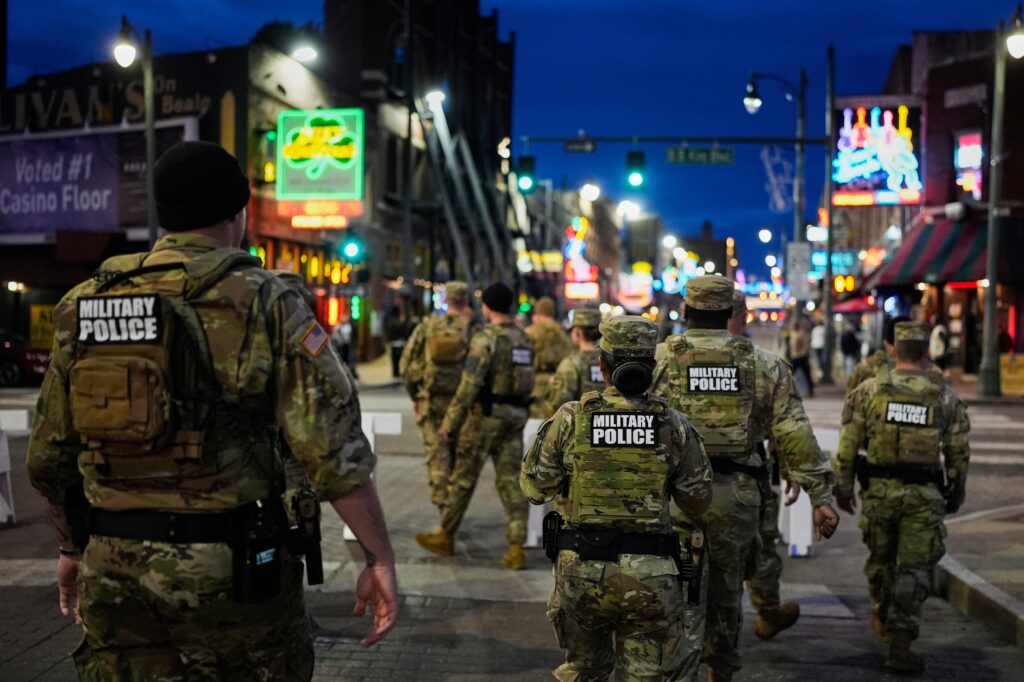
MEMPHIS — President Donald Trump declared victory over crime here Monday, months after hundreds of federal agents and Tennessee National Guard troops poured into this Southern city, using the crackdown to bolster a central midterm-year argument: Republicans are better at keeping Americans safe.
“They tell me this is like an entirely different place,” Trump said, after talking about rampant crime that has impacted the city for years, which he blamed on Democratic policies. “Memphis was known for … being the murder capital of the U.S.A. But here’s the good news: It’s been fixed.”
The White House claimed his task force has made over 7,000 arrests since the surge, seizing about 1,200 firearms and locking up 44 suspected killers. “The city is coming back. It’s stronger than any other city in the country,” Trump said, “because of what’s happened with crime.”
Memphis is one of several cities — all with Democratic leadership — where Trump has launched major deployments of National Guard troops and federal agents, pushing past local leaders he has derided as ineffective at stanching crime.
But as Trump seeks to turn the Memphis crime crackdown into a broader selling point about Republican strength on public safety, local officials, advocates and data suggest a more complicated picture. Violent crime rates were falling well before the surge, in line with national trends. And city residents question whether the strategy will produce lasting gains or primarily serve short-term political goals. Six months in, city leaders and crime reduction advocates say they are navigating a persistent tension: frustrated by crime and open to additional help, but skeptical of heavy-handed policing that fails to address systemic problems.
State Sen. London Lamar, a Democrat who lives in Memphis, said she is worried about what will happen when Trump’s attention — and his law enforcement officers — turn elsewhere.
“If you don’t invest in affordable housing, better public education, bringing more jobs to Memphis then you can see [crime] potentially being able to tick back up because you’re not actually addressing the problems,” Lamar said. “Don’t just send the National Guard to our city. Send the Small Business Administration. Send more health care officials. Send departments around increasing affordable housing. Send other things that are going to help improve the livelihood of everyday Memphians, instead of just scaring them back into the house.”
Leslie Taylor, who founded Memphis Crime Beat, a website that parses public safety data, welcomed any effort to reduce crime. But she said the influx of personnel has also underscored long-standing gaps: The city’s police force is understaffed, and its public safety apparatus is inadequate to deliver justice, with too little jail space and too few prosecutors and judges to move cases through the courts.
“I think that having the National Guard here has been a case study for what could happen if our police force were fully staffed,” Taylor said. “But if we’re not addressing things in the criminal justice system, then we’re just cycling people in and out of the jail.”
The arrests have strained the already overcrowded Shelby County Jail, anti-crime advocates say, which has seen 66 deaths since 2019 — including two within a week last fall.
Lamar said there are other consequences that the proponents of Trump’s surge have ignored. Some neighborhoods in Memphis — including historic Beale Street, a cultural magnet — have at times been so heavily militarized they resemble a war zone. One downtown restaurant reported a 70 percent revenue drop after customers were spooked by the National Guard presence at an adjacent hotel. Lamar said even she was stopped by a sheriff’s deputy for no apparent reason, driving a Mercedes Benz with her child strapped into the back seat.
Still, as Trump has rolled out the strategy to city after city, Memphis has been largely spared the controversies that have followed federal agents elsewhere. The city has not had widespread demonstrations like those in Minneapolis, where federal agents killed two protesters in January.
On Monday, at a National Guard hangar on the city’s outskirts, members of Trump’s Memphis task force spent more than an hour extolling the impact of federal agents and Tennessee National Guard troops, crediting the assembled officers with transforming the city’s trajectory.
The White House reinforced that message with a visual display: seized guns and other evidence spread across the stage, law enforcement SUVs and helicopters nearby, and two large banners reading, “Making America Safe Again.”
“I do believe, and have believed all my life, that this is a great city, and now it is on a trajectory of greatness,” Tennessee Gov. Bill Lee (R) told the crowd, after U.S. Attorney General Pam Bondi listed achievements including fraud arrests, gun seizures, Narcan saves of overdose victims and the return of 150 missing children.
Memphis, a blue city in a deeply red state, has long been a target of GOP legislators who would strip tax funding from the city, and Lee, who bolstered Trump’s surge by sending in the Tennessee National Guard. Trump has alluded to the political underpinnings of the influx. During a Cabinet meeting in August, Trump said he believed public safety would be a salient issue in the 2026 elections.
“I think crime is going to be the big thing,” Trump said then, in response to a question about deployments. “And we are the party — the Republicans are the party that wants to stop crime. The Democrats like crime. I don’t know why.”
Two weeks later, the Memphis Safe Task Force was deployed, turning the city into a test case for a half-century-old question about the best way to keep American safe: investing in more police and bigger jails or addressing the societal roots of crime?
Trump’s most vocal opponents in Memphis said the executive branch’s show of force is an effort to distract from problems far from this town on the eastern bank of the Mississippi River: an increasingly unpopular military action in Iran, an economy that gets shakier by the day and even the Jeffrey Epstein files.
Trump “has started a war that is unwinnable and costing billions of dollars,” said state Rep. Justin Pearson, a Democrat whose district includes Memphis. “His name is listed thousands of times in the Epstein files. Costs are rising, and it’s more difficult for people to survive every single day, and he is seeking to distract.”
Others point to a different disconnect — between the administration’s claims and the work already underway on the ground.
Durell Cowan has dedicated his life to reducing crime and violence in his hometown. He founded Heal 901 to bring a community investment model to Memphis, and hopes to mirror success stories in other parts of the country, including Los Angeles and Baltimore.
Two months into Trump’s second presidency, he learned that the Department of Justice had revoked a $1.5 million grant to his organization for violence intervention. Six months later, the president announced he was surging law enforcement officers to Memphis. Cowan has been fuming as the president of the United States takes credit for hard-fought crime drops that he and other Memphians have worked for.
“For the first time in the history of the city, we saw leadership invest into a full community violence intervention ecosystem,” he said. “We were already seeing a record number of declines … and now Donald Trump is coming to take credit for another thing that the African American members of this community have done to help themselves. It’s an insult for this president to steal credit for something he has no right to claim credit for.”
The post Trump hails Memphis crime drop as a win. Locals see a more complex reality. appeared first on Washington Post.