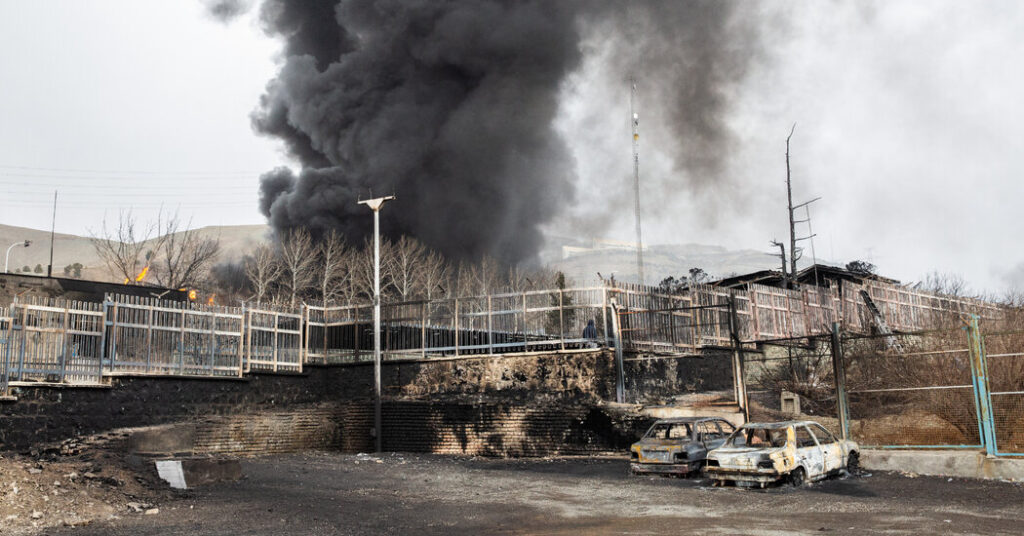
President Trump’s order to postpone strikes on Iran’s power plants gives the country a small reprieve, but U.S. and Israeli strikes have already battered critical infrastructure and stoked popular outrage over the war, even among Iranians who oppose their government.
Mr. Trump and Israel’s leader, Benjamin Netanyahu, have at times urged Iranians to rise up against their government, but the U.S.-Israeli attacks are angering Iranians already struggling with the conflict’s devastating cost.
The attacks are also drawing international criticism. Mirjana Spoljaric, president of the International Committee of the Red Cross, warned on Monday that “what we have seen in recent days in the Middle East risks reaching a point of no return.”
“War on essential infrastructure is war on civilians,” she said in a statement. “It must stop. Every effort to de-escalate is critical.”
Overnight Sunday into Monday, parts of the capital, Tehran, were plunged into darkness. It wasn’t clear what caused the blackout, but Israel had said earlier that it would target the city’s infrastructure, without offering specifics.
On Saturday, strikes on Andimeshk, in southwestern Iran, damaged the city’s only hospital, according to Iranian media. And strikes last Wednesday on the South Pars offshore gas field, a cornerstone of Iran’s domestic energy supply, sparked widespread fears of an energy crisis in the country.
Israeli strikes on Tehran’s fuel depots turned the skies orange and enveloped the capital in toxic fumes and acid rain. And on the very first day of the war, a U.S. strike on a girls’ elementary school killed some 175 people, most of them children.
Mr. Trump’s threats to attack power plants if Iran didn’t open the Strait of Hormuz rattled even vehement critics of the government who have vocally supported the U.S.-Israeli campaign.
Reza Pahlavi, son of the deposed Shah, urged the United States and Israel to distinguish between attacking the Iranian people and the country’s government, while the activist Masih Alinejad asked that attacks spare infrastructure that more than 90 million people depend on.
Omid Memarian, a senior Iran analyst at DAWN, a nonprofit in Washington, said the strikes reflected a failed strategy by Mr. Trump and Mr. Netanyahu.
The attacks, he said, “have achieved what the Islamic Republic had long tried and failed to do: convincing people that the military campaign is not against the government, but against the Iranian people, the Iranian state, and their very existence.”
In a social media post on Monday, Mr. Trump said he had postponed his ultimatum to allow five days of talks with Iran over ending hostilities. Iranian officials have publicly dismissed it as a ploy ahead of further U.S. attacks.
Iran is already retaliating against strikes, including attacking a Bahraini desalination plant after Iranian desalination facilities were struck. Iranian officials have warned those efforts would become more aggressive if their own infrastructure came under attack, potentially destabilizing the region even more.
Esfandyar Batmanghedilij, who heads the economic think tank Bourse & Bazaar Foundation, argued that if Washington had followed through with Mr. Trump’s threats, it could have drastically escalated the level of attacks.
He noted that Iran had nearly 500 power plants, compared to 50 in Israel. The largest Iranian plant only provides 4 percent of Iran’s total capacity, he wrote, while Israel’s largest plant provides a fifth of the country’s energy.
“If Trump hits a major power plant, Iran will respond by hitting utilities in the Gulf states and Israel — including power plants and desalination facilities — and will count on the fact that it has to hit fewer targets to have a bigger impact,” he said.
Sanam Mahoozi contributed reporting
The post Trump Delays Energy Strikes, but Iran’s Infrastructure is Already Battered appeared first on New York Times.