The adoption listing described Heinz, a Shih Tzu-poodle mix, as sweet, happy and energetic.
“But he also has a sad story,” said the bio on the website of Rolling River Rescue, a nonprofit in New Orleans.
The caramel-colored pup hadn’t run away, nor had he been given up by owners who no longer wanted him. He had “lost his family,” the listing said, as a result of “recent events in New Orleans,” a reference to immigration enforcement that has swept up people under President Trump’s mass deportation campaign.
Federal agents have conducted large-scale crackdowns in New Orleans, Chicago, Los Angeles and Minneapolis, and smaller roundups from Hawaii to Maine. Hundreds of thousands of immigrants have been arrested. Most have remained locked up and many have been deported.
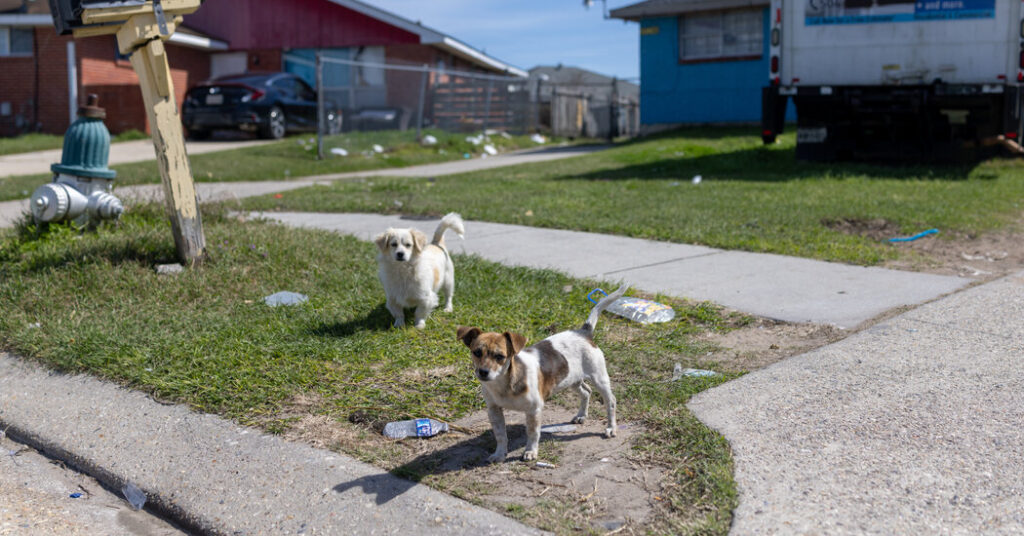
Left behind have been their dogs, cats and bunnies, even chickens, according to pet rescue groups and animal control agencies.
“What many Americans don’t realize is that there are companion animals being left by families that disappeared overnight,” said Maria Thomas, president of Rolling River, which has been scrambling to find foster and adoptive families for dogs and cats in New Orleans.
“We were already working at such a deficit because there are so many pets in need all the time,” she said. “Now we have the additional challenge of animals who need re-homing when their owners are deported or they self deport.”
New Orleans is a place all too familiar with displacement. In 2005, Hurricane Katrina forced many people from their homes and, in some cases, out of the city altogether. Abandoned animals roaming the streets became part of the post-Katrina tableau. The disaster also led people to forge new ways to help each other.
More recently, as the federal immigration crackdown upended life, that same spirit spurred mutual aid groups into overdrive. With many immigrants afraid to leave their homes, volunteers have delivered food and other provisions for families, and often for pets, including those taken in by neighbors or wandering the streets after their owners vanished.
Exactly how many displaced pets there are is impossible to quantify. The problem is not tracked by the patchwork of government agencies responsible for animals or by the local and national nonprofits that fill gaps in care.
What agencies and organizations do say is that there have been unmistakable surges in stray or abandoned pets in the aftermath of immigration crackdowns.
In Minnesota, St. Paul Animal Services, a government agency, recorded a 38 percent increase in stray, seized and relinquished cats and dogs in January 2026 compared with January 2025, coinciding with Operation Metro Surge in the Twin Cities region.
A rescue group in the area, The Bond Between Us, said that it received nearly twice as many surrenders early this year than it had during the same period last year.
In Los Angeles, where thousands of people were arrested in sweeps last year, the County Department of Animal Care and Control added a pet plan to its website for people “facing immigration-related challenges.”
But Marcia Mayeda, the department’s director, said that the burden nationwide has fallen mainly on rescue groups because immigrants fear interacting with animal control.
“We are the government, our officers look like law enforcement and we euthanize,” she said. “What we get is the tip of the iceberg.”
In Florida, where Gov. Ron DeSantis has championed deportation, Mercy Full Project in Tampa is caring for three times as many pets as it was last year.
“It’s big dogs, little dogs, well-cared-for French bulldogs,” said Heydi Acuna, a co-founder of the nonprofit. “We are facing a major crisis.”
During an interview with The New York Times, she received a text from a woman who had just rescued a hound puppy named Damian, who needed a home. “Unfortunately, his owners were deported,” she wrote.
As much as Americans seem to love pets, shelters have long struggled to accommodate all the animals in need, and the immigration raids have added to the strain. With limited space, shelters routinely euthanize animals if they haven’t been adopted.
At Animal Rescue of New Orleans, calls have been pouring in.
“People reach out begging us to take animals,” said Ginnie Baumann Robilotta, the nonprofit’s vice president.
“The worst part is, we are so full — with a waiting list,” she said. “All we can do is offer free food and supplies.”
Becky Warpinski, a retired veterinary technician, said New Orleans has been tackling the issue with a zeal borne of battling big disasters. “We are approaching this crisis with the emergency protocols of a hurricane,” she said. “If we get a mass deportation, we are going in there and saving these pets.”
New Orleans East is among the neighborhoods feeling the fallout, according to animal welfare groups. Isolated and swampy, the area has long been a dumping ground for unwanted dogs. Now, it’s worse, the groups say.
In late February, Cristiane Rosales-Fajardo, who runs the mutual aid group NOLA Villageplaced donated pet food outside vacant houses where dogs lingered, perhaps waiting for owners who were unlikely to return.
She also distributed it to households fostering pets that had been left behind by former neighbors. One bag went to a family that had taken in a 2-year-old Labrador and a Rottweiler puppy.
Even after leaving the United States, some families hold out hope of being reunited with their pets. It can be complicated and costly.
Ms. Rosales-Fajardo has fostered Cheddar, an athletic Bluetick Coonhound, for a couple who self-deported to Honduras and hoped that their dog would follow.
Medical exams and travel documents for Cheddar are ready, but the transport cost, $4,500, is prohibitive.
Last month, a Guatemalan man surrendered his two cats. He wept as he said goodbye, knowing he would probably be detained when he reported to court days later.
“He adored those cats, and they loved him,” said Ms. Robilotta of Animal Rescue New Orleans, who met the man.
For weeks, the cats cowered in a corner, she said. On a recent afternoon, Pantera, a velvety black cat, watched from a felt cave as other cats played. When two strangers approached, she retreated deeper into her small sanctuary.
Heinz, the caramel-colored pup with a white splotch on his tummy, was spotted nearhomes where immigration enforcement had occurred. After his picture went up on pet databases and no one claimed him, Roving River Rescue tapped its roster of fosters.
Shannon Dugan, a teacher, agreed to take him on Feb. 24.
That evening, he arrived house-trained and neutered, sporting a glossycoat.
“He obviously came from a family that loved him,” Ms. Dugan said.
The next day, Ms. Dugan posted a short biography of Heinz on the rescue’s website. Within a week, he had a new home.
Miriam Jordan reports from a grass roots perspective on immigrants and their impact on the demographics, society and economy of the United States.
The post The Pets Left Behind When Their Owners Are Deported appeared first on New York Times.