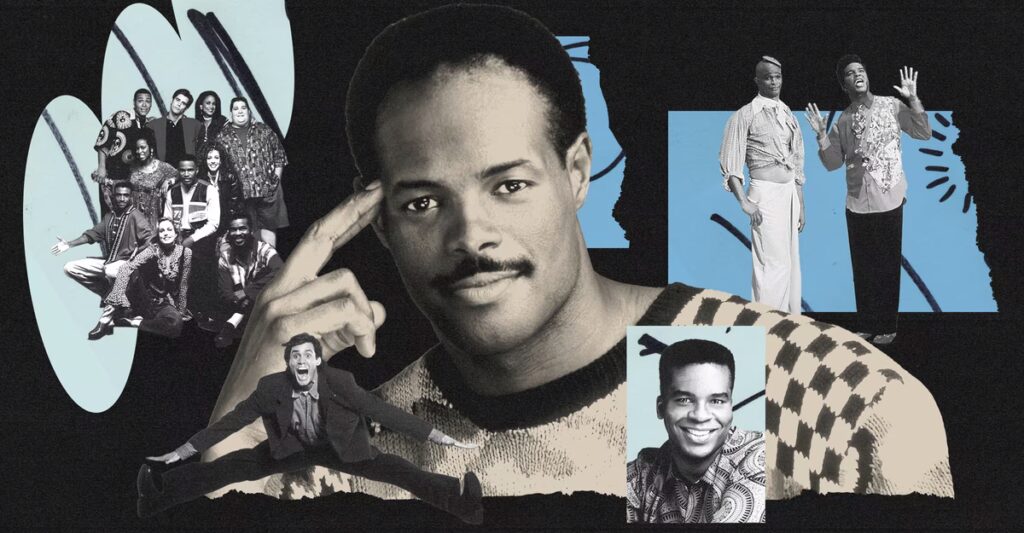
On Sunday, April 15, 1990, Americans got their first look at a daring new experiment in television—a sketch-comedy show intended to pose a direct challenge to NBC’s long-running Saturday Night Live. In Living Color was the brainchild of Keenen Ivory Wayans. He was the head writer and star, supported by four of his brothers and the rest of a cast—and dance troupe—made up almost entirely of people of color. Americans had never seen anything like it before. And they loved it. I sure did.
I was 10 years old, sitting wide-eyed beside my brother in our family’s South Jersey living room. It felt like someone had kicked open the door to a party I hadn’t even known I was waiting to be invited to. I’d seen Black faces on TV before, but rarely had I seen so many, all at once, being this funny, this free, this in control. In Living Color didn’t just make me laugh, it reflected the rhythm of the barbershops, family reunions, and cookouts I knew so well.
That wasn’t an accident. It was the product of a deliberate strategy set in motion when Barry Diller launched the Fox network in 1986 with a mission to disrupt the television status quo. Back then, the Big Three—ABC, CBS, and NBC—offered a steady stream of safe, interchangeable programming. As the scrappy new contender, Fox had to break the mold. Diller, along with the programming chief, Garth Ancier, set out to build a network that was alternative by design and saw being different as a virtue, not a risk.
The breakthrough, Diller told me, came with a script for a show pointedly titled Not the Cosbys—a reaction to the wholesome, top-rated sitcom The Cosby Show. That script became Married … With Children, that gleefully subversive sitcom that set the tone for everything that followed. “It was as alternative as you could get in terms of what the American networks were offering to viewers,” Diller explained. “Once we knew we were an alternative and that we had to be edgy, it dictated almost every decision we made.”
That ethos produced groundbreaking successes—The Simpsons, Cops, and a slate of other shows that challenged everything about what network television could be. But nowhere did it shine brighter than in the emergence of In Living Color and, soon after, Martin, two shows that would help transform Fox into an unlikely powerhouse of Black cultural creativity. It wasn’t a plan; it was a by-product of being open to voices, visions, and brilliance that the legacy networks too often ignored. “It made Fox the No. 1 network,” Diller noted.
What most of America didn’t realize at the time was that they were witnessing the dawn of a new era in entertainment, one where Black artists were flourishing because of, rather than in spite of, their Blackness.
In the months leading up to In Living Color’s debut, Keenen Ivory Wayans and the cast had been grinding, fine-tuning sketches without knowing which would make the cut. Fox, meanwhile, was on edge—eager for a hit but wary of just how much ground this groundbreaking show might actually break. Their fears proved unfounded. The premiere drew a staggering 23 million viewers—an astronomical number for a fledgling network that wasn’t even airing programming seven days a week.
Fox slotted In Living Color right after its two biggest comedies, The Simpsons and Married … With Children, but by then, the show was already a hot topic. The network had dragged its feet so long on airing the pilot that bootleg copies started circulating within the industry—and beyond. In New York City, street vendors were selling tapes of the unaired episode months before its official debut. One of those copies found its way to the Details magazine writer Martha Frankel, who wrote a rave review questioning why Fox was holding it back. The next day, Fox executives scrambled and finally green-lighted eight episodes.
A closer look at the sketches in the pilot demonstrates just how far Keenen was willing to go to upend norms and rattle people—and just how subversive his vision was. Keenen was eager to take down whoever he felt would get a laugh. “What was cool about those guys is that they’d mock the heroes of their community, which is a real threading of the needle,” Les Firestein, a co–head writer of the show, said of Keenen and his younger brother Damon. “Having the ability to make fun of yourselves as a culture is a show of great strength. One of the things that was seminal about In Living Color was that Black people enjoyed laughing at Black people. That was the seismic change. You had an entire culture getting to the point where they said we’re strong enough that we can laugh at the more ridiculous parts of our own culture.” That alone was new ground for Black comedy on television, which hadn’t been ready 13 years earlier for the strange, rebellious vision of Richard Pryor on The Richard Pryor Show.
One of the first things the audience sees in the In Living Color pilot is Keenen stepping onto the stage, introducing his cast—but, in true form, he doesn’t play it straight. “I’ll tell you what I’m most proud of,” he says, locking eyes with the camera. “Unlike other shows, I’ve got nothing but qualified Black people backstage making decisions.”
[Read: The Godfather of American Comedy]
With perfect timing, he swings open the door to the writers’ room—only for a swarm of panicked white writers to scurry out. Keenen, deadpan, assures the audience they’re just the cleaning staff. He then gestures toward a bewildered Black woman holding a mop. “And this,” he says with a grin, “is our head writer.” The bit lands perfectly—sharp, subversive, and hilarious. Then, without missing a beat, Keenen moves on and introduces the cast: “We went nationwide to find the most talented people in the country,” Keenen announces with a straight face—before rattling off a lineup that sounds more like a family roll call than a casting list. “Damon Wayans, Kim Wayans, Crystal Wayans, T. J. Wayans, Toney Wayans, Tommy Wayans …” The message is clear—and hilariously ironic. Many cast members would later (half) joke that the surest way to get on the show and thrive was to have “Wayans” on your birth certificate.
Keenan brags about how integrated the show is—and then opens a door that is labeled White Cast Members Only, behind which Jim Carrey and Kelly Coffield are shining shoes and ironing clothes while grinning and singing “Camp Town Ladies.”
“Oh, those people,” Keenen says. “Always singing, always happy.”
From there, the pilot goes on to directly lampoon a Black hero: The first sketch, “Love Connection,” features Carrey as the ever-smarmy Chuck Woolery, while Keenen steps in as Mike Tyson, paired with Kim Coles as his new wife, Robin Givens. Keenen leans into the broad caricature—giving Tyson the signature lisp and playing him as a clueless, sexist ogre. From the jump, the show made its stance clear: No one was off-limits.
That particular Tyson impression became more common, but in 1990, Mike was still young, ferocious, and not yet a go-to punch line. (Remember, this was some 20 years before Tyson made fun of himself in The Hangover.) He had just been knocked out by Buster Douglas in Japan two months before the episode aired—though the sketch had been written before that stunning defeat. It didn’t take long for Keenen to learn that Tyson wasn’t amused. One night at a club, Mike spotted him and stormed over.
“That was the scariest moment of my life,” Keenen recalled. “All I feel is this paw land on my shoulder. I turn around and it’s the heavyweight champion of the world. He stepped to me. He goes, ‘What? I kill your mother or something?’”
Tyson clearly didn’t like the impression. Months later, Keenan said he ran into Tyson again, and he was more relaxed. “He was actually really cool,” Keenen said. “He was like, ‘Yo, I was just going through some things. You do your thing.’”
The show never shied away from making fun of Black culture, as seen in the recurring sketch “Great Moments in Black History.” One of the most memorable bits claimed that a Black man had “invented” self-serve gas stations. The punch line? Cast member Tony Riley playing an apathetic gas-station attendant who yells at a customer, “Get it your damn self!”
Audiences loved it. The studio crowd for In Living Color’s pilot exceeded even Keenen’s wildest expectations. “Black audiences don’t just laugh at stuff, we stomp our feet, we high-five,” said Paul Miller, the show’s primary director. “People were literally running up and down the aisles during the taping, high-fiving each other. One of the executives turned to me and said, ‘Did you pay these guys to do that?’” Kevin Bright, a supervising producer in the first season who later co-created Friends, had never seen anything like it. “At Friends, I’d never seen a first taping of anything where the audience was that crazy,” Bright told me. “They were on fire.”
For Larry Wilmore, a writer on the show’s first three seasons who went on to co-create The Bernie Mac Show and produce The Office and Black-ish, working on In Living Color often felt “surreal.”
“In those days, if you worked on In Living Color, people went crazy,” Wilmore told me. “They would say, ‘So what do you do?’ I go, ‘Oh, I write for television.’ ‘Oh, really?’ They didn’t seem that impressed. ‘Well, what shows do you write for?’ ‘I write for In Living Color.’ And they go, ‘In Living Color! Oh my God!’ The energy they had for that show, it was so interesting. And I think because we were pushing boundaries at that time that hadn’t really been pushed before, especially in race and culture. And people were so excited to see that on their television.”
Those who had devoted their lives to making the show had other reasons to be excited. Keenan recalls having moved to L.A. with Hollywood dreams—only to discover that the industry expected young Black men to only play thugs or pimps. Even worse was when they wouldn’t get those parts because they were told they sounded too educated.
“I’m from a family of 10 in the projects, and I find out I’m not ‘Black enough,’” Keenen said.
In the summer of 1978, Keenen stood in line for his shot at a five-minute set at the Improv in Los Angeles. He met the only other Black guy there, Robert Townsend, and the two became inseparable. (Townsend would go on to become an accomplished comedian, actor, and the director of legendary comedy specials such as Eddie Murphy Raw.) Keenen bombed his first set, but it didn’t matter. “I bombed terribly. It was an out-of-body experience,” he said. “Still, I was looking at myself like, You’re doing it.”
Keenen studied other comics closely, analyzing how they wrote jokes. “Even as a young comedian, Keenen was kind of a master craftsman. He knew instinctively how to set up a punch, deliver the joke, rewrite the structure, make it funnier.” Those were skills that would serve him well with In Living Color 12 years later.
But when Keenen came home from Tuskegee in his second year to tell his parents he was dropping out to pursue comedy instead of engineering, they didn’t understand. Marlon, still in elementary school, was there to witness the moment. “My mother cursed Keenen out,” Marlon told me. “My mother said, ‘Boy, a stand-up comedian? I known you your whole life and you ain’t never said nothing funny. This shit is the funniest thing you ever said! You’re going to be a stand-up comedian? Let me tell you something, boy. You better go out there and get your engineer’s degree and a job with some benefits!” Keenen knew there was very little chance they would understand. “I might as well have said I was going to smoke crack,” he said. “But I knew deep in myself what I wanted to be. I knew I was going to do it.”
His biggest break came when he landed a spot on The Tonight Show in 1983. By then, he was five years into his stand-up career—seasoned, confident. He told a joke about his older brother, Dwayne, who, as Keenen put it, finds racism in everything. “He’s like, ‘The white man don’t want to see you make it! They don’t want to see you get ahead. They got a conspiracy out there!’ Does he think there’s some secret organization sitting around going, ‘Now, there are too many Black people making it in this country. They’re making too much progress. Now, let’s see … We got Malcolm X, we got Martin Luther King … Dwayne! He’s up for promotion at McDonald’s! Stop him!’” The crowd erupted. Then came the ultimate trophy—Carson called him over to the couch. They were headed to commercial, so there was no time for an interview, but as the show cut away, Carson’s voice could be heard: “That’s funny stuff.”
Keenen grew close with Eddie Murphy and even closer with Townsend. Along with Arsenio Hall and Paul Mooney, they formed what Mooney later called the Black Pack, a nod to Sinatra’s Rat Pack. When the time came, assembling the cast for In Living Color proved to be a challenge—even with Keenan’s siblings in the mix. Keenen saw SNL as a writer-driven show, but he wanted ILC to be performer-driven, where the writing would serve the cast. His plan was to build the show around his brother Damon and add the best talent he could find. “Damon was at a point comedically where he was the most brilliant guy on the planet,” Keenen said. “The way he thought, the way his point of view was completely different than mine or anybody else’s. He was really on the edge.”
“The Wayanses are kind of a comedy troupe in and of themselves,” Rob Edwards, a Black writer on the show who created “Great Moments in Black History,” told me. “They’d go out to dinner—they eat as a family all the time—and try to crack each other up.” The next day, they’d bring those stories to the writers’ room. “The writers would take as much of this down as humanly possible,” Edwards said. “They have incredible characters, timing, and a great sense of what’s funny.”
Keenen’s authority over the show was undisputed. He had strong ideas, and whether people saw him as confident and visionary or arrogant and dismissive, he commanded respect. He wasn’t a screamer or a tantrum thrower, but his presence was intimidating. He took input, but not dissent. “It was a dictatorship,” Keenen admitted.
And that dictatorship worked. Right before the premiere of Season 2, In Living Color won an Emmy for Outstanding Variety, Music, or Comedy Series—beating The Arsenio Hall Show, Saturday Night Live, and Late Night With David Letterman. Keenen especially enjoyed besting SNL, which had unceremoniously dumped Damon. But Hollywood had no interest in rewarding the show beyond that—In Living Color never won another Emmy.
“Keenen is one of the true geniuses of sketch comedy,” says David Alan Grier. “Meaning, you do a scene, it’s all flat, and Keenen says, ‘If you pick up your pencil, look to the right and say the same joke, it’s gonna work.’ You trust him, you do it, and it kills. Most people don’t know comedy. They can’t fix it. You stumble on a great joke, you don’t know why it’s great. But Keenen had that ability. I’ve been acting over 30 years, there’s maybe two or three people like that.”
By the time Jamie Foxx joined in Season 3, the show had hit its stride. But breaking in wasn’t easy. “When I saw Damon walk in and Jim walk in, it was like fucking Jurassic Park,” Foxx recalled. “I was the eighth-funniest person in the room at any given time. I had to be quiet sometimes to learn my way.”
Black comedians had been honing their craft since the days of vaudeville, through the early days of television, and into the transformative decades of the 1960s and ’70s, despite segregation and institutional racism. Bert Williams, Jackie “Moms” Mabley, Redd Foxx, Dick Gregory, Bill Cosby, Richard Pryor, Eddie Murphy—these were artists who used humor to subvert the status quo and carve out space where there had previously been none.
By the 1990s, that legacy had taken root. And as Keenen Ivory Wayans assembled the cast of In Living Color, he sought talent outside the industry’s usual pipelines. “Minority talent is not in the system, and you have to go outside,” he told the press at the time. “We went beyond the Comedy Stores and Improvs, which are not showcase places for minorities.” He pulled in unknowns and rising stars—his brothers Damon, Shawn, and Marlon, alongside T’Keyah Crystal Keymáh, Kim Coles, and Tommy Davidson. Jennifer Lopez danced as part of the “Fly Girls,” with Rosie Perez as choreographer. There was one white guy: a rubber-faced impressionist from Canada named Jim Carrey.
The show’s success kicked off what would become a cultural boom. I didn’t have the language then to describe what was happening, but I felt it—this rush of pride, this sense that we were finally being seen not just as characters on a screen, but as full, complex people. The ’90s were the first time I remember being able to flip through TV channels and see Blackness represented in a way that felt real and expansive: in Martin Lawrence’s outrageous antics, the aspirational brilliance of A Different World, Living Single’s confident cool, and The Fresh Prince of Bel-Air’s blend of humor and heart.
[Read: I Watched Stand-Up in Saudi Arabia]
Of course, tensions simmered behind the scenes. The Wayans family’s bold vision for In Living Color eventually collided with the instincts of Fox network executives, who found the show too raw, too provocative—especially in contrast to the pastel wholesomeness of NBC’s The Cosby Show. But the irreverence was the point. It was what made the show matter. And it was what drew comics including Chris Rock and Jamie Foxx into its orbit. Rock famously left—or was pushed out of—SNL after growing frustrated with the limited roles he was given. “SNL is a pretty white show,” he later said. “And In Living Color was just hip. The shit was hot.”
It was hot because Black creative power was being unleashed across every creative industry—television, yes, but also film, fashion, and music.. “I think a lot of Black culture was finding its voice during that time,” Larry Wilmore told me. “If you talk about Black shows on television [before that], many of them were created and run by white people.” That shift—from being the subject of stories to being the storyteller—is what made the ’90s revolutionary.
I am a product of that revolution. I came of age watching Black characters who reminded me of people I knew, who were messy and hilarious and ambitious and flawed. They shaped how I saw the world and how I saw myself moving through it. I’m a journalist now, but I grew up loving comedy because it was one of the first places I saw truth telling as an art form. Jokes that punched up, that slipped past defenses, that revealed something deeper while still making you laugh.
The boom of Black comedy unfolded against a backdrop of real political change: the end of the Cold War, an economic boom, and shifting demographics that made America more diverse—and more reflective of voices that had long been kept on the margins. The decade also saw a resurgence of Black political consciousness, inspired by the civil-rights generation and fueled by modern injustices—the beating of Rodney King, rising incarceration rates. Black TV responded in kind. Shows tackled racism, sexism, and classism. Even sitcoms, cloaked in laugh tracks, were often sly Trojan horses for deeper truths.
The audience was changing too. More Black people were attending college and joining the middle class, which created demand for more nuanced portrayals. Before the ’90s, TV ratings among Black and white audiences were nearly identical. But by the decade’s end, Black viewers had more options—and made different choices. Seinfeld, while beloved by critics, never broke into the top 10 for Black households. This was more than a shift in taste. It was a cultural realignment. And through it all, the lineage of Black comedy stayed unbroken.
Jamie Foxx named himself in tribute to Redd Foxx, the comic who went from performing in nightclubs where he was the only Black person onstage to his role on the breakout hit Sanford & Son as Fred Sanford. Arsenio Hall gave Chris Rock his big break, which led him to SNL. Arsenio also mentored Will Smith, paving the way for The Fresh Prince—and shared a screen with Eddie Murphy in Coming to America. That movie featured John Amos, who’d starred in Good Times, and a then-unknown Samuel L. Jackson.
By 1992, even as the golden age of Black sitcoms was peaking, a struggling playwright in Atlanta named Tyler Perry put on his first play with $12,000 of his life savings. Three decades later, he would be a billionaire, having founded the largest Black-owned studio in the country.
When you compare American comedy in the 1920s of Redd Foxx’s childhood with American comedy in the 2020s, one thing is clear: Black comedians have had one hell of a century. Many of these comics were more than entertainers. They were cultural translators and civil-rights figures in their own right. They didn’t change the world by marching on Washington or facing down fire hoses, but because they climbed onstage night after night, often in rooms where few looked like them, and dared to be brilliant.
Without In Living Color, and Keenan Ivory Wayans’s vision for it, we may never have witnessed the rise of Damon Wayans, Jim Carrey, Tommy Davidson, Jamie Foxx, Kim Wayans, Shawn Wayans, Marlon Wayans, David Alan Grier—even Jennifer Lopez. Without them, there would not have been any “golden age” of Black comedy. The path that led to a Secretary of State Colin Powell or a President Barack Obama might have looked very different. And I don’t know that I’d be sitting here today, writing this essay.
This essay was adapted from Bennett’s new book Black Out Loud: The Revolutionary History of Black Comedy from Vaudeville to ’90s Sitcoms.
*Illustration by Mark Harris. Sources: 20th Century Fox / Everett Collection; Timothy White / Alamy.
The post The In Living Color Effect appeared first on The Atlantic.