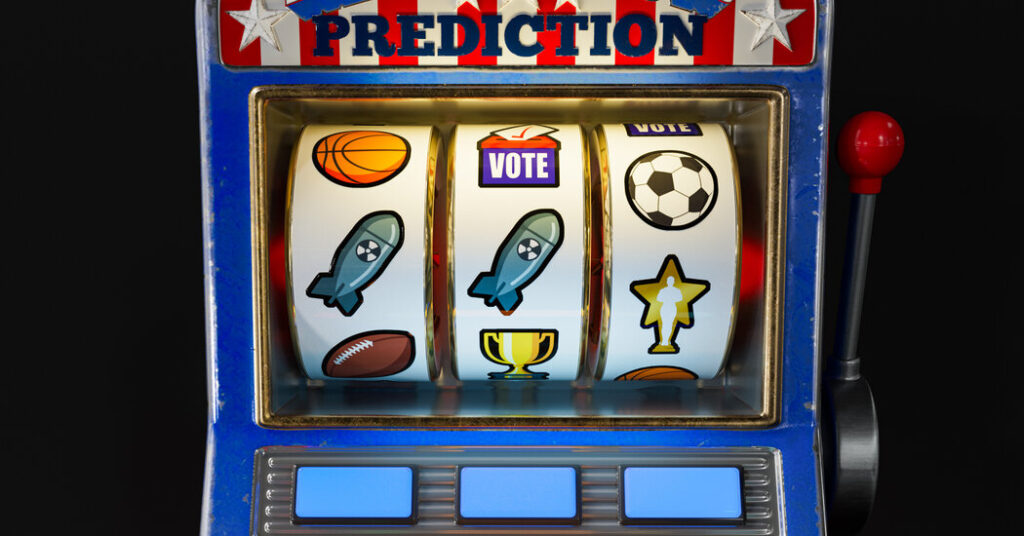
Last month, as American forces gathered in the Middle East in obvious preparation for an attack on Iran, you could’ve made a small fortune gambling on when exactly the bombing would begin.
One user on the prediction site Polymarket — where you can wager on an increasingly large share of human events, from the trivial to the tragic — made $553,000 on bets placed right before Iran’s supreme leader, Ayatollah Ali Khamenei, was killed by U.S.-Israeli strikes. Another user was quickly flagged by observers on X as having made $2.14 million by placing bets on different aspects of the military operation.
In another context, these bets would trigger an insider-trading investigation, and indeed someone in the Iranian military might well have treated the bets as a form of actionable intelligence. But what is the average American meant to do with this kind of news, observing that big spike in betting activity and guessing that it might well mean someone with inside information is sending a clear signal? One intuitive answer would be: Bet on it yourself. What’s the point of knowing anything, after all, if you don’t put some skin in the game?
This kind of proposition used to seem, to many, obviously grotesque. But increasingly it seems stitched unmistakably into the cardsharp logic of American life. In theory, prediction markets are pretty straightforward: They’re online marketplaces where people can buy and sell stakes in futures of various kinds much like they might trade stocks.
Last week, for instance, for 92 cents you could buy a future that will pay off a dollar if the Ryan Gosling movie “Project Hail Mary,” which opened Friday, has a Rotten Tomatoes score of 93 percent positive or higher on Monday morning, several hours after this article is published. (For 8 cents, you could buy one that will pay off a dollar if that doesn’t happen.) Each market sustains trading on those futures, and the result is effectively a collective forecast of a future outcome: When a future is trading at 50 cents, the market is telling you it is an even bet; when it goes to zero, it has essentially concluded it is impossible.
For a long time, these online prediction markets were, like online sports betting, so tightly regulated as to be inaccessible to the average person in most of the United States, though enterprising would-be gamblers could gain access to sites with V.P.N.s. But after a series of ambiguous legal victories and the arrival of a friendlier presidential administration, they have leaped into the legal gray area and exploded not just in popularity but in visibility, as well.
Their boosters tell us, grandly, that the sum of all those bets gives us our best forecast of the future — even a workable approximation of the truth. They also offer an unnerving implicit philosophy: that we should relate to the future not as citizens or moralists, problem solvers or advocates, but as gamblers, each of us surveying the horizon of possibility somewhat indifferent to human outcomes and looking instead for a betting edge.
The markets don’t concern only matters of grim geopolitical consequence, such as when Iran might lose control over Kharg Island, when China might invade Taiwan or how many different countries Israel will attack this month. No, they offer lighthearted action, too, such as whether the vacuous YouTuber MrBeast will be the Democratic presidential nominee in 2028 (he won’t be legally eligible to run until 2036), or about what words would be said in an episode of “The Late Show” (even after the interview in question had already been taped), about just how high the temperature will rise one day in Miami or how much snow might accumulate the next day in Manhattan, on when the United States might confirm the existence of aliens, whether the price of Bitcoin will be up or down in the next five minutes or whether Jesus Christ will return this calendar year.
For most of the last year, the price of a $1 future on that last question cost less than 4 cents, which means that the market gave less than a 4 percent chance of the Lord’s return, and in 2025 nearly $3.3 million was bet on the possibility — a small enough market that most of the wagers were probably jokes and larks. Then, suddenly, in February, the odds jumped.
This wasn’t because there had been any big theological news, but because a secondary market had opened up, in which people were gambling on which direction the odds in the eschatology market would move. It was easy enough to spend a little money betting up the odds in the first futures market and collecting a much bigger payoff in the second. And now there is almost $50 million riding on the chances of a Second Coming.
On March 10, the journalist Emanuel Fabian, live-blogging the Iran war for The Times of Israel, reported that a ballistic missile had struck near the city of Beit Shemesh, just outside Jerusalem. He soon began to receive a series of emails and messages — polite at first, then threatening, then life-threatening — imploring him to rewrite his story to say that the missile had been intercepted overhead by an Israeli rocket, with debris falling to the ground below.
The issue, he wrote in a terrifying account for the newspaper, was a Polymarket future: “Iran strikes Israel on…?” More than $14 million had been bet on that happening March 10, and an intercepted missile didn’t count. “You have no idea how much you’ve put yourself at risk,” read one message. “If you do not correct this by 01:00 Israel time today, March 15, you are bringing upon yourself damage you have never imagined you would suffer,” it said. “You have exactly half an hour to correct your attempt at influence,” read another. “You made a fatal mistake and you’d better respond to us,” and then: “I expect a response from you within 9 minutes.” Then: “One minute remains…” He reached out to the police and Polymarket, which condemned the attempt at intimidation and posted on X that said it “banned the accounts for all involved & will pass their info to the relevant authorities.”
As Fabian pointed out in a kind of addendum, an Israeli reservist and a civilian were indicted last month, accused of using classified information to place bets about the country’s 12-day war against Iran last June.
“The long-term vision is to financialize everything and create a tradable asset out of any difference in opinion,” Tarek Mansour, the chief executive of another major prediction market, Kalshi, declared in November. But who wants this future, besides perhaps inveterate gamblers and those people who profit off them?
When people use the phrase “casino economy,” it isn’t as a term of praise but rather a lamentation — that in a healthier world, held together by thicker bonds, less inequality and more evenly distributed opportunity, fewer of us would feel that high-risk gambles were the best chance of getting ahead.
But moneyballing everything has produced an abundance of data on almost all subjects for idle hands to play with, and when there are profits to be made, financialization is typically treated as a social inevitability. Some Americans flush with stimulus checks spent the pandemic day trading meme stocks and crypto, NFTs and SPACs, and the A.I. economy that followed is so highly leveraged on large language models that even some of the biggest boosters at the frontier labs have acknowledged that the boom looks like a bubble (though, they might say, a useful one).
In this new era of gambling, the political context matters, too. The Oval Office today is occupied for a second time by a failed casino magnate who famously declared bankruptcy on multiple ventures then managed a high-stakes, highly leveraged return. He’s surrounded by family members and appointed officials comfortable with self-dealing side hustles. And it’s not just the president — even leaders of the opposition party have been reluctant to ban increasingly common stock trading by members of Congress.
The rest of us now watch odds onscreen as Oscar and Grammy winners are announced, considering placing last-second bets when we might once have been crossing our fingers about the $5 office pool — or perhaps naïvely cheering a personal favorite.
On cable news, odds lifted from prediction markets are presented as the informational equivalent of polling results, often by newscasters employed by media organizations now working in corporate partnership with those same betting sites. And a net effect of all this coverage, Kyla Scanlon has argued, may be to undermine public deliberation by manufacturing a kind of premature consent — reporting about the prospect of, say, a military strike through prediction market odds that are treated as objective and immutable, rather than engaging in debate about whether the strike should happen.
Sports, too, have been remade by on-demand gambling in ways once considered taboo. Just a few years ago, before sports betting was legalized in 2018, broadcasters were prohibited from mentioning betting lines; now, some podcasters talk about little else. Leagues back then wanted to avoid the taint of betting at almost any cost; now they’re in partnerships with gambling apps.
Before easy-access casinos were installed on everyone’s phones, Americans could still engage with sports as an escapist pastime, mixing aspects of low-stakes tribal conflict and periodic collective exultation. Now, even on Super Bowl Sunday, we engage with those same events less as a strange secular religion and more as if we are sitting in front of a slot machine, experiencing an entirely different game than even the loved ones sitting right beside us in identical jerseys, but staring down at their phones to monitor their various parlays.
Estimates suggest that in 2022, Americans gambled the equivalent of nearly 4 percent of the gross domestic product and lost more than 10 percent of that money on those bets. Half of all men between the ages of 18 and 49 have an active online sports-betting account, and though surveys are rarely so reliable about these things, one-quarter of sports bettors report being unable to pay bills because of money lost gambling. A 2024 report from researchers at the University of Massachusetts in Amherst suggested that 90 percent of the state’s gambling revenue came from “at-risk and problem gamblers.”
This is a power law familiar from other pastimes that Americans used to categorize as “vice,” and the costs of legalization and destigmatization have proven distressingly familiar, too. In just a few years, the rise of betting apps has produced big spikes in personal bankruptcy and big drops in personal credit ratings, and, on days when there are big upsets, a measurable and horrifying uptick in domestic violence.
The legalization of online gambling increased the population-level risk of personal bankruptcy by roughly 25 percent, according to one scholarly paper; according to another, households that frequently bet reduced their investments after legalization; according to a third, legalization led to reduced savings. It appears to have made binge drinking among young men worse, as well.
When the frenzy of sports betting was really taking off in 2022, the share of Americans who thought legalization was good for society were outnumbered by those who thought it was bad by about four to one. Three years later, the ratio had grown to six to one.
Are we sure we want to expand the aperture of this activity so much that it swallows all of us, the world we inhabit, and all events that might transpire upon it? Are we sure that we need to be wagering on war and nuclear Armageddon?
For decades now, high-minded advocates for prediction markets have argued that, beyond the diversion of gambling on events of real-world consequence, they offer real social value — namely, more accurate forecasts than prognosticators or polls can manage. In certain settings, the advocates are right: A pretty robust finding in social science is that well-designed markets with well-informed participants can perform quite well.
But as the actual futures-market future comes into view, it doesn’t look exactly utopian. And it’s not just the market manipulation, insider trading and potential for strong-arming, as in the case of Emanuel Fabian. It’s that it doesn’t look as if prediction markets have granted us access to a crack team of superforecasters and subject-area experts. At least not all of the time. Instead, it seems that the casino logic of day trading meme coins and stocks has simply been extended into every last corner of our lives.
Prediction markets have been drawing in new customers with low-grade social media clickbait, and, as it turns out, the thing people seem to want to do with prediction markets most of all is just gamble on sports — about 90 percent of volume on Kalshi is now sports-related, just a year after the site began offering sports futures, and other sites are quickly moving in that direction, too.
One recent report suggested that the median bettor waging on prediction markets lost seven times as much money in the first 90 days as they did on other forms of gambling. Which is to say: We may tell ourselves that prediction markets are elevated endeavors, used by high-minded individuals trying to monetize expertise, but they seem overall to be attracting less skill than Americans deploy in throwing money away on college football. A paper written last month identified one eye-opening reason: Those gamblers operating with useful knowledge were routinely outperformed by know-nothings with more experience in betting markets because the former moved too slowly to take advantage of their knowledge and the more experienced gamblers moved fast enough that their ignorance didn’t matter.
So what is all this for? In theory, true believers say, the more markets grow, the more accurate they become, with betting volume smoothing out bias and ignorance over time. But not all money spent on speculation is smart money, and when you look in more detail at the actual markets, it gets harder to pretend that the inevitable outcome of all this gambling is something we want to call wisdom.
Last month, betting markets correctly favored James Talarico in the seemingly wide-open race for the Democratic nomination for a U.S. Senate seat in Texas. But for long stretches of 2022, they also said the Republican most likely to be nominated for the White House wasn’t the former president leading the polls but instead the Florida governor trailing behind him. And while prediction markets seemed to move more toward Donald Trump than polls did in the fall of 2024, a recent review concluded that while Polymarket and Kalshi were a bit better than pure chance at predicting the outcome, they were inconsistent and unimpressive, especially given the size of the market. $3.6 billion had been spent betting on the outcome just on Polymarket — nearly as much as the $1.8 billion spent by the two candidates themselves in 2023 and 2024. Even so, those researchers found, the odds were volatile enough that they often moved in different directions across different markets on the same day, delivering what was less like a consensus forecast than a running arbitrage opportunity for always online traders.
Polls aren’t perfect, either, of course, and we make a mess of understanding them properly as a public. But on the biggest so-called misses for polling over the last decade, the record of prediction markets isn’t obviously better. In the shock 2016 presidential election, for instance, some of the major betting markets did worse than polling averages. The same was true for the seismic 2016 Brexit vote in Britain.
Betting markets hadn’t exactly predicted that Joe Biden would drop out of the 2024 campaign, and when he stumbled in his June debate with Trump, suddenly opening up the possibility of a change at the top of the ticket, those flocking to PredictIt to take stock of the contenders would have seen Gavin Newsom as the likeliest replacement. On other sites, Michelle Obama looked like the favored alternative. Those odds may have told us something about the Democratic Party in 2024, at least as it was understood by a relatively small number of like-minded political gamblers. But they certainly didn’t tell us the future.
What, then, are we getting out of it? Maybe it is useful to be able to say concretely that Timothée Chalamet was the favorite to win the Oscar for best actor for a long stretch before eventually losing the lead (and eventually the award) to Michael B. Jordan. Perhaps it’s helpful to know that the betting odds of nuclear war this year spiked to 22 percent before Polymarket shut the market down. But a country this hooked on gambling probably doesn’t need to turn more of life into a game of chance, played alone, on the knife’s edge.
The post The Casino That’s Eating the World appeared first on New York Times.