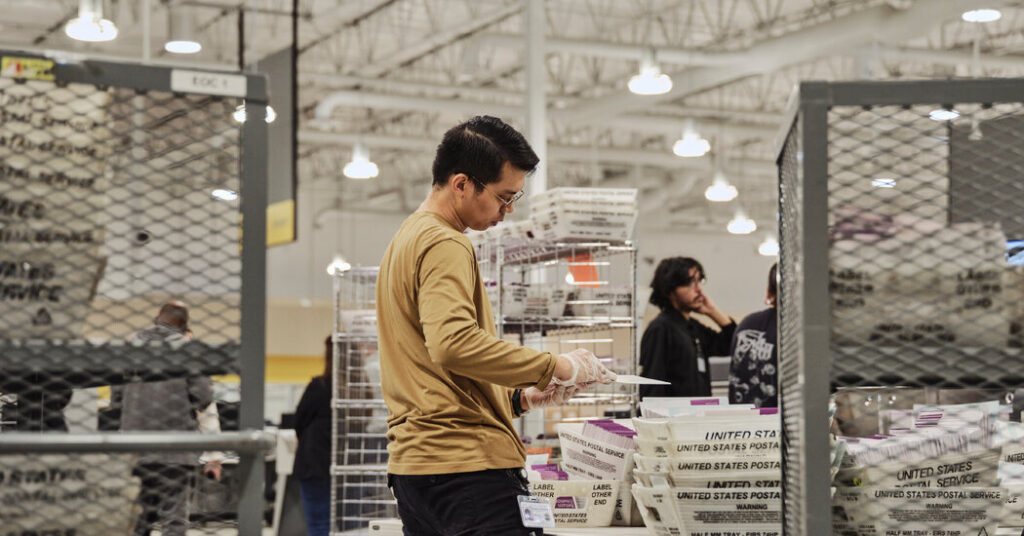
The Supreme Court’s conservative majority on Monday appeared poised to reject Mississippi’s mail-in ballot law, a decision that could upend mail-in voting throughout the country.
At issue is whether Mississippi’s law, which allows ballots postmarked by Election Day to be counted if they are received within five business days after the election, is legal given that federal law requires votes to be cast by that day.
The outcome of the case could have sweeping consequences for voters in the midterm elections, potentially creating chaos among states that allow mail-in balloting. Mississippi and at least 18 other states and territories — including 2026 battleground districts in Nevada and California — allow late ballots to be counted.
President Trump has long opposed mail-in voting and has falsely claimed that the practice was a source of fraud and contributed to his defeat in the 2020 presidential election.
He has encouraged Republicans to support legislation outlawing mail-in voting and his administration backed the challenge to the Mississippi law, in hopes of halting vote counts that continue after Election Day.
The Republican-led Mississippi legislature adopted the law allowing late arriving ballots to be counted in 2020, during the pandemic. It is being challenged by the Republican National Committee and Mississippi’s state GOP.
During more than two hours of argument on Monday, the court’s six conservative justices repeatedly pressed the lawyer for Mississippi on what is required to make a ballot selection fully complete, suggesting that federal law sets out Election Day as the day ballots should be considered final.
“So when do I know whether or not a choice is final?” Justice Clarence Thomas asked.
Several other conservative justices including Justice Amy Coney Barrett, who is often a key vote, also had sharp questions for Mississippi. They focused on how the state could guarantee a ballot had officially been cast by Election Day, particularly because Mississippi allows late-arriving ballots to be counted when delivered by FedEx, a private company.
A decision in the case is expected by late June or early July, ahead of the November vote.
A majority of states allow military and overseas ballots to be counted after Election Day, and it remains unclear what effect a ruling against Mississippi’s law would have on those rules.
The court’s three liberal justices appeared to defend the Mississippi law, noting that federal law allows the states to set their own election regulations.
They also appeared concerned the challenge could endanger all early voting and make it harder for members of the military to vote.
“Congress couldn’t have conceived of the kind of early voting we have now, it couldn’t have conceived of a thousand other ways in which we administer elections now,” said Justice Elena Kagan, suggesting federal law does not invalidate the state statute.
Key conservatives also appeared troubled by potential implications for early voting, including Justice Barrett, who pressed the lawyer for the Republican National Committee on the question.
“It seems to me that if you look at the historical practice, what an election meant was showing up in person and casting your vote and being qualified as the voter on that same day,” she said.
Justice Brett Kavanaugh wondered whether the court might run afoul of a legal principle that holds federal courts should not change state rules too close to an election. The principle aims to prevent confusion among voters.
Would there be any “issues with the states for the upcoming fall elections,” Justice Kavanaugh asked Paul D. Clement, who argued for the Republican challengers, if the court invalidated the state law?
Mr. Clement said that a decision in June — which is typically when the court ends its term and issues some of its most consequential rulings — would give states “plenty of time.”
The Mississippi dispute marks the latest in a string of election and voting rights cases before the court this term, which began in October. In January, the justices cleared the way for a Republican congressman from Illinois to challenge his state’s rules governing vote counting, clarifying who is allowed to sue over voting rules.
The justices are currently considering two other major election-related matters — a Republican challenge to federal rules that limit how much political parties can spend in coordination with candidates and a challenge by a group of white Louisiana voters who claim that the state’s creation of a second majority-minority voting district violated the Constitution. That case will test a key provision of the Voting Rights Act, a landmark of the civil rights era.
State officials asked the Supreme Court to weigh in and uphold the Mississippi law after it was struck down by a federal appeals court.
In a brief to the court, state officials argued that the appeals court ruling, “if left to stand — will have destabilizing nationwide ramifications” and that it “would require scrapping election laws in most states.”
The Mississippi leaders asserted that under the “plain meaning” of the word “election,” Mississippi voters make their choice by casting and submitting their ballots by the date of the election, even if some of the ballots are not received by election officials until after that day.
Ally Triolo, a spokeswoman for the Republican National Committee, which brought the case, said in a statement that “Watson v. RNC is about a simple principle: ballots must be received by Election Day.” She added that laws that require ballots to be received by Election Day prevent elections from “dragging on for days and weeks after voters have cast their ballots, causing confusion and undermining our elections.”
Cisco Aguilar, the Democratic secretary of state in Nevada, was at the Supreme Court on Monday to hear the arguments, because he said the case posed a significant challenge to his state and its rules.
“It is a huge concern,” Mr. Aguilar said of the possibility the court could force late changes to the state’s ballot counting laws. “And it’s a huge burden, both from a work perspective, a capacity perspective, but also a fiscal impact to local counties.”
Nick Corasaniti, Aishvarya Kavi, Adam Liptak, and Ann E. Marimow contributed reporting.
Abbie VanSickle covers the United States Supreme Court for The Times. She is a lawyer and has an extensive background in investigative reporting.
The post Supreme Court Appears Poised to Reject Late-Arriving Mail-In Ballots Law appeared first on New York Times.