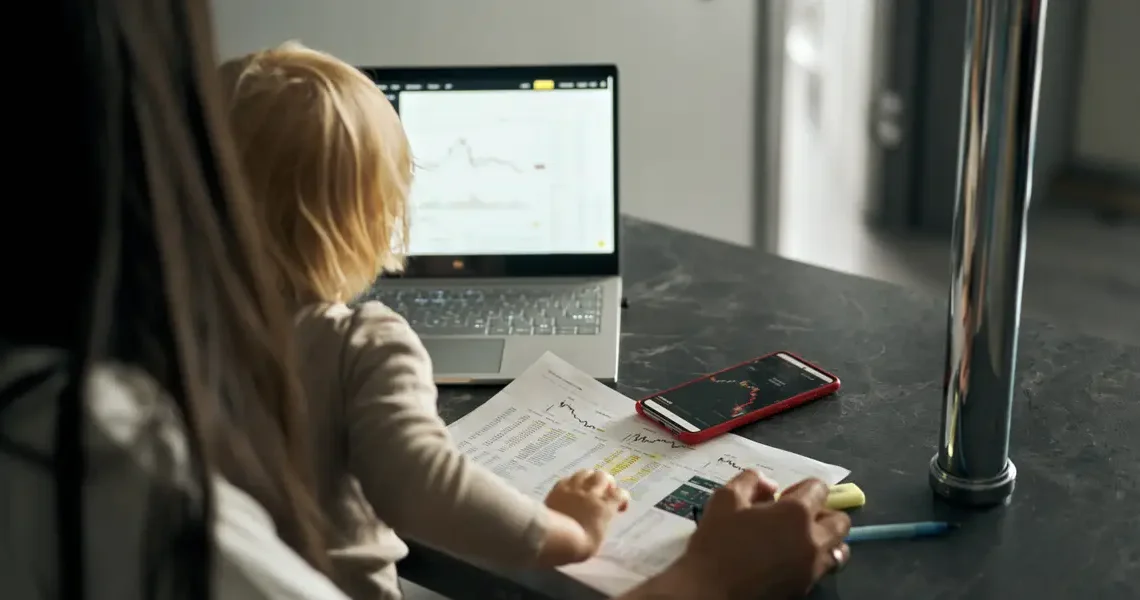

After having her first child, Lindsay Thomas went back to her full-time, in-office job. When a second kid came in 2024, Thomas says she knew she didn’t want to juggle everything again, so she negotiated a part-time, remote version of her communications role in medical research — working anywhere from 2 to 40 hours a month — and started picking up freelance work on the side.
Now, when a kid gets sick and Thomas is up all night — something that would have made her “spiral,” when she worked in the office —she knows she’ll be at home with flexibility to schedule her day. If Thomas hadn’t had the option to freelance, she says, she would have chosen to stay home with the second kid — even though she hadn’t envisioned herself as a stay-at-home mom. “There are costs to everything,” she says of leaving her full-time gig. “The cost to our family, the cost to the stress levels, to mental health, to going back to doing that and knowing what it was gonna feel like for all of us, especially with an older child involved,” she tells me, “that was just a cost we didn’t want to absorb.”
After making employment gains during the height of the pandemic, women have begun a downhill slide out of the workforce. The number of working mothers of young children between 25 to 44 fell nearly 3% from January and June of last year, hitting its lowest rate in more than three years, according to a Washington Post report. In December, 91,000 women older than 20 dropped out of the workforce. The number of men over 20 employed jumped by 10,000 that month, according to an analysis of federal jobs data from the National Women’s Law Center.
AI is also affecting America’s gender imbalance in the workforce. A March report from Anthropic found that those who work in roles with a high exposure to AI automation are 16% more likely to be female, putting women more at risk for layoffs.
An uptick in return to office mandates is also disproportionately pushing women to choose whether they’ll be able to stay in a job that requires a commute as they also balance after school pickup and domestic responsibilities. And a wave of mass layoffs has upended employment security, workplace loyalty, and the job hunt.
Women make 85% of what men make at work on average and take on twice as much of the domestic labor and caregiving tasks at home. “The real friction is we just haven’t built systems that allow people to integrate their work and their lives and and their desires and what do they want their life to look like,” says Brea Starmer, CEO of staffing firm Lions and Tigers, which focuses on fractional workers. “For anyone that doesn’t fit this very specific narrow look and feel and mold, there is just not a lot of options.” In a bleak job market, freelancing is one way working parents can claw back power. And as AI adoption transforms company needs and could shift the number of workers and hours needed to work, employers are starting to see more value in hiring part-time and contract workers.
There’s autonomy in ditching the full-time gig; but it often means making a choice between several imperfect paths.
The pandemic showed that flexible, remote work benefitted parents, particularly women. As of 2023, 74% of mothers worked, up from 72% in 2019, according to the Institute for Women’s Policy Research. But many CEOs who are calling workers back to the office have metaphorically shrugged at the costs to women. A survey from the freelance platform Upwork found that more than half of executives reported losing a disproportionate number of women after implementing RTO policies. Turnover among female employees at these companies is 82%, higher than those that allow for remote work. Nearly a third of women freelancers said RTO was a direct factor in leaving their full-time jobs. Forty-two percent of women who voluntarily left the workforce in 2025 cited caregiving and childcare costs as the main reason their choice, and these women were more likely than those who stayed employed to work at companies that did not offer flexible schedules, according to a survey from Catalyst, a nonprofit focused on women’s progress.
But as many employers don’t adapt to the needs of families, they’re seeing the benefits in hiring freelance workers. Another survey of about 350 business leaders conducted by Upwork last fall found that 77% said AI was increasing the need for them to hire fractional, freelance workers with specialized skills. “What we historically saw was that business leaders were maybe a little more hesitant to embrace these kinds of non-traditional work models,” says Gabby Burlacu, senior manager at the Upwork Research Institute. Now, “business leaders are far more open to working with the most skilled talent that they can, especially the most AI-enabled talent, because they’re all trying to figure out: How are we going to unlock the value of this technology?”
There are costs to everything. The cost to our family, the cost to the stress levels, to mental health.Lindsay Thomas
It’s hard to say how many people, and particularly women, are working in freelance roles. Upwork doesn’t track gender of the freelancers on its platform, but tells me that in a recent report, 44% of knowledge freelancer workers were women, compared to 41% of people working similar jobs in full-time roles, among those they surveyed. Freelance marketplace Fiverr tells me there’s been growth in areas like voiceover, user-generated content creation, and spokesperson or modeling projects specifically seeking female talent. In 2022, 9.8 million people were self-employed, according to the US Bureau of Economic Analysis. Other analyses of the freelance workforce estimate that as many as 75 million people participate in some capacity.
Working freelance has given women more flexible schedules and eased childcare costs, but that can also mean taking on even more unpaid household and caregiving labor.
Jaime Hollander previously commuted three to four hours a day roundtrip into Manhattan. She freelanced on the side, and split the care of two kids with her husband equally. Her mindset shifted after her father died in 2019. “You have those moments of reckoning where you’re like, this can’t be all that there is,'” she tells me. So, she cut back on work and shortly after quit her job. She focused on freelance marketing and copyrighting. The challenge with being a full-time freelancer, she tells me, is that the shift threw her into becoming “the default parent,” on call for all of her kids’ needs throughout the day. “If something has to get done between 7 and 7, I will do it,” she tells me. “Sometimes, it’s really challenging.”
Paid parental leave has become more common, but just 40% of companies in the US offered it as of 2023, according to a survey from Society for Human Resources Management. A short period of leave tied only to the birth of a child doesn’t answer for the flexibility working parents need as their kids age — there are sick days, potential disability diagnoses, and more hands-on needs at schools. “It’s not just about retaining women in those early years,” Neha Ruch, author of “The Power Pause: How to Plan a Career Break After Kids — and Come Back Stronger Than Ever.” She says “there is recalibration happening” in the workforce, where more women may take fractional work, part-time roles, or freelance gigs. For companies, retaining women workers requires “thinking about parenting through the longitudinal experience of early parenthood,” Ruch says, “going all the way up to college admissions and how and the demands that are made within the system on parents’ time, and how we can make those work in the ecosystem of the professional space as well.”
Many of the working parents I spoke to for this story chose the freelance or part-time route not upon having a kid, but as they grew up and demands of their families changed. When Erin Bartholomew’s son was born, her husband stayed home to care for him. A few years later, she took her turn, wanting to have that hands-on time while her son was still young. She re-entered the workforce after a year into a remote job, logging on at 6 a.m. in Oregon to work in marketing for an East Coast company. But Bartholomew was laid off last year in 2024. Instead of searching for a similar role, she started her own marketing consultancy “It’s so night and day,” Bartholomew tells me. “It’s allowed that balance that my husband and I really wanted.”
As some women find flexibility in freelancing, others will be left out. Those who work in offices with 9-to-5 in-person mandates, or in education, retail, and healthcare roles, can’t always make their own schedule. Parents who are the sole provider of income and health insurance for families often can’t make ends meet working part-time. Others are pushed to stay at home with kids because the costs of childcare outpace their salaries. Leaving a full-time job can also disrupt a career trajectory toward leadership, and mean lost contributions to retirement accounts like 401(k)s. If companies don’t adapt their schedules and remote work policies or future-proof roles for AI, many women will be forced to change how they think about their careers and priorities. They might not see going part-time or leaving a job as a choice they want to make, but something they have no choice in.
Amanda Hoover is a senior correspondent at Business Insider covering the tech industry. She writes about the biggest tech companies and trends.
Read the original article on Business Insider
The post Return to office and AI are pulling more women out of work appeared first on Business Insider.