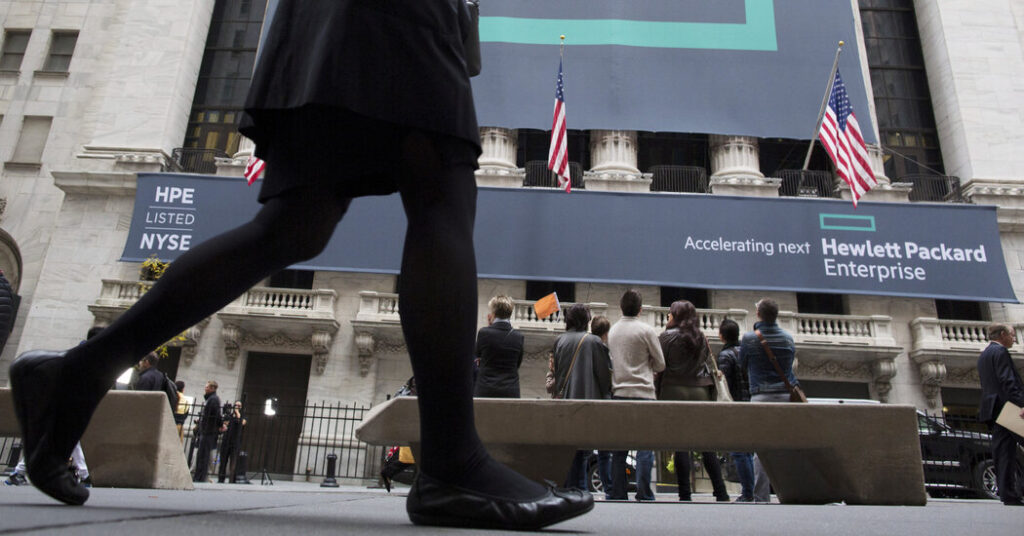
A California federal judge on Monday will consider whether the Trump administration improperly cleared the way for a multibillion-dollar technology deal, the first major legal challenge to a string of antitrust settlements during the president’s second term.
A group of Democratic state attorneys general have argued that the judge should not permit a settlement that cleared the software company Hewlett Packard Enterprise to buy the information technology firm Juniper Networks for $14 billion last year. The Justice Department’s settlement was ineffective and corrupt, the states have argued.
The Justice Department and HPE have denied those claims.
The case, which is being heard by Judge P. Casey Pitts of the U.S. District Court for the Northern District of California, is the most significant courtroom vetting of an antitrust settlement between the government and a technology company in 30 years. It follows increasing frustration from some states and critics about the administration’s efforts to allow mergers and settle antitrust and consumer protection lawsuits.
The Justice Department this month reached a tentative settlement to drop its 2024 lawsuit against Live Nation, the owner of Ticketmaster, over allegations that the company operates a monopoly. Last year, the agency settled another Biden-era complaint arguing that the software company RealPage enabled collusion between landlords to raise rents. The Federal Trade Commission this month also settled a 2024 lawsuit that accused Adobe of making it difficult to cancel expensive subscriptions to its software.
Federally, “the zone of scrutiny and enforcement by regulatory authorities has shrunken,” said William Kovacic, a former Republican chairman of the F.T.C. “Companies interested in deal making — they’re better off.”
States, which can bring their own federal lawsuits against monopolies and mergers, are pressing forward in some cases. A bipartisan group of state attorneys general have hired a lawyer to continue arguing the Live Nation case in New York federal court.
Last week, a group of states sued to block the merger of the broadcasting companies Nexstar and Tegna, saying the deal would raise prices and consolidate control of local news. Hours later, the merger was approved by the Federal Communications Commission.
A spokesman for HPE said that the state attorneys general had misstated the facts about its settlement. The Justice Department did not provide a comment.
Monday’s hearing stems from a 2024 announcement by HPE that it was buying Juniper Networks. The companies made tools that connect people to the internet at big institutions, like a college campus.
Shortly after Mr. Trump took office last year, the Justice Department sued to block the acquisition, saying it would eliminate competition that had resulted in lower prices for customers.
But in June, the Justice Department reversed course and settled shortly before the government’s merger challenge went to trial. As part of the agreement, HPE agreed to sell a portion of its services for small businesses and to license some of its technology to competitors. The companies closed the deal in July.
The Democratic state attorneys general from 12 states and the District of Columbia asked Judge Pitts to block the settlement in a filing this month. HPE’s lobbyists negotiated the settlement over the heads of Gail Slater, then the Justice Department’s top antitrust official, and her team of expert lawyers and economists, the states said in their filing.
HPE ultimately hashed out a deal directly with senior department leaders that failed to resolve competitive concerns, according to the states.
These claims echo accusations made by Ms. Slater’s former deputy, Roger Alford, who left the agency after the settlement. Senior Justice Department officials had “perverted justice and acted inconsistent with the rule of law,” Mr. Alford said in an August speech after his exit.
Ms. Slater and Mr. Alford declined to comment.
“If we don’t make a stand here, we’re tolerating pay-for-play politics, political influence peddling and giving favored companies better treatment,” said the Colorado attorney general, Phil Weiser, who has led the states’ effort.
Judge Pitts has allowed the states to intervene in the case but has pushed back on some of their demands, including hearing witness testimony.
The Justice Department and HPE have dismissed the states’ concerns. The government told the judge last year that “speculative allegations about the Department of Justice’s internal decision-making process” were outside the scope of his authority to review the settlement.
“The evidence shows that HPE and the D.O.J. engaged in a robust, arms-length negotiation process that resulted in an appropriate compromise with meaningful remedies,” HPE said in a filing.
David McCabe is a Times reporter who covers the complex legal and policy issues created by the digital economy and new technologies.
The post Judge Hears State Challenge to Trump’s Tech Deal Settlement appeared first on New York Times.