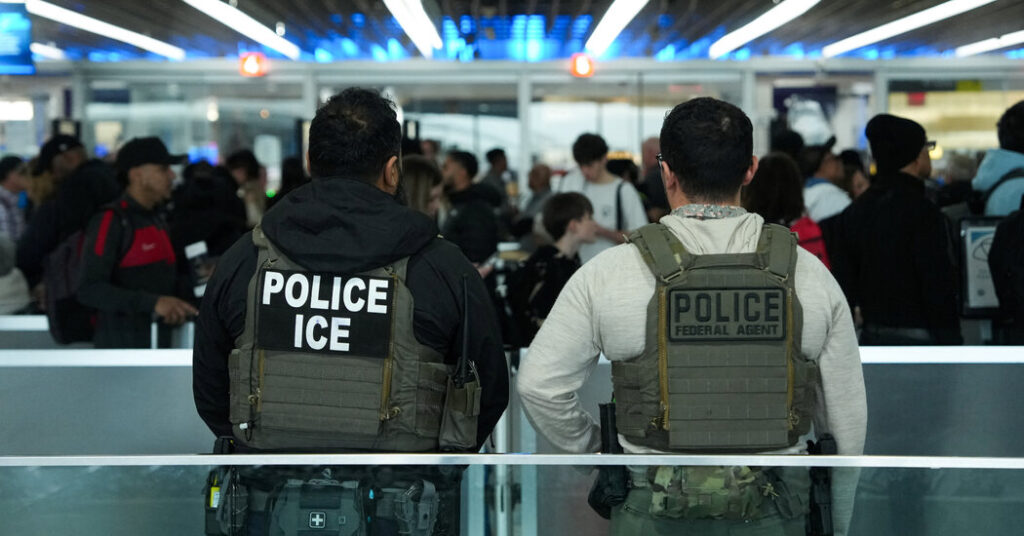
Up to 150 Immigration and Customs Enforcement officers were deployed at airports across the United States on Monday, a move that the Trump administration said was an effort to address long lines amid a shortage of Transportation Security Administration agents, who are working without pay during the partial government shutdown.
ICE officers’ exact duties at airports remained unclear. Officers were seen on Monday at several airports walking in small groups through check-in areas and standing near exits, their faces mostly unmasked. Unlike T.S.A. agents, ICE personnel are being paid.
Democratic lawmakers and the union representing T.S.A. officers denounced the deployment of ICE to airports as disruptive, unsafe and unhelpful.
Here’s what travelers need to know.
Why are ICE agents being sent to airports?
The Department of Homeland Security said in a statement on Sunday that ICE would “help bolster T.S.A. efforts to keep our skies safe and minimize air travel disruptions.”
The shortage of T.S.A. personnel stems from the ongoing partial government shutdown. Nearly 50,000 T.S.A. officers have been working without pay since Feb. 14, when funding for the Department of Homeland Security, which oversees the T.S.A., lapsed amid a congressional standoff over immigration enforcement.
Many T.S.A. officers have taken on second jobs to pay their bills, sometimes calling out of work to do so, and more than 400 officers have quit since the shutdown began, D.H.S. said on Monday. Nearly 12 percent of T.S.A. officers called out of work on Sunday, the highest rate so far during the shutdown. That includes about 42 percent of officers at Hartsfield-Jackson Atlanta International Airport and Louis Armstrong New Orleans International Airport, and more than 37 percent at Kennedy Airport in New York.
The shortage has led to long security lines that have snaked out of terminals, causing some travelers to miss flights.
The administration has said that using ICE agents to perform non-screening roles like guarding exits would allow the T.S.A. to focus on staffing security checkpoints.
Critics of the ICE deployment argue that it will not alleviate security lines and is instead intended to pressure Democrats to pass funding for D.H.S. without the changes to immigration enforcement they have called for.
Where is ICE being deployed?
The administration has not released a list of airports where it is sending ICE agents, but they were spotted on Monday at major hubs including Hartsfield-Jackson, Chicago O’Hare, and LaGuardia, J.F.K. and Newark Liberty in the New York area, as well as at smaller facilities like William P. Hobby Airport in Houston.
What are the agents doing?
So far, ICE officers have been seen walking through airports and observing, but not actively assisting with passenger screening.
In an interview on Sunday with CNN, Tom Homan, President Trump’s chief border official, suggested that ICE agents would play a limited role in security operations. “I don’t see an ICE agent looking at an X-ray machine, because they’re not trained in that,” he said. But an ICE agent could “cover an exit,” allowing T.S.A. officers to focus on screening, he said.
But, also on Sunday, Transportation Secretary Sean Duffy told ABC News that ICE agents could take a more active approach.
“They know how to pat people down,” he said. “They know how to run the X-ray machines.”
Aaron Barker, the president of the T.S.A. employees’ union in Georgia, pushed back on that assertion, saying said ICE agents “can’t do what a T.S.A. officer is doing with screening passengers. They don’t have the training for that.”
ICE and T.S.A. are both part of the Department of Homeland Security. But the shutdown does not affect ICE officers’ pay because Congress funded immigration enforcement last year.
How are travelers being affected?
It’s unclear whether ICE agents will be able to shorten security lines. Wait times at many airports on Monday remained long, including more than four hours in Terminal E at George Bush Intercontinental Airport in Houston, where ICE agents were present.
Security lines at the major New York-area airports grew so long and unpredictable that the Port Authority of New York and New Jersey, which runs the airports, turned off its real-time wait trackers. The Atlanta airport replaced its tracker with a warning that passengers should arrive at least four hours early.
Mr. Trump wrote on social media on Saturday that ICE officers’ duties at airports would include “the immediate arrest of all illegal immigrants who have come into our Country.” But there have so far been no reports of arrests connected to the deployment.
Mr. Trump said on Monday that he would send the National Guard to assist at airports if ICE agents were unable to ease delays. He also said that Republicans should stop negotiating with Democrats to end the partial government shutdown.
Follow New York Times Travel on Instagram and sign up for our Travel Dispatch newsletter to get expert tips on traveling smarter and inspiration for your next vacation. Dreaming up a future getaway or just armchair traveling? Check out our 52 Places to Go in 2026.
Gabe Castro-Root is a travel reporter and a member of the 2025-26 Times Fellowship class, a program for journalists early in their careers.
The post ICE Agents Are Now Patrolling U.S. Airports. Here’s What to Know. appeared first on New York Times.