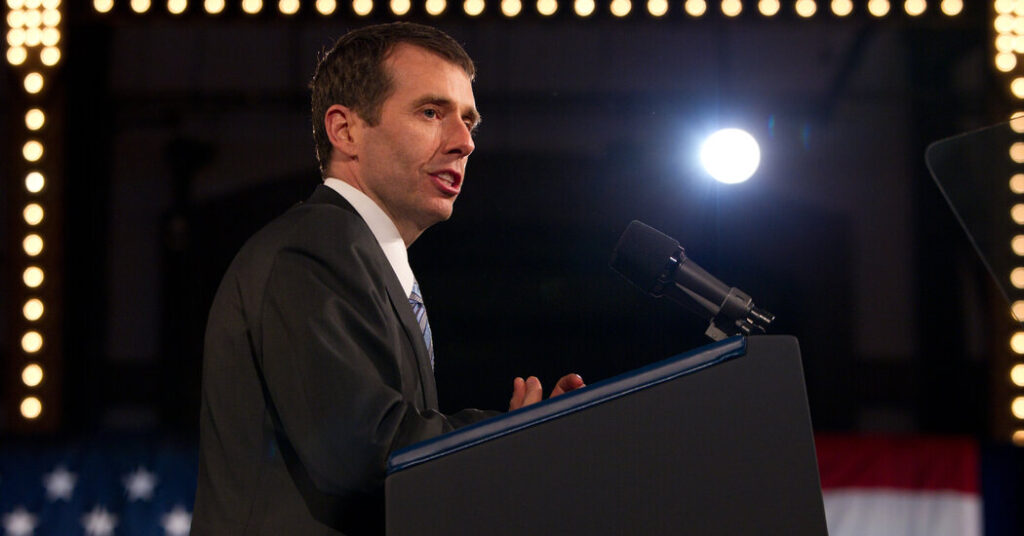
As the Democratic presidential contest heated up in 2015, it fell to President Barack Obama’s political strategist to tell Vice President Joseph R. Biden Jr. what he did not want to hear: He should not run for president because he could not win.
It could not have been an easy mission for the strategist, David Plouffe. Mr. Biden was well liked in the Obama White House. But as the vice president mulled jumping into the race, he was grieving the death of his son Beau Biden from cancer and was many months behind the two main candidates, former Secretary of State Hillary Clinton and Senator Bernie Sanders.
“I talked to Biden many times during this period,” Mr. Plouffe recalled in a newly released oral history of the Obama presidency. “What I would say is: ‘Listen, sir, first of all, I’m concerned about you as a human being. I’m not sure you’re in a state to run. But if this was six, seven months ago, it’s a different conversation. There’s no room. There’s just no room for you.’”
Mr. Plouffe shared his account of those discussions with researchers from the University of Virginia’s Miller Center, which is posting the first installment of its Obama presidential oral history on Monday morning. The Miller Center has conducted oral histories of every presidency since Gerald R. Ford, making it the nation’s premier repository of original recollections of key moments in the modern White House.
Unlike his recent predecessors, Mr. Obama opted to cooperate with Columbia University’s Incite Institute rather than the Miller Center for his official oral history. The Incite Institute released its own oral histories last month. But the Miller Center decided to proceed with an oral history of the Obama presidency on its own and interviewed 80 cabinet members and senior officials. The first 36 of those interviews are being made available on Monday.
The Plouffe interview sheds additional light on one of the pivotal moments of the Obama presidency. The decision by Mr. Obama and his team to throw their weight behind Mrs. Clinton instead of Mr. Biden for their party’s 2016 nomination is often second-guessed, given that she ultimately lost to Donald J. Trump in the general election. Mr. Biden went on to run in 2020, when he beat Mr. Trump, then dropped out in 2024 amid concerns over his age.
Mr. Obama embraced Mrs. Clinton’s candidacy soon after winning his own re-election in 2012 when he assumed that Mr. Biden would not run in four years. Beau Biden’s illness absorbed the vice president through part of the second Obama term, and he did not seriously weigh a 2016 run until after his son’s death in May 2015.
By that time, the race between Mrs. Clinton and Mr. Sanders was in full swing, and Mr. Biden was still struggling with his family’s tragedy. In his memoir, Mr. Biden described Mr. Obama’s efforts to dissuade him from running, expressing concern about his legacy. Mr. Obama urged Mr. Biden to speak with Mr. Plouffe, who laid out the case for why a late-starting campaign made little sense.
Mr. Biden was upset that his two-time ticket-mate would not support him in 2016. To this day, some of Mr. Biden’s confidants maintain that he would have won, which would have kept Mr. Trump out of the White House and changed history. The friction between the two worsened in 2024, when Mr. Biden became convinced that Mr. Obama was quietly trying to pressure him to drop out following a disastrous debate performance against Mr. Trump.
Mr. Plouffe has publicly defended his advice to Mr. Biden in 2015. In his interview with the Miller Center, he described how he went into granular detail with the vice president about the state of the Democratic primaries.
“Iowa is a tough state for you,” he recalled telling Mr. Biden. “New Hampshire is a tough state for you — Bernie’s going to win. And South Carolina, Hillary’s going to clean up there. There’s just no room for you. And by the way, Hillary’s not going to implode. Maybe she’ll struggle — she’s not going to implode. And Bernie, surprisingly, is — he’s not going to implode.”
Mr. Plouffe said Mr. Biden had been “stirred up” by several people around him. “Well, the donors are telling us to run,” Mr. Biden said, in Mr. Plouffe’s recollection.
“Well, I know these donors,” Mr. Plouffe replied. “Let’s talk about them.” They amounted to a couple of contributors in California. “That’s not a campaign. I get that Hillary is struggling in this campaign vis-à-vis Bernie. That’s true. But there’s no room for you in part because of that. Bernie and Hillary both are guaranteed 80 percent of this electorate.”
Mr. Plouffe, however, agreed that if Mr. Biden had gotten into the race earlier in the cycle and overcome Mrs. Clinton, he might have had a better chance of defeating Mr. Trump in the general election. “He would have struggled with Trump as anybody would; he’s a strange guy to run against,” Mr. Plouffe said. “But he didn’t have the trust and character issues that Hillary — I would say, unfairly — but that she has with the electorate.”
Not everyone discouraged Mr. Biden at that time. Jay Carney, who had served as the vice president’s communications director and later as Mr. Obama’s White House press secretary, told the researchers that Mr. Biden had reached out to him in 2015 about whether to run. Mr. Carney, who had left the White House for the private sector, went to see him.
“He was not himself,” Mr. Carney said. “He was subdued and just listening and quiet. I didn’t think he was going to run. I’ve never told anybody this. Then I called back and, again, to see him, and I did a memo for him about what it would look like if he ran and what the press would say.”
Then he went to see Mr. Biden again. “He was different,” Mr. Carney said. “He was feeling better.” So Mr. Carney encouraged him. “I said, ‘If you’re prepared to lose — because you’ll probably lose in the primary to Hillary, given all her advantages — sure, you should run. Why not?’ I remember walking out thinking he was going to run.” Mr. Biden announced in October 2015 that he would forgo the race.
The oral histories collected by the Miller Center offer other windows into Mr. Obama and his time in office. Cody Keenan, his last chief speechwriter, recalled how reticent the president was to talk about his mother. “It was so rare that when he did, it was kind of exciting,” Mr. Keenan said. What about his father, who left him as a young boy? “Never.”
Like others who worked for Mr. Obama, Mr. Keenan described an even-keeled figure who did not show emotions much. But he described a time when Mr. Obama returned from a meeting with members of Congress steaming. “Obama said, ‘He basically called me everything short of “boy” in the way he talked to me,’” Mr. Keenan said of a Republican lawmaker. “He was mad. He was big mad.”
Mr. Obama, he added, had a salty tongue outside the public eye. “The biggest difference behind closed doors for us is that he was a lot more profane than he is in public,” he said. “Otherwise, he was who you see on TV. Just more colorful.”
Race was an inescapable factor for the first Black president. Ben Rhodes, one of his closest national security aides, said that while there were legitimate policy disagreements over Mr. Obama’s nuclear agreement with Iran, public opposition was fueled in part by identity politics.
“If you’re watching Fox News, what you’re watching is a segment on the border, a segment on the Iran deal and a segment on radical Islam, and it’s all kind of the same thing,” he said. “Then you go on social media, and it’s all the same thing. It’s just one big ‘other,’ that Barack Obama — Barack Hussein Obama — is somehow on their side, not on your side.”
Still, not all skepticism about Mr. Obama’s Iran policy came from outside the building, and not everyone felt that their opinions were necessarily welcome inside the building. Dennis C. Blair, who served as director of national intelligence until he was pushed out, described a meeting that was advertised as looking for fresh insights on Iran.
“When it came my turn to speak at this meeting,” Mr. Blair recalled, “I said, ‘Mr. President, you really just have one decision to make. It’s really important, but it’s only a single one. Are you going to tolerate Iran having a nuclear weapon or not?’” If no, he said, then that would prompt certain espionage and military options. If yes, then it would require ways to contain and deter a nuclear-armed Iran.
But evidently, Mr. Blair’s contribution peeved the slow-to-anger president. “The president took me aside after that meeting and said, ‘Denny, don’t ever put me on the spot like that again,’” Mr. Blair recalled. “I said, ‘What?’ I mean, I didn’t say, ‘What?’ but I said, ‘Yes, sir, Mr. President. I certainly won’t.’” But Mr. Blair said, “I was kept out of meetings from that time forward.”
Other former advisers told stories about Mr. Obama’s support for his team. Ray LaHood, a Republican who served as transportation secretary, recounted how the president worked behind the scenes to liberate his son Sam LaHood when he was barred from leaving Egypt for two months. The younger Mr. LaHood was the director of the International Republican Institute in Egypt and targeted by the government in a crackdown on foreign groups.
“Obama didn’t make a lot of noise about it publicly, but I was told that every day, he talked to his staff about, ‘What are we doing? How are we going to get him out of there?’” Ray LaHood recalled. “I never really placed a call to Obama and said, ‘Hey, come on.’ They just — they told me, ‘He’s taking care of it.’ That was it.”
Peter Baker is the chief White House correspondent for The Times. He is covering his sixth presidency and sometimes writes analytical pieces that place presidents and their administrations in a larger context and historical framework.
The post How Obama’s Strategist Discouraged Biden From Running in 2016 appeared first on New York Times.