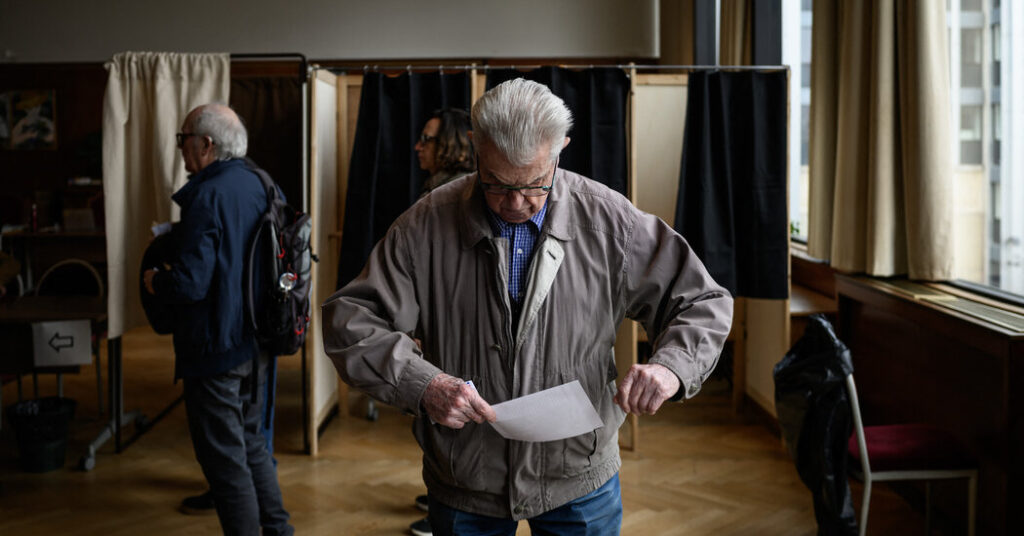
For months, the far right in France has been viewed almost as a national government-in-waiting, its leaders holding wide polling advantages against their rivals a year before presidential elections. Yet on Sunday, in mayoral elections across the country, French voters delivered a more mixed verdict.
Far-right candidates lost in the major places in the south they had hoped to win — including Marseille, France’s second-largest city, which the far-right National Rally had identified as a ripe target to showcase its ascent. Their losses were balanced by far-right victories in two other southern cities, Carcassonne and Nice.
As the results trickled in on Sunday evening from a second round of voting, the election ended up being less a far-right wave than a complex portrait of the fragmented state of French politics. With a grab bag of results — some of which favored the mainstream parties, others the hard left or hard right — leaders of every political stripe went before TV cameras to try to claim victory.
Yet turnout was the lowest in two decades, except for 2020, when the pandemic kept voters away. That suggested a disenchanted electorate — one that is open to populist appeals and insurgent candidates.
While the election may not have produced the sort of victories that would have electrified the far right and alarmed its opponents, it still left the National Rally as a force to be reckoned with 13 months before the presidential vote.
The party held on to its traditional strongholds along the Mediterranean coast and in the north of France and won a significant number of small cities in the far north and far south. But that would not be enough to triumph in a presidential election, said Jean-Yves Camus, an expert on the far right at the Jean Jaurès Foundation, a left-leaning think tank based in Paris.
“If it wants to win 2027, it really needs to enlarge its fan base to other provinces of the country,” Mr. Camus said. “It’s a party that has a problem in the big cities,” he said. In Paris, for example, the National Rally’s candidate eked out just 1.6 percent of the vote in the first round a week ago.
Marine Le Pen, a fixture of far-right politics in France, and her protégé, Jordan Bardella, the party’s 30-year-old president, have topped most polls for the presidency for nearly a year. If Ms. Le Pen is barred from running by her conviction on embezzling charges, which she is appealing, Mr. Bardella is likely to run in her stead.
At one level, the election of more than 34,000 mayors was a quintessentially local exercise. Parochial issues, like trash collection, figure high on the list of voter concerns. Yet the elections are also a bellwether for the political winds in France, which have blown against centrist parties in recent years.
A far-left party, France Unbowed, claimed early momentum by scoring a victory in the industrial town of Roubaix. But the party’s gains were limited elsewhere, notably in Toulouse, where it had allied in the runoff with a center-left candidate, who was projected to lose.
And the long-suffering center left managed to rally in two big cities. In Marseille, Benoît Payan, running in a coalition of left-wing parties, comfortably turned back a challenge by the National Rally’s candidate, Franck Allisio, who had almost matched Mr. Payan’s vote tally in the first round.
In Paris, Emmanuel Grégoire, the candidate of the center-left Socialist Party, won his runoff against a conservative, Rachida Dati. Ms. Dati had amassed support from a far-right candidate who dropped out after the first round. Mr. Grégoire is a former deputy to the departing mayor, Anne Hidalgo, and his victory kept Paris, which has elected Socialist mayors for 25 years, in the hands of the left.
Mr. Grégoire said Parisiens had sent a message to the National Rally: “Paris is not, and never will be, a city of the extreme right.” Mr. Grégoire celebrated his victory by riding his bicycle to City Hall.
Analysts cautioned against over-interpreting what the mayoral results reveal about the likely outcome of the presidential election. Yet they are a useful gauge of the relative strength of the parties, and as an indicator of the terrain that politicians plan to stake out once the national campaign gathers momentum.
The elections were also fateful for two political heavyweights who still harbor ambitions for higher office. Édouard Philippe, who served as prime minister under President Emmanuel Macron from 2017 to 2020, was re-elected mayor of Le Havre, bolstering his candidacy for president. François Bayrou, whose 10 months as prime minister ended in a no-confidence vote last September, was ousted as mayor of Pau, in southwestern France, raising questions about his political future.
Ms. Le Pen and Mr. Bardella tried to put a good face on the results, saying that the National Rally would now control city halls in dozens of towns across France. “The National Rally and its candidates are achieving the biggest breakthrough in the party’s history,” Mr. Bardella said on Sunday evening.
Ms. Le Pen said the results vindicated the party’s “strategy of establishing a local presence.” But its failure to pick up any major cities — it was a far-right candidate from another party who won in Nice — was difficult to paper over.
“These are the jewels the National Rally hoped to have in its crown,” said Vincent Martigny, a professor of political science at Côte d’Azur University in Nice. “It was not crowned tonight.”
Still, Professor Martigny argued, “the main loser was France Unbowed,” the far-left party. He noted that in cities where center-left candidates allied with the far left, those candidates often went on to lose. But in Paris and Marseille, where center-left candidates rejected those alliances, they were victorious.
The message, Professor Martigny said, was that for all the talk of the polarization of French politics, many voters, at least on the local level, are not ready to hand over their municipal governments to parties viewed as extreme. “They don’t want that,” he said. “So, they are ready to vote for anybody else.”
Ana Castelain and Daphné Anglès contributed reporting.
Mark Landler is the Paris bureau chief of The Times, covering France, as well as American foreign policy in Europe and the Middle East. He has been a journalist for more than three decades.
The post French Far Right Falls Short of Statement Win in Yardstick Local Races appeared first on New York Times.