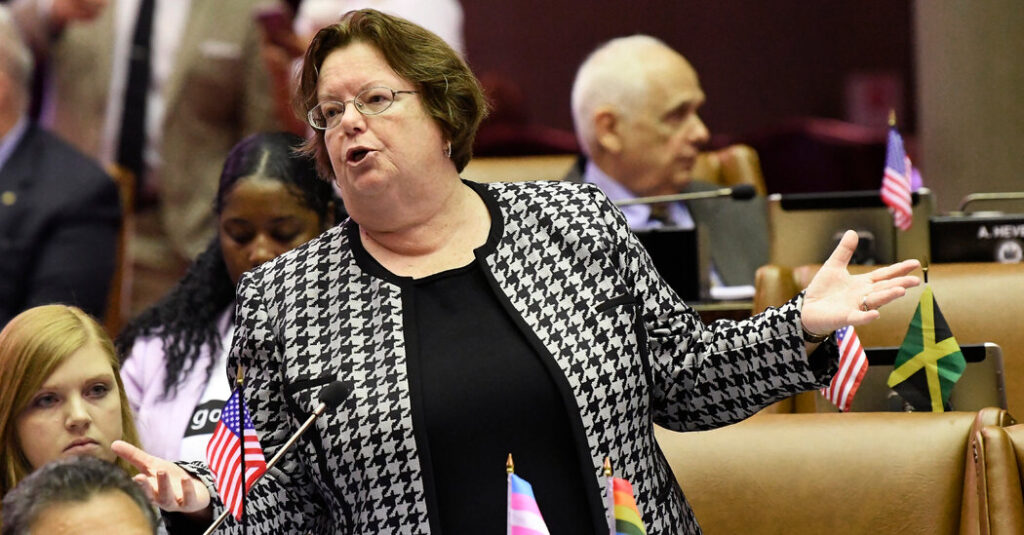
Catherine T. Nolan, a Democrat from Queens who spent nearly 38 years in the New York State Assembly, wielding her significant influence to serve as an early champion of progressive causes like abortion and labor rights for farmworkers, died on March 11 at her home in Queens. She was 67.
Her husband, Gerard Marsicano, said the cause was mesothelioma.
A resident of the Ridgewood neighborhood of Queens since she was a child, Ms. Nolan won her first race for the State Assembly in 1984, when she was just 26.
Pushing against the traditional male-dominated politics of Albany, she began to accumulate power and influence almost immediately. She chaired several key committees, including labor, banking and education, and served as deputy assembly speaker from 2019 to 2022.
When she was first elected, Ms. Nolan was decidedly more liberal than the average Democrat in the State Assembly. And while she was not the first woman to join the legislative branch’s lower chamber, her arrival — the same year that Rep. Geraldine Ferraro, a Democrat from Brooklyn, was nominated by the presidential nominee, Walter Mondale, as his running mate — heralded a tidal shift in the gender politics of Albany.
Out were the late nights of backroom poker and saloon politics; fresh-faced assembly members now hurried back to their districts whenever they could.
Such clubbiness “must have been glamorous back then,” she told The New York Times in 1986, “but it’s not a part of the currency anymore.”
Ms. Nolan established herself as a reform-focused legislator, taking on bloat and corruption in the state’s transportation and energy sectors. She backed strong protections for abortion rights and for workers, including higher minimum wages.
As chairwoman of the assembly’s education committee from 2006 to 2018, she worked closely with the administration of Mayor Michael R. Bloomberg to extend his office’s control over New York City schools.
And in a move that might have seemed surprising coming from a politician with deep roots in the heart of urban Queens, she was one of the assembly’s most powerful advocates for the state’s farmworkers.
She spent years fruitlessly advancing a bill to ensure they received overtime pay, disability and unemployment benefits, only to see it die in the State Senate. Thanks to her diligence, it finally passed in 2019.
“We all eat food, and these people have a right to be treated like any other worker,” she told Newsday in 1995.
Catherine Theresa Nolan was born on March 12, 1958, in Syracuse, N.Y. Her father, Philip Nolan, worked as a telephone installer for a phone company, and her mother, Margaret (Muccio) Nolan, worked in a hospital lab. Her parents, both from New York City, moved back there when Catherine was less than a year old.
Her home was animated by conversations around her father’s work as a shop steward for his union, a devotion that inspired Ms. Nolan to enter politics herself.
“Politics was the topic of conversation around the dinner table,” Mr. Marsicano said. “Other people talked about movies. That family talked about politics.”
Ms. Nolan graduated from New York University with a bachelor’s degree in political science in 1979 and almost immediately began to plan her entry into politics.
She worked for the city’s office of preservation, and in 1982, became the ombudsman for Queens, an office within the state government. She also volunteered with the Democratic Party in her Queens district, and within a few years was campaigning for office.
Ms. Nolan was not always an establishment favorite. The New York Times endorsed her Republican opponent in 1984 (though it endorsed her in subsequent races).
She faced a stiff challenge in 2000 from Patrick T. O’Malley, a former prosecutor and brother of Martin O’Malley, a former mayor of Baltimore.
Though Patrick O’Malley was just 33 and untested politically, he received endorsements from Edward I. Koch, the former Democratic mayor, and Rudolph W. Giuliani, the Republican mayor at the time; he also received support from leaders of the Queens Democratic Party. Nevertheless, she won the primary handily.
She married Mr. Marsicano in 1978. Along with him, she is survived by their son, Nicholas Marsicano; her sister, Margaret Nolan; and her brother, Phillip Nolan.
By the time she decided to leave the State Assembly, in 2022, citing a long-running fight with cancer, her district, and the state’s Democratic voters, had moved significantly to the left, making her appear a relative moderate.
She was succeeded by Juan Ardila, who lost his re-election campaign in 2024 to Claire Valdez.
“Her nearly four decades of public service leave a lasting legacy in our district and throughout our state — one we can all only hope to live up to,” Ms. Valdez said in a statement.
Clay Risen is a Times reporter on the Obituaries desk.
The post Catherine T. Nolan, State Assembly Powerhouse From Queens, Dies at 67 appeared first on New York Times.