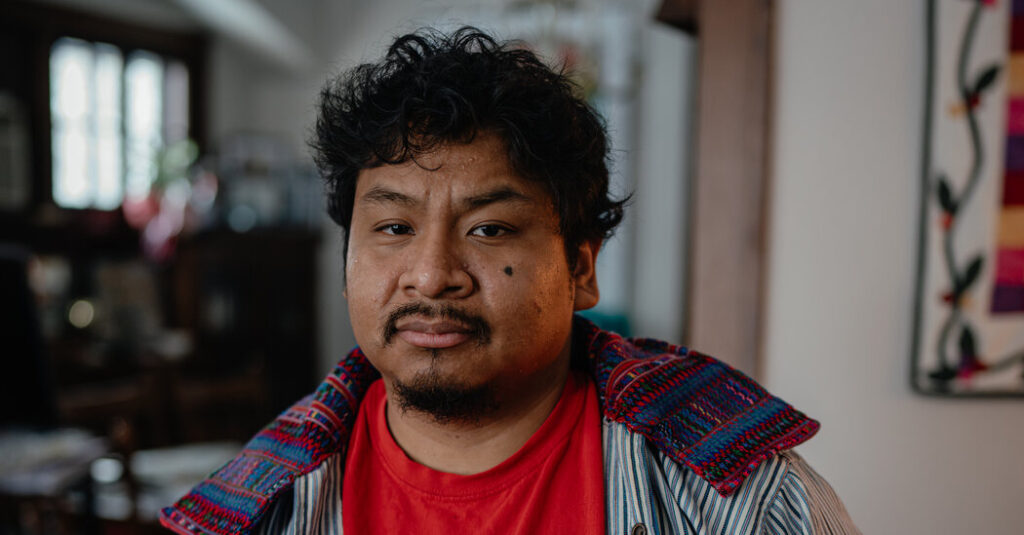
Born in Guatemala and adopted as an infant by a Minnesota couple, Tiko’ Rujux-Xicay scarcely considers himself an immigrant, much less a vulnerable one. But after federal immigration agents arrested some of his neighbors in January, he began carrying his American passport and encouraging other adoptees to do the same.
That is how Mr. Rujux-Xicay, 27, (pronounced ruh-OOSH she-KYE) learned that faulty laws and practices surrounding international adoption had left many adoptees trying to prove they have a legal right to live in the only nation most of them have ever known. As many as 200,000 adoptees are vulnerable to deportation because they lack U.S. citizenship or important proof of it, immigration lawyers say.
The problem is decades old, but has taken on new urgency during the Trump administration’s determination to deport millions of undocumented immigrants. Immigration lawyers say they know of no accurate count of how many international adoptees have been deported, but say they are increasingly being detained.
“Most immigrants know from the very beginning what they have to do to gain legal status, but many adoptees have never questioned whether or not they have it, until now,” said Mónica Dooner Lindgren, a family law attorney at Southern Minnesota Regional Legal Services in St. Paul. Many international adoptees first learn they are not citizens when they apply for a drivers license, join the military or, these days, when federal agents stop them on the street.
Beginning with war orphans and refugees in the 1940s, Americans have adopted more than 500,000 children from abroad, more than any other nation. The practice peaked in 2004, and has since slowed dramatically as Russia, China, Guatemala and other countries have halted foreign adoptions because of evidence of corruption and other irregularities.
At the height of the international adoption boom, shifting requirements and corruption often made the process chaotic. Children who were adopted legally obtained new birth certificates with their adoptive parents’ names, but federal law also required that the children become naturalized citizens. Thousands of parents were either unaware of or did not take this step, which made their adopted children potentially subject to removal.
In 2000, Congress passed the Child Citizenship Act, which granted automatic citizenship to adoptees who were younger than 18 on Feb. 27, 2001, the day the law took effect. But up to 75,000 adoptees did not qualify because they were older than 18 on that date.
Tens of thousands of others faced different obstacles.
Some entered the country on tourist or medical visas that have long since expired. Others came in on so-called orphan visas, but their American parents did not complete the process for them to become citizens. Still others were sheltered by Americans posted abroad, often military members, who did not pursue legal adoption upon returning with them to the United States.
The State Department does not track how many international adoptees become naturalized citizens. But Gregory Luce, an immigration lawyer and executive director of Adoptees United in Minneapolis, scoured records back to 1968 and found that a total of about 200,000 children brought to the United States from abroad since that year had grown up without U.S. citizenship.
Mr. Luce said international adoptees who are not U.S. citizens often discover they are not naturalized when they apply for a U.S. passport, Social Security benefits or a Real ID.
Under federal law, people who make a false claim of citizenship are barred from ever acquiring it, but international adoptees who did so in error are exempted. Even so, Mr. Luce said that many adoptees who find themselves in these circumstances do not seek citizenship through the exemption, fearful of an administration that is using every legal avenue to meet deportation quotas.
“Naturalization in this environment is much harder and much riskier,” said Mr. Luce, whose organization sponsors a pro bono legal clinic for adult international adoptees. “Most people are super scared, and the hard question for me is always, what should they do? Naturalize, renew a green card, do nothing?”
Minnesota, with its strong public benefits system, network of support groups and one of the first adoption medicine clinics in the nation, has one of the largest concentrations of foreign-born adoptees of any state, including the highest number of Korean-born adoptees. At least 17,547 of 114,536 Korean children adopted by Americans between 1953 and 2023 lack U.S. citizenship, according to the Overseas Koreans Agency.
After Immigration and Customs Enforcement agents launched one of the broadest immigration enforcement actions in history in Minnesota, “we found that ICE is not discriminating,” said Ms. Dooner Lindgren, the family law attorney in St. Paul. “All people of color are being targeted.’’
Ms. Dooner Lindgren and her husband are adoptees from Colombia, as is their daughter. Ms. Dooner Lindgren was adopted as an infant, and said confusion over the law meant that it took three years for her to become a full U.S. citizen. “I was only 3 years old, but I remember the naturalization ceremony and being given a United States flag,” she said. “My parents and many others did their due diligence, but for some it wasn’t a priority or they didn’t know.”
Mr. Rujux-Xicay, who uses his Mayan name, was born in 1998 and adopted the following year by Laurie Stern and Dan Luke, Minneapolis-based filmmakers who spent nearly a year navigating Guatemala’s complicated adoption procedures.
The Child Citizenship Act cemented Mr. Rujux-Xicay’s legal status, but he did not automatically receive a certificate of citizenship. Although not required for citizens born in the United States, it is the most permanent proof of citizenship for those who are naturalized. Unlike a passport, which has to be renewed and can be revoked for certain financial crimes, not paying child support or if a person is deemed a flight risk, a certificate of citizenship is difficult to revoke.
“The Department of State website says that a U.S. valid passport is sufficient to prove citizenship, but that is not preventing agents from detaining adoptees,” Ms. Dooner Lindgren said. She said international adoptees were “scrambling” to apply for the certificate, which is available from U.S. Citizenship and Immigration Services field offices after an approval process that involves submitting several supporting documents.
That agency recently waived the $1,300 filing fee for adult international adoptees, and wait times range from six months to 18 months, Mr. Luce said.
When Mr. Rujux-Xicay drives to his high school teaching job or ferries his young daughter to day care, he carries his passport, birth certificate and an enhanced driver’s license embedded with a radio frequency identification chip that allows border agents to readily access his traveler information. A kidney transplant recipient, he also carries a long list of medications and a note from his doctors saying that without them, he could die.
Despite the risks, he says he will not apply for a certificate of citizenship, calling it “bureaucratic B.S.”
“I have all this stuff that says I’ve gone through the right channels,” he said. “I’m a citizen, I have a job and family, and I’ve never committed a crime.”
“I have to believe in the system. If you don’t, then what’s the point?”
Congress has tried for a decade to plug legal gaps that endanger adoptees. The latest effort, the Protect Adoptees and American Families Act, introduced in late September, would provide automatic citizenship to international adoptees regardless of their current age, provided they still live in the United States and were adopted lawfully by parents who are American citizens.
The bipartisan legislation has support from evangelical Christians, who have long embraced adoption. But it has yet to receive a committee hearing.
Some adoptee advocates say the legislation’s chances for passage are slim, given the Trump administration’s refusal to admit or protect any but a handpicked few foreign-born people.
Mr. Luce said he was less pessimistic.
“It has bipartisan support and could be sold to everyone seeking immigration reform as some small symbolic step, because everyone recognizes the system is broken,” he said.
“If it passed, I have clients who would instantly become citizens.”
Elizabeth Williamson is a feature writer for The Times, based in Washington. She has been a journalist for three decades, on three continents.
The post Born Abroad and Fearful of ICE, Adoptees Try to Prove They Belong appeared first on New York Times.