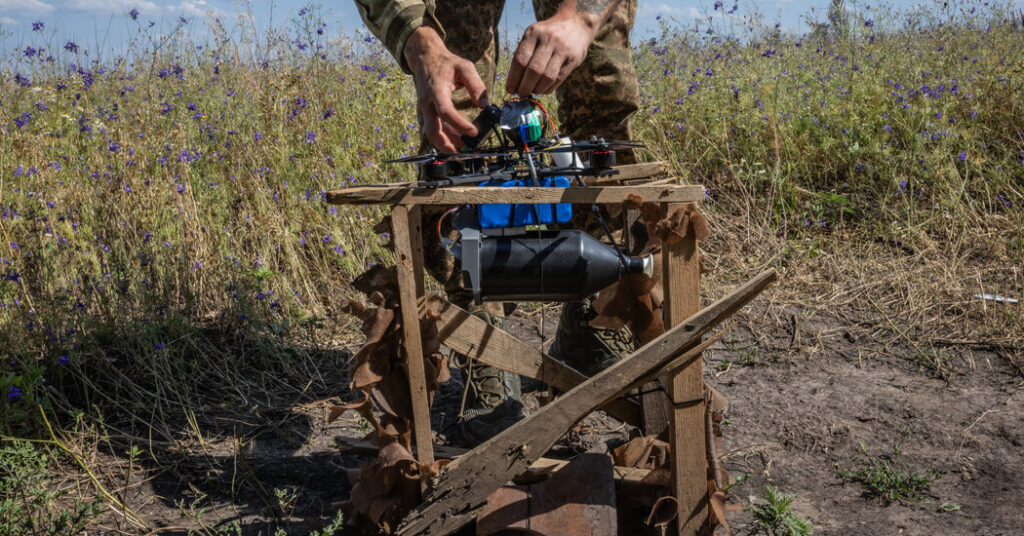
In an icy bunker in eastern Ukraine, Capt. Denys Poliachenko worried as Russian forces built up equipment about 20 miles away. His attack drones, their batteries sapped by temperatures far below freezing, could not reach that far.
But a solution was just a few clicks away. He opened his phone, scrolled through an online marketplace for lethal weapons established by the Ukraine military for its fighters, and ordered a drone model for quick delivery, one capable of reaching the Russians even in the cold.
“I can order any device sitting in a dugout,” said Captain Poliachenko, the head of unmanned systems for Ukraine’s 25th Brigade, in an interview.
Militaries have long standardized their arsenals from unit to unit and fighter to fighter, simplifying mass production, training and supply lines. Fighting in the age of drones, Ukraine has had to turn that logic around. It is expanding the variety of drones as widely as possible, and allowing troops to choose their own weapons, rather than have them selected by faraway officials.
To fight with devices that began as modified consumer technology, Ukraine is turning to something resembling a consumer marketplace, like an Amazon for lethal goods. The government has set up two websites to allow combat units to choose from among hundreds of specialized military drone models, according to their own judgment and needs.
Innovations like these show that fighting with drones requires adaptations beyond simply buying hardware. Ukraine has emphasized this as it has sent teams to help U.S. allies in the Middle East that are contending with drone attacks by Iran.
Ukraine’s own drone-purchasing program, intended to ensure that lower-level commanders have the right equipment by letting them choose it themselves, expanded in November to include 130 brigades, nearly all of the Ukrainian military.
Outnumbered and outgunned, Ukraine out of necessity has pioneered drone fighting, which accounts for most of the war’s casualties, learning battlefield tactics that are being closely studied by militaries around the world. One major lesson is that drone technology evolves too quickly for military procurement bureaucracy to keep up, with the constant introduction of new models that can evade jamming, fly farther, see better and carry heavier loads.
Ukraine has responded with decentralized procurement that its officials say is the future of warfare, matching supply to demand that can vary widely depending on the place and time. Military analysts and Ukrainian officials say they do not know of any other military in the world that is doing anything like it.
“Ukraine has mastered something NATO hasn’t,” said Marina Miron, a postdoctoral researcher at the War Studies Department of King’s College London.
The program reflects the kind of innovation and adaptation the war has forced on Ukraine, said Rob Lee, a senior fellow in the Foreign Policy Research Institute’s Eurasia Program and a former U.S. Marine infantry officer. “A unit on one part of the frontline might need different types of drones than those operating elsewhere,” he said.
Demand for drones has been growing every month, with technical requirements constantly changing, said Col. Pavlo Palisa, a former brigade commander and now a deputy chief of staff for President Volodymyr Zelensky. While the great majority of troops can use the same rifles and ammunition, technology that changes slowly, drones are a very different matter.
As a commander in the field, he said in an interview, “I thought how effective it would be to buy exactly what we needed at that moment, because centralized supply doesn’t respond as quickly or flexibly.”
Ukraine’s military allocates credits to each brigade to use on the websites, which for now primarily offer drones, along with some other gear. A unit can pad its budget with bonus points for successful drone attacks. In addition, Ukrainian volunteers, in collaboration with the military, last month launched an online platform allowing donors to deposit money directly to a specific brigade’s account to acquire weapons.
Troops describe the program as user-friendly. A soldier logs into an online store to peruse the offerings. Only a commander can place the order, paying with his unit’s account. The system places the order with the manufacturer, generates all the necessary paperwork and arranges for the weapons to be shipped. The usually arrive within 5 to 10 days.
When drone pilots had to rely solely on large-scale Ministry of Defense contracts, drones “either came in the wrong quantity or the wrong quality,” said Col. Ruslan Habinet, commander of the 5th Separate Heavy Mechanized Brigade.
In addition, “it is difficult for a centralized system to respond to needs immediately,” said Major Olexandr Kelbas, head of the Aviation and Air Defense Service in the 28th Brigade, responsible for drones.
That prompted Ukraine’s Ministry of Digital Transformation introduced an online marketplace called Brave1 that allows soldiers to see hundreds of drone models, many from new producers that have sprung up during the war. It is tied to a points system for killing Russian soldiers and destroying Russian weapons.
“Basically, it’s like an online store where you can see different categories,” said a sergeant who oversees equipment repairs with the 93rd Brigade, and who asked to be identified only by his first name, Denys, in keeping with the military’s operational security practices. He demonstrated on his phone, scrolling through various options, like multirotor drones, reconnaissance drones and attack drones.
Separately, the Defense Ministry created another online marketplace, called DotChain, where brigades can buy drones and ammunition with credit in their virtual accounts. For now, it has less variety than Brave1 — about 30 manufacturers selling 150 drone models — but there are plans to expand it.
“If you look at this demand from a civilian perspective, the natural instinct is to decentralize everything and just say, ‘Buy whatever you want,’” said Arsen Zhumadilov, the head of the Defense Procurement Agency.
“The technical solution really is similar to a marketplace,” he said, “but it’s actually even better than the marketplaces we’re used to, because our brigades can see exactly who has what and in what quantities in stock.”
Captain Poliachenko, who is fighting the Russians near the besieged city of Pokrovsk, is happy with the new program, but he said one basic problem remains.
“We always need more money.”
Maria Varenikova covers Ukraine and its war with Russia.
The post A Choice of Deadly Drones Is Only a Few Clicks Away for Ukrainian Troops appeared first on New York Times.