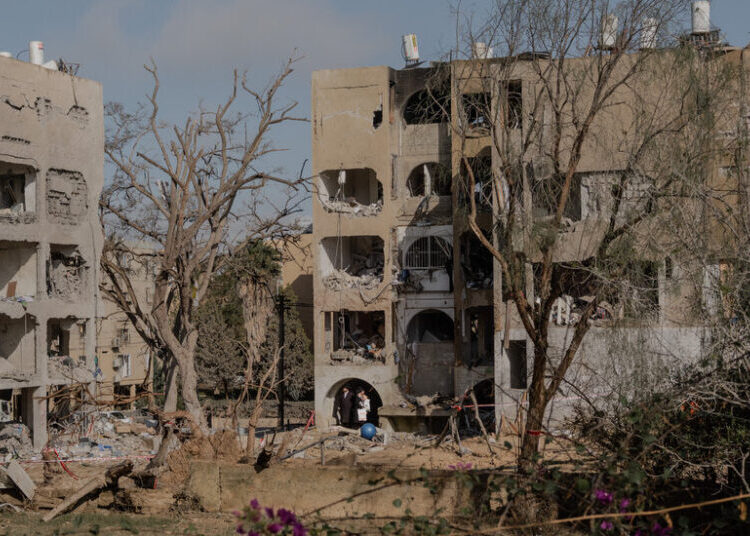
CARACAS, Venezuela — For Vanessa Farina, hope had become dangerous. For more than a year, she had measured out her life by the number of days her husband, the human rights activist and politician Luis Tarbay, spent in Venezuela’s most notorious prison.
Now, with President Nicolás Maduro in U.S. custody and the Trump administration applying pressure, his vice president and confidante, Delcy Rodríguez, had begun to release some of the hundreds of political prisoners it held. Morning and night, Vanessa checked her phone, hoping for good news.
For more than a year, I did the same.
Vanessa and I have been close for years. Our sons became best friends in kindergarten, and we naturally followed. I was at the house Vanessa and Luis shared with their two children on the day he was arrested. I stayed by her side through the months that followed.
Then came the Sunday that a source connected to the El Helicoide prison messaged me: “Tarbay might be getting out today.”
I hesitated to tell Vanessa. I had slept over at her home several days during her ordeal, and I didn’t want her to suffer another false dawn. Finally, I called her on WhatsApp. In Caracas, where I report for The Washington Post, we haven’t used regular phone lines for sensitive conversations in a decade.
When she called back, she was leaving for lunch. I told her to stay home.
“Luis might be released today,” I said. “I’ll be there in 30 minutes.”
‘This is it. I think that’s him.’
Maduro imprisoned thousands of political prisoners during his dozen years in the Miraflores Palace. As his socialist regime ground forward, staying in power through elections widely condemned as fraudulent, the pace of repression quickened.
“Several thousand” Venezuelans were “arbitrarily detained” amid mass anti-government demonstrations in 2017, then-U.N. rights chief Zeid Ra’ad Al Hussein said at the time. Many, he said, were “reportedly subjected to ill-treatment and even torture.” After Maduro claimed reelection in 2024, he boasted himself of arresting at least 2,200 in mass protests.
But the U.S. raid has transformed relations between Washington and Caracas. Rodríguez bristled at President Donald Trump’s plan to “run” Venezuela, but the government quickly approved legislation to ease foreign access to Venezuelan oil.
Rodríguez also promised political change. Days after Maduro’s Jan. 3 capture, the regime announced it would begin releasing prisoners — a “unilateral gesture,” National Assembly President Jorge Rodríguez said, “to reinforce our unwavering decision to consolidate peace in the republic and peaceful coexistence among all.” Jorge is Delcy’s brother.
An amnesty law was introduced and approved. Among the first let go were former opposition lawmaker Enrique Márquez, a 2024 presidential candidate; the journalist and former lawmaker Biagio Pilieri; and rights activist Rocío San Miguel, whose nonprofit investigated extrajudicial killings by Venezuela’s security forces.
But there was no word on Luis. He was the international coordinator of Vente Venezuela, the political party headed by the popular opposition leader María Corina Machado, in December 2024 when he was stopped at a government checkpoint and arrested.
He was charged with terrorism, a common accusation against regime critics, and sent eventually to El Helicoide. Built atop a hill, the pyramid-shaped citadel, headquarters for Maduro’s secret police, dominates western Caracas. According to the U.N. fact-finding mission for Venezuela, it has doubled as a torture center.
On Jorge Rodríguez’s announcement that “an important number” of detainees would be let go, family members descended on the prisons where they believed their loved ones were being held. They were told nothing about their status, several said, but some expressed cautious hope.
“I told myself, ‘I’m going,’ said Ingrid Rodríguez, whose friend Jesús Armas was an opposition organizer. “If he doesn’t get out today, then it’ll be tomorrow — but I have to be there.”
The U.N. mission welcomed the passage of a draft of the amnesty law, but called for “rigorous oversight.”
“This law has the potential to contribute to restoring rights and repairing Venezuela’s social fabric, ” said Alex Neve, a U.N. expert. “But the voices of the countless Venezuelans whose rights have been violated in the country’s prisons, as well as the civil society organizations who have assisted and defended them, must be at the center of this process.”
Of particular concern were the 50 or so detainees who had disappeared inside the prison system. Some remain missing.
So we waited. By mid-January, the regime claimed it had released hundreds of prisoners. According to Foro Penal, an independent legal rights group that represents detainees, the real number was far smaller. But it was clear that detainees were coming out.
Then came the Sunday in February when opposition politician Juan Pablo Guanipa was released. The regime had singled out the popular former Zulia state governor and National Assembly vice president for particular harassment.
The mood in Vanessa’s kitchen changed.
Vanessa canceled plans to go out and ordered in Chinese food. Her children and nieces watched TV while we huddled around her phone. Messages and calls flooded in from people who had heard the rumors.
And then, the phone rang once more.
“Vane,” she told me. (In Spanish, it sounds like VAH-nay.) “This is it. I think that’s him.”
She picked up. “Hello?”
A year in hell
The family’s nightmare began less than a week before Christmas in 2024. On Dec. 19, Luis was swept up in the post-election crackdown. That night, I went to their house to pick up my son.
Vanessa met me at the door.
“I have something to tell you,” she whispered. “Luis was arrested. Don’t say anything. The kids don’t know.”
Fear flooded our lives.
Since 2014, at least 19,000 people have been arrested for demonstrating, speaking against, trying to oust or voting against the government, according to Foro Penal and other rights groups here. Several say they were simply bystanders when they were arrested.
Maduro’s security forces killed at least 300 demonstrators, according to rights groups. Former political prisoners say they were tortured. The International Criminal Court is investigating allegations of arbitrary detention, sexual violence and other abuses.
Most of the cases happened in El Helicoide.
For six months, Luis was barred from communicating with his family. He was prohibited from receiving visitors and denied access to a private lawyer. We heard nothing.
Out of the anguish, Vanessa tried to create routine. Because Luis is a cook, she began to make the elaborate dishes in his cookbooks. “It’s like having a part of him here,” she told me.
Their sons, Mateo, 8, and Andrés, 4, lived their own pain, but tried to stay strong for Papito — Daddy.
I asked my son if he ever spoke with Mateo about his dad. “No, mommy,” he said. “That’s something I’ll talk about only if he starts the conversation.”
But Mateo never did.
Finally, Luis called. It was now spring. He was okay, he claimed. Vanessa could visit.
She went to El Helicoide twice a week. She was required to wear a white shirt and blue jeans — the visitor’s uniform.
In Venezuela’s prison system, the burden of an inmate’s survival falls entirely on women like Vanessa. The state provides neither bread nor water; it offers only filthy cells. Detainees eat the food that family members bring them — some bring more than they require, so they can share — or nothing at all.
For Luis to survive, Vanessa channeled her grief into a ritual of logistics.
“Hell, my hell,” she wrote after one visit last year. “Hades’ underworld translates for me as El Helicoide. You are received by those in black; you are in white. What an irony.”
She described climbing the spiral-shaped pyramid, step by step. “Who would have thought that to reach the underworld, one goes up? At the end is Luis, who also refuses — he refuses to die. Because when you are alive in hell, you don’t want to stay; you only want to pass through.”
Despite the weight of her wait, Vanessa, an artist, continued to rise. The head of a prestigious design school here, she turned her tragedy into a line of clothing — jackets and trousers, skirts and bags, with vertical stripes that recall bars. Her love was imprisoned, but she would not be kept down.
The embrace
For the first month after releases were announced, Vanessa lived on a diet of tips and rumors, only to be disappointed time and again.
“I have a way of measuring how I’m feeling,” she told me the first night. “Sometimes I’m in ‘terrace mode’ — full of hope. Other times, I’m in the basement.”
Hearing one rumor, I spent a night at her house. “Today is a balcony day, Vane,” I told her. I hoped it was true.
It was not.
Our friendship had become a master class in digital survival amid government harassment. We texted on WhatsApp, with messages set to disappear after 24 hours. We communicated in codes, kept our call logs scrubbed, and never mentioned her husband’s situation outside our trusted circle.
As the hours passed and Luis failed to appear, Vanessa fell from balcony to basement. He hadn’t been released.
But on the Sunday in February, a notification dinged my phone. It was a new message to the encrypted group chat I share with Vanessa and another friend.
“Terrace,” she wrote. I smiled, feeling the weight finally begin to lift. “A balcony with a view,” I replied.
Vanessa answered the call. “Guru,” her nickname for him. “Hola amor. ¿Bien y tú?
A pause. And then a scream of pure joy. It was as if the weight and the pain of a year had finally left her body. Luis was on his way home.
Homecoming
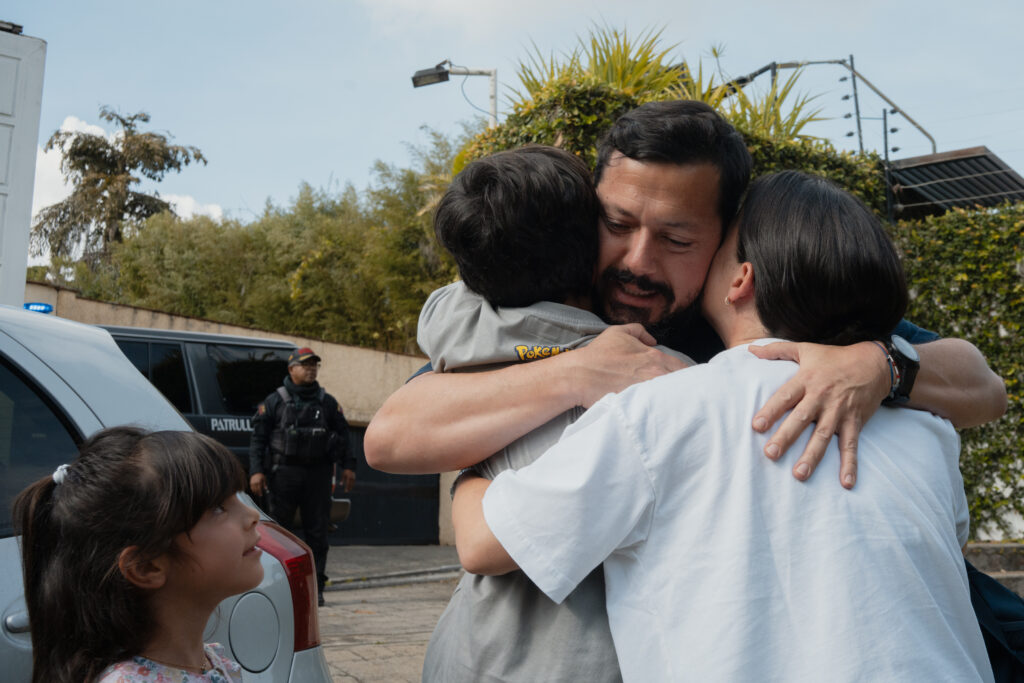
Andrés embraced his cousin. “Daddy is coming home,” he shouted. Mateo leaped into his mother’s arms. “Happy birthday, Mateo,” she said.
In no time, the black SUV pulled up to the high front gate. Luis, escorted by intelligence officers in black, stepped out — paler, bearded, thinner. The officers watched him to the door. The gate closed.
Luis and Vanessa embraced and kissed. His mother buried her head in his chest and cried.
Luis was released, but he’s not yet free. He’s still charged with financing terrorism and conspiracy. He’s required to appear in court every 30 days. He’s been warned not to leave the country.
On the day of his arrest, he told us, he was taken by several men to a house used by security forces to detain people. “I went through different stages, different cells,” he said. The first one, a space two meters by two meters that he shared with another man, had no water or toilet.
“We had to relieve ourselves in a pot that we then had to throw into a dumpster,” he said. He was soon transferred to El Helicoide, to be held first in a small cell. A month passed before he saw sunlight. “It’s like a quarantine you go through before they start giving you the chance to go outside.”
He was eventually taken to a “pressurized” cell — 16 people in a 40-square-meter space. “It is totally sealed, with no windows,” he said. “During the first months of detention, speaking with people in other cells was forbidden.”
Outside El Helicoide, the Venezuelan economy was in free fall. Inside, prisoners started small businesses — selling empanadas, cutting hair — to generate cash for their families.
During this time, Vanessa was his lifeline. She brought enough food for his entire cell because other families simply couldn’t afford to feed their loved ones. Some cellmates shared their food with their families.
Maduro’s capture was a turning point, he said. “The guards changed,” he said. “They became more human.” He was allowed more time in the prison courtyard.
His cellmates were let go, one by one. “Each release was a celebration,” he said. His came last.
Release hadn’t come quickly enough for his cellmate and friend Alfredo Díaz. The former governor of Nueva Esparta, arrested a few weeks before Luis, died in custody in December. Authorities said he appeared to suffer a heart attack.
Luis, now back home, looked around. “What I missed the most, beyond my family, was to walk barefoot and feel the grass,” he said. “I missed the dirt. There, that’s just concrete, everywhere. You feel you are entering the guts of a concrete beast. There’s no life.”
That night, Vanessa sent me a photo. Luis, Vanessa, Mateo and Andrés huddle together in anticipation of their first night back under one roof. Vanessa looks at the camera, tears in her eyes. Mateo and Andrés cling to them. Luis holds them all.
They’d reached the terrace. The view was finally clear.
The post When my friend came home from Maduro’s torture prison appeared first on Washington Post.