TEL AVIV — A surge of additional U.S. forces to the Middle East and President Donald Trump’s threat to “obliterate” Iran’s energy infrastructure have set the stage for what U.S. and Israeli security officials increasingly see as the war’s possible endgame: a battle for control of the Strait of Hormuz and key energy installations.
Reopening the strait — a critical conduit for global energy supplies — has emerged as perhaps the paramount objective of a war that security officials now believe is unlikely to achieve goals that briefly seemed possible at the outset of the U.S.-Israeli military operation, including overthrowing Iran’s theocratic regime and putting a nuclear weapon permanently out of Tehran’s reach.
Instead, breaking Iran’s stranglehold on the strait could enable Trump to wind down the war while claiming victory, halt an expanding global energy crisis and deprive Iran of a potent deterrent against future strikes — which senior Israeli officials described as inevitable if Tehran resumes ballistic missile production or moves to develop a nuclear weapon.
In Israel, Trump’s online threats have raised expectations that a new phase of the war could soon get underway with the arrival of additional U.S. firepower.
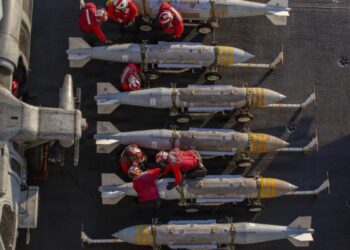
A contingent of 4,500 U.S. sailors and Marines is heading to the Middle East, including an infantry battalion landing team backed by helicopters, F-35 fighter jets and armored landing vehicles. The Pentagon also sped up the deployment of a similar unit, the 11th Marine Expeditionary Unit, from San Diego, defense officials said last week.
“Those Marines aren’t coming for decoration,” said an Israeli official, one of several who spoke on the condition of anonymity to discuss sensitive military and intelligence issues.
An Iranian military spokesman saidSunday that Iran would retaliate for attacks on its oil and gas assets by hitting U.S.-linked energy targets, information technology, and water desalination infrastructure in the Persian Gulf region.
Tehran also hammered Israel overnight Sunday with one of its most powerful airstrikes yet — two ballistic missiles that made rare direct hits on two southern Israeli towns, injuring about 115 people. One of the towns, Dimona, is about eight miles from a nuclear research facility. Iranian state television framed the strike as payback for a reported attack Saturday on Iran’s Natanz nuclear site. (Israel’s military said it was not aware of a strike on the facility.)
The new U.S. deployment signals a plan “to take the island and the strait,” the Israeli official said, referring to Kharg Island, Iran’s main hub for exporting petroleum. Doing so could enable the United States and Israel to starve Tehran of oil revenue and provide a political off-ramp for a president who, the Israeli official said, “needs to show that the strait is open.”
The surging level of U.S.-Israeli concern over the strait was underscored by Trump’s latest effort to shape the course of the war on social media.
“If Iran doesn’t FULLY OPEN, WITHOUT THREAT, the Strait of Hormuz, within 48 HOURS from this exact point in time, the United States of America will hit and obliterate their various POWER PLANTS, STARTING WITH THE BIGGEST ONE FIRST!” he posted on the Truth Social platform.
At the same time, Trump’s unusual decision to lift oil sanctions on Iran, potentially giving his enemy access to a windfall of revenue, has prompted even Republicans to raise new concerns about the war’s direction and merit.
Sen. Thom Tillis (N.C.), speaking on ABC on Sunday, said that “it’s a real problem” that he, and others, don’t know what the U.S. objective is, especially if the Pentagon continuesto push its request to Congress for more than $200 billion to finance the war.
Sen. Lindsey Graham (S.C.), an ally of the president, said on Fox News Sunday that he would tell Trump: “Keep it up for a few more weeks. Take Kharg Island, where all of the resources they have to produce oil. Control that island. Let this regime die on a vine.”
Iran has used an array of conventional weapons and asymmetrical capabilities to bring shipping traffic through the Strait of Hormuz to a standstill, from as many as 130 oil tankers a day in peacetime to a tiny number now being granted passage by Iranian authorities.
U.S. strikes have pounded Iranian positions along the Gulf waterway, destroying missile launch sites, suspected mine-laying vessels and small watercraft capable of racing toward vulnerable tankers — but that has done little to ease the near-shutdown of tanker traffic.
Israeli officials said that a perceived U.S. reluctance to send its own ships into the strait and Trump’s efforts to outsource that mission to European allies or China underscore its danger and complexity. “The fact that they are slow going to Hormuz shows that it’s more complicated than expected,” a former senior Israeli security official said.
Any effort to secure the Strait of Hormuz would overwhelmingly fall to the United States because of its naval capabilities and the expertise of its leaders, officials said. Adm. Brad Cooper, who is leading the war effort as head of U.S. Central Command, previously served as commander of the U.S. Navy’s 5th Fleet, whose area of responsibility includes the entire Persian Gulf region.
Even so, an operation to restore commercial traffic in the strait could take at least weeks, put U.S. sailors and other forces at risk, and expose U.S. warships to attacks from hidden coastline positions, submerged mines and drones sent by air or skimming the water’s surface. Keeping the channel open could mean devoting U.S. military and intelligence resources to escorting missions and monitoring threats for an unknown duration — with any successful attack by Iran sowing panic in energy markets and in the shipping industry.
The ability of Houthi militant groups in Yemen to harass passing vessels in recent years underscored the difficulty of policing commercial shipping lanes even when the threat comes from a proxy force with a fraction of Iran’s resources.
At the site of the Iranian ballistic missile strike in Arad, an Israel Defense Forces sergeant with a body-sniffing dog, who spoke on the condition of anonymity because she was not authorized to talk to the media, said this war was “frustrating” because “it’s quiet and then it’s not … so you need to be all the time 100 percent ready.”
David Azran, 54, said the missile hit about 10 meters from his home while his wife and son were sheltering there. “They cannot beat us. We build it again stronger and nicer,” Azran said, standing barefoot in the rubble of the blown-out part of his home and with a gun slung over his shoulder.
The speaker of Iran’s parliament claimed on X that if Israel failed to intercept missiles in Dimona, “it is operationally a sign of entering a new phase of the battle … Israel’s skies are defenseless.”
Nadav Shoshani, international spokesperson for the IDF, told reporters after the strikes that Israel has had a “92 percent successful interception rate” in the 22 days of war as Iran has fired more than 400 ballistic missiles. Visiting the strike site, Israeli Prime Minister Benjamin Netanyahu said Iran “endangers the entire world” and asked world leaders: “What more are you waiting for … where are you?”
Meanwhile, Israel and the U.S. have continued to bombard Iran. About 1,500 people, including 208 children, have been killed in Iran, its Health Ministry said. In Lebanon, Israeli strikes have killed at least 1,029 people since March 2, the Ministry of Public Health said Sunday.
The struggle for control of the strait has been cast mainly as a matter of global energy and economic security, given that one-fifth of the world’s oil and natural gas supplies flow through the channel.
The outcome in Hormuz, however, has additional strategic implications for Israel, where security officials increasingly expect that the need to conduct follow-on strikes against Iran will persist beyond any declared end to the current conflict.
Israeli officials said they could regard such measures as necessary if the U.S. or Israel detected efforts by Iran to reconstitute its ballistic missile program, degraded by hundreds of strikes in recent weeks, or seek to recover its buried uranium in a rush to develop a nuclear weapon.
Israel would have few constraints on its ability to conduct such strikes if Iran is no longer able to target ships in Hormuz or rain missiles on its Gulf neighbors, officials said.
“But if Iran can block Hormuz, they have a deterrence tool” that the regime could wield in retaliation and mobilize global opposition, said Amos Yadlin, former head of the IDF’s Military Intelligence Directorate.
That concern has risen as early elation over opening strikes that killed Ayatollah Ali Khamenei, Iran’s supreme leader, and most of his inner circle — raising hopes of a regime collapse — has given way to more sober assessments of the regime’s staying power.
The newly designated supreme leader, Khamenei’s 56-year-old son Mojtaba, is wounded, isolated and not responding to messages being relayed to him, U.S. and Israeli security officials said. Even so, Israeli officials said that surviving clerics and leaders of Iran’s powerful Islamic Revolutionary Guard Corps have consolidated their grip on the country.
In a note of defiance, the IRGC, Iran’s principal military force, said in a Friday statement that it is “impatiently waiting” for the arrival of the U.S. Marines and is prepared to give them “a close-up view of naval surprises,” according to Mehr, a semiofficial Iranian news agency.
Iran’s effective closure of Hormuz has added to soaring tensions between Tehran and Gulf neighbors that have borne the brunt of Iran’s strikes but maintained a largely defensive posture — condemning Iran’s actions but avoiding measures that might escalate the conflict.
Several Gulf states have signaled in recent days, however, that their patience may be nearing a breaking point.
“The Strait of Hormuz is an international waterway, and Iran has hijacked it,” said Abdulkhaleq Abdulla, a political science professor from the United Arab Emirates. “The world has to be a bit more united and decisive about taking it back from a hijacker.”
He emphasized that the U.S. and Israel had started the war and that the UAE would not be dragged into a military campaign that it had tried to avoid. But he noted that the UAE had announced Saturday that it had joined a coalition of countries condemning the closure and expressing “readiness to contribute to appropriate efforts to ensure safe passage through the Strait.”
At a news conference Thursday, Saudi Foreign Minister Prince Faisal bin Farhan Al Saud warned Iran that Saudi Arabia and other Gulf nations have “very significant capacities and capabilities” and that Saudi Arabia’s “patience …. is not unlimited.”
On Saturday, the Saudi Ministry of Foreign Affairs said it was ordering Iran’s military attachés and four other embassy staff members to leave the country. “The Gulf was against this war from the beginning, but Iran is crossing every red line,” said a well-connected person in the Gulf, who spoke on the condition of anonymity because of the sensitivity of the situation. “Now, the Gulf might be willing to go all the way.”
On Sunday, in the wake of Trump’s threat, Iran’s Mehr warned Gulf states to “say goodbye to electricity,” publishing a map of power plants across UAE, Qatar, Kuwait and the Gulf coast.
Chason reported from Abu Dhabi, and Levine from Dimona.
The post Trump threats, U.S. troop build-up raise specter of battle for Hormuz appeared first on Washington Post.