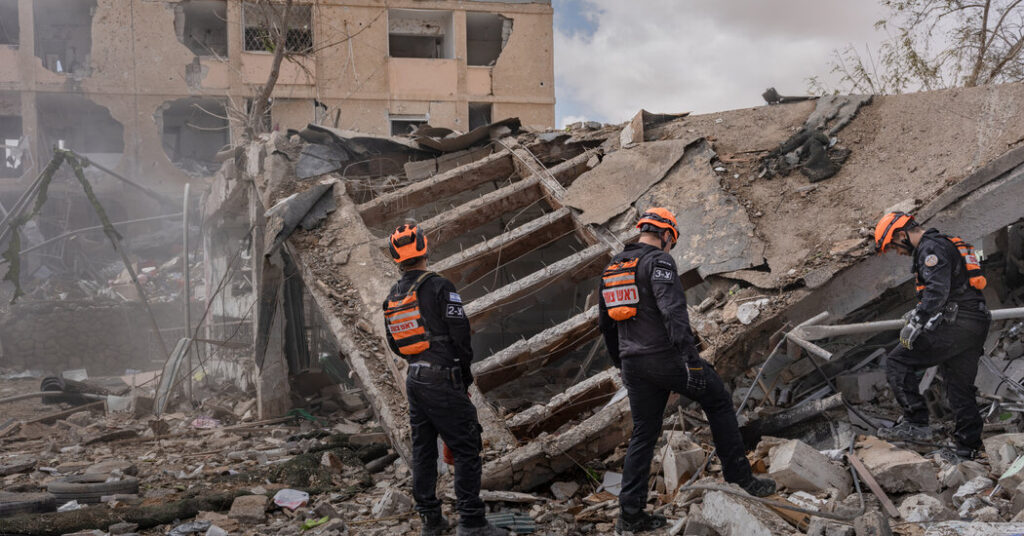
Shards of glass and charred debris littered the streets of Arad and Dimona on Sunday morning, hours after missiles from Iran struck residential neighborhoods in these small desert cities in southern Israel.
The blast in Arad on Saturday night carved out a crater of sand and twisted metal in a grassy courtyard and shattered windows more than half a mile away, according to residents. In Dimona, a missile smashed into a sandy yard between several apartment buildings.
About 175 people were injured in the two strikes, at least 10 of them seriously, according to the emergency and health services. There were no fatalities.
Dimona and Arad are the closest cities to Israel’s main nuclear research installation and reactor, one of the most guarded sites in Israel. Neither had been directly hit before, including in more than two years of wars in Gaza, Lebanon and Iran, according to local officials.
Yitzhak Salem, 62, was sheltering with his wife in a fortified safe room in his home in Dimona when the blast filled the room with dust and smoke. “It felt like a hurricane mixed with an earthquake,” he said.
The mayor of Dimona, Benny Biton, told Israeli news media that many residents in the destroyed buildings had avoided injury because they had made it to bomb shelters after receiving alerts of incoming missile fire.
In Arad, a city of roughly 30,000 people in the Negev Desert, three four-story apartment blocks closest to the impact site were set to be demolished, according to Kfir Levy, a spokesman for Arad’s city hall.
Residents from surrounding buildings trickled in on Sunday morning to inspect the damage and try to collect their belongings. Some saw their hollowed-out homes for the first time.
Many of the 80 or so people wounded in Arad were not inside a shelter when the missile hit, Mr. Levy said. Among them were many older residents who struggle to descend multiple flights of stairs when warning sirens sound, he said.
Mike Getner, 45, a taxi driver who lives several blocks from the impact site in Arad, said the blast that followed the siren at roughly 10 p.m. felt like nothing he had experienced in his city before.
“The house shook, you could feel the blinds shudder, you felt the ground shaking,” he said. “You could tell it was right here.”
Isaac Waxler, a store owner who lives a block away from the impact site, said he was sheltering at home with his wife when they heard the blast. His son and eight grandchildren live in the buildings that surround the impact site.
“It was a terror,” Mr. Waxler said, describing the moments he tried to reach his son. His son managed to tell him he was OK before the lines went down, Mr. Waxler said. The family of 10 then moved to Mr. Waxler’s house to spend the night.
The post Residents in Southern Israel Are Shaken After Direct Strikes by Iranian Missiles appeared first on New York Times.