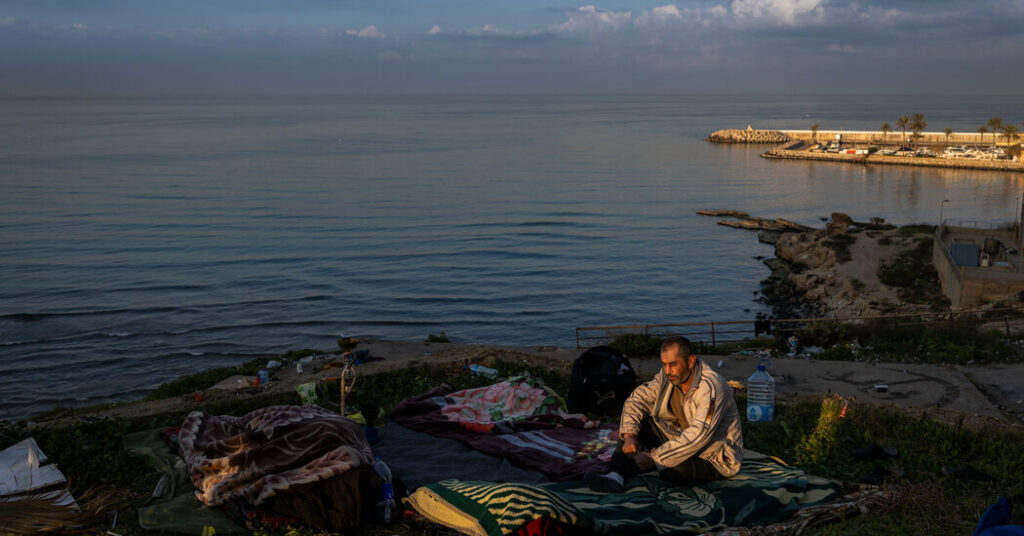
The shirtless jogger, his headphones in and his back slick with sweat, ran past a row of tents pitched along the seafront in downtown Beirut, Lebanon’s capital. In one tent, a displaced family of four — uprooted by weeks of war that have convulsed the nation — watched him pass.
For a moment, the scene held its uneasy calm. The evening sun faded into the Mediterranean Sea, the steady rhythm of the waves softened the edges of the day, and the runner kept his pace, eyes forward. And then a deafening roar shattered it all: An Israeli airstrike had hit a nearby neighborhood, sending plumes of smoke into the sky.
“We chose the seaside because it is peaceful,” said Hussein Hame, 37, who, along with his wife and two children, was displaced this month from Dahiya, a collection of neighborhoods on the southern outskirts of Beirut where Hezbollah holds sway. “But this war finds you everywhere.”
War has returned to Lebanon, and the capital’s meandering seafront has become an unlikely front line. Here, a stark contrast has emerged: The displaced and destitute sit in the cold, while others live life as usual — jogging, cycling — amid the dizzying wealth and luxury that exist nearby.
In early March, Israel unleashed a barrage of attacks on Lebanon after the Iran-backed proxy group Hezbollah fired rockets at northern Israel following the U.S. and Israeli strikes on Iran. The violence has uprooted more than a million people, with Israel issuing evacuation warnings across much of southern Lebanon and in parts of Beirut and the eastern Bekaa Valley. Israel’s strikes have killed more than 1,000 people, injured more than 2,700 and put Lebanon, once again, on the precipice of disaster.
On the city’s seafront, the human toll is visible in stark detail: Tents line the promenade, cars serve as makeshift shelters and bundles of clothes scatter the sidewalks. Teenagers, with nowhere to go and no school to attend, roam around. Toddlers, hungry and exhausted, cry and fuss.
Families huddle through cold nights, lighting small bonfires that do little against the wind and rain. There is nowhere to shower, nowhere to change, barely enough to eat — especially difficult for those who were fasting during the Muslim holy month of Ramadan.
The displaced form a mosaic of Lebanon itself: locals uprooted from homes, businesses and farmlands. But there are also foreigners, many of whom are domestic workers and day laborers. They arrived from Africa, Asia and across the Middle East in search of better economic opportunities and safety only to find uncertainty.
A week into the fighting, an Israeli strike hit several cars along the seaside corniche, killing at least eight people and injuring dozens more, health officials said.
But even as suffering persists along the waterfront, a different reality unfolds beside it.
From the corniche, the city opens to a breathtaking panorama: the glittering Mediterranean, the rugged peaks of Mount Lebanon and the iconic Raouché Rocks rising from the sea.
The promenade is also one of the city’s most affluent stretches, lined with upscale apartments and hotels, luxury car dealerships and swanky restaurants with well-heeled patrons sipping cocktails. Those displaced share the same stretch with cyclists, joggers in sleek athletic wear, families out for evening strolls and fishermen casting lines from the rocks below.
On a recent afternoon, Vera Noon, who was walking along the seafront, described a swell of conflicting emotions. Some people moved along the corniche, walking their dogs and laughing as if nothing had changed, seemingly untouched by the surrounding suffering. And yet, she said, she understood that people were navigating the crisis in their own ways.
“They didn’t choose this war,” said Ms. Noon, a Lebanese doctoral student at the University of Edinburgh who is researching the connection between the Mediterranean and her country’s heritage.
The seafront, she said, offers a sanctuary for both those clinging to daily routines and those with nowhere else to go.
“The sea is the last refuge,” Ms. Noon said. “It gives people peace. They relax, it gives them calm.”
The Beirut seafront is no stranger to war.
In April 1973, Israeli commandos departed from this coastline after targeting members of the Palestinian Fatah organization who were operating in the city. In August 1982, an image of coastal buildings ablaze after Israeli bombardment appeared on the cover of Time magazine. During the 15-year civil war that ended in 1990, the waterfront was lined with bullet-scarred buildings.
In the years that followed, the area was rebuilt, most notably by the private development company Solidere, led by former Prime Minister Rafik Hariri, which reshaped downtown Beirut with high-rise buildings and commercial projects. That transformation came at a cost: Cafes, hotels and beach clubs privatized large stretches of the shore, putting access out of reach for many.
Even so, the public never fully let go. Activists organized campaigns, protests and legal challenges to preserve access to the sea.
At the same time, crises kept coming. A financial collapse in 2019 fueled an antigovernment revolt that pushed crowds demanding change onto the waterfront. In 2020, an explosion at Beirut’s port tore through the city, killing hundreds and devastating entire neighborhoods. Then came war with Israel in 2024, once again driving people toward the seafront in search of refuge.
Now, with conflict returning, many like Gizelle Hassoun, a 52-year-old bar owner, say they feel exhausted and detached — and are drawn back to the waterfront for a fleeting touch of normality.
“We are all in a state of bala mokh,” said Ms. Hassoun, using an Arabic phrase that literally means “no brain” but colloquially describes being mentally drained and numb.
During the 2024 war, she said, she and those around her rushed to help the displaced along the waterfront whose homes and businesses had been destroyed. This time, she was spent, and the famed Lebanese resilience that usually carried her was gone.
When the fighting between Israel and Hezbollah began on March 2, she didn’t bother to stock up or fill her car’s tank.
“This is sad, but maybe we’ve gotten too used to this,” she said, strolling along the seafront with a friend as the buzz of an Israeli drone cut through the air.
Not everyone coming to the waterfront carries the same weariness.
Mohammed Ismail has been returning to this stretch of Beirut’s coast for more than a decade. Usually, he lives in Dahiya, the Hezbollah stronghold that has been evacuated, and runs an electronics store there. But even since fleeing, he has made sure to come to the waterfront.
On a recent afternoon, he sat tanning in the sun, reading the Quran open in his lap as he fasted for Ramadan. It was the second time he had been displaced in less than two years. His mind sometimes wandered to hardship, he said, but he was trying to carry on as normally as he could.
Nearby, a group played padel, others smoked and chatted, and some exercised. For a fleeting moment, life felt ordinary.
“This is the best place to remove the stress from your life,” he said.
On some days, the tranquillity of the beach masks a deadly reality.
In mid-March, Israeli airstrikes tore through several cars along the corniche in the Ramlet al-Baida neighborhood, splattering the sidewalk with bloodied sand. Just days before, a suite in the four-star Ramada Plaza Hotel farther down the seafront was hit. Israel says its attacks are aimed at reaching Hezbollah operatives and their Iranian backers.
For those taking shelter along the waterfront, like Mr. Hame and his family, life now swings between dread and relief. The night that Ramlet al-Baida beach was struck, his children panicked and leaped onto him inside their tent. He held them and tried to calm them, he said. When that failed, he raced them on his motorcycle to a church east of Beirut where displaced people were offered shelter.
They stayed there for the morning, but soon after, he said, the children insisted on returning to the shore.
Abdi Latif Dahir is a Middle East correspondent for The Times, covering Lebanon and Syria. He is based in Beirut.
The post On Beirut’s Waterfront, Loss Meets Life, and Luxury, Amid War appeared first on New York Times.