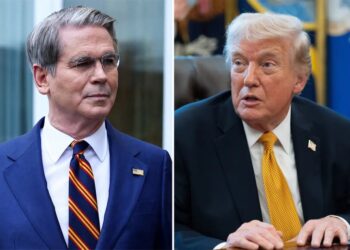
After 13 U.S. troops were killed during the opening weeks of the Iran war, Joe Kent had seen enough. It was time, he said, to stand on principle and resign his position as director of the National Counterterrorism Center, knowing it was likely that some of President Donald Trump’s other advisers would turn on him.
Kent, a retired Special Operations soldier whose military career included 11 combat deployments, had decided days earlier that if hostilities with Iran erupted into a “full war like we’re doing now,” then there was no way he could stay. Doing so, he reasoned, would have contradicted a promise that he made to himself years earlier while serving during the Iraq War, a costly, devastating conflict that he came to view as having been built on lies and foisted on the American people by the administration of President George W. Bush.
“I said, ‘If I ever have a seat at the table, I’m not going to put up with this. I’ll do whatever I can to prevent it,’” Kent said in an hour-long interview with The Washington Post.
Kent’s stunning resignation last week has thrust him to the center of a bitter debate about whether and how the Trump administration should prosecute its war with Iran, a powerful longtime U.S. adversary responsible for the deaths of hundreds of Americans. Now, he said, he is making his case to fellow conservatives through a series of interviews with podcasters popular among Trump’s political base, including Tucker Carlson, Megyn Kelly, Saagar Enjeti and Shawn Ryan.
It’s a concerted effort, Kent said, to rally members of the president’s Make America Great Again movement and ensure he hears dissenting voices on an issue that has divided Republicans. While some Trump supporters are inclined to use military might to influence global affairs, others — like Kent — say they chose to support him in part because he voiced scorn for America’s earlier wars.
Administration officials have gone on the attack against Kent. Davis Ingle, a White House spokesman, said in a statement that Kent’s “self-aggrandizing” resignation letter and recent interviews have been “riddled with lies,” the “most egregious” of which was him claiming that “the largest state sponsor of terrorism somehow did not pose a threat to the United States and that Israel forced the President into launching Operation Epic Fury.”
The president, Ingle said, took “decisive action based on strong evidence” that Iran “posed an imminent threat and was preparing to strike Americans first.” Trump, he said, “does not make these incredibly important national security decisions based on fluid opinion polls or podcast hosts, but on the best interest of the American people.”
A White House official, speaking on the condition of anonymity under ground rules set by the administration, said recent polls, including one by The Post, have shown Trump’s decision to launch the war against Iran has support from a majority of Americans, with Republicans strongly supporting it. The official acknowledged that “some online commentators with large followings” disagree with Trump, and said the media has highlighted that “to try and sow division” while the president’s political base “is not wavering one bit.”
Kent’s high-profile exit and messaging campaign comes as Trump sends mixed signals about his next moves in Iran — having left the door open to ordering the deployment of U.S. combat troops onto Iranian soil, a move that could drastically increase the number of American military fatalities. U.S. officials, speaking on the condition of anonymity to discuss military planning, have said the Pentagon is developing options for the White House that include thousands of Army paratroopers and Marines.
Kent declined to disclose what the administration may be planning, but said Trump appears to have “some really key decisions” to make in the next couple of weeks. The potential deployment of U.S. ground troops “makes me very nervous,” he added, citing recent reporting that the president is considering seizing Kharg Island, Iran’s main hub for oil exports.
“I just think that would be a disaster,” Kent said of deploying U.S. troops there. “It would essentially be giving Iran a bunch of hostages on an island that they could barrage with drones and missiles.”
Earlier this month, Trump said he directed a “large-scale precision strike” on Kharg Island, located in the Persian Gulf about 15 miles from Iran’s mainland, that “totally obliterated” every military target there “while preserving the oil infrastructure.”
Kent has zeroed in on comments by Secretary of State Marco Rubio, who is also Trump’s national security adviser, who said after the start of hostilities that the United States had begun the war in part because U.S. officials knew that Israel was about to attack anyway and the administration’s expectation was that Iran would retaliate against U.S. facilities in the region. Trump has disputed that, saying the decision to strike was his alone and that he may have forced Israel to act.
Kent informed the White House of his departure last Monday, seeking to meet with Trump and tender his resignation in person. He and his immediate supervisor, Director of National Intelligence Tulsi Gabbard, instead sat down with Vice President JD Vance, a detail first reported by The Postthe following day.
Kent said Vance asked him why he was leaving the administration and that they “left on favorable terms.” He declined to detail their conversation. Later in the day, Kent said, he spoke by telephone with Trump.
The president, Kent said, told him he was “a little bit surprised” and disagreed with Kent’s assessment — later made public in his resignation letter — that Israeli officials had drawn the United States into an unnecessary conflict. But they, too, “ended on good terms,” and Kent thanked Trump for the opportunity to serve in the administration, Kent said.
The White House did not address questions about the phone call between Kent and Trump. Last week, Vance’s office said in a statement that the vice president had encouraged Kent to speak to Trump and White House chief of staff Susie Wiles “before making any final decisions.” Vance, the statement added, “believes that it’s imperative for the national security team to remain cohesive, trust one another, and avoid mouthing off to the media about internal deliberations.”
Vance, too, served in the Iraq War and has repeatedly voiced skepticism about the U.S. launching wars overseas. In recent days, he has projected loyalty to the president, saying that “when the president of the United States makes a decision, it’s your job to help make that decision as effective and successful as possible.”
Kent’s public exit caused an uproar, not only because he is the first high-profile administration appointee to break ranks, but because of his assessment, which he detailed in his resignation letter, that Israeli officials and “influential members of the American media” worked in tandem to “deceive” Trump into believing that Iran posed an imminent threat to the United States and convince him there was a “clear path to a swift victory.”
Kent also cited the death of his wife, Shannon, a Navy cryptologist who was killed in 2019 with three other Americans in a suicide bombing in northern Syria. Kent “cannot support sending the next generation off to fight and die in a war that serves no benefit to the American people nor justifies the cost of American lives,” he wrote in his resignation letter.
He asserted that the war in Syria also was “manufactured by Israel,” and said in his recent interview with Carlson that he believes that is the case because the multifaceted war in Syria, which includes the Islamic State’s rise, “never would have happened without the war in Iraq.”
White House press secretary Karoline Leavitt responded to the resignation letter within hours of Kent sharing it, saying on social media last week that there were “many false claims” in Kent’s resignation letter. She also called it “absurd” that the president, as Kent claimed, “made this decision based on the influence of others, even foreign countries” and she described the allegation as “both insulting and laughable.”
White House officials also told reporters that Kent is under federal investigation for allegedly leaking information to the media — an accusation Kent denies — and said he had not visited Trump at the White House in some time.
Trump sought to distance himself from Kent as news of the resignation spread, saying that while the combat veteran “was a nice guy,” Trump “didn’t know him well” and thought he was “weak on security.”
Reaction on both sides of the political aisle has varied, touching in part on Kent’s own political background. It includes running unsuccessfully twice for Congress in Washington state, embracing Trump’s false claims that he defeated Joe Biden in the 2020 presidential election and sympathizing with those detained by the U.S. government after the U.S. Capitol riot on Jan. 6, 2021. Kent later moderated those positions, during a political debate.
Some Republicans, including Iraq War veterans, like Sen. Tom Cotton (R-Arkansas) and Rep. Derrick Van Orden (R-Wisconsin), have indicated that they respect the immense sacrifices that Kent’s family has made, but disagree with his read of the U.S. war in Iran.
Other officials have raised alarm about Kent’s assertions, with Sen. Mitch McConnell (R-Kentucky) saying on social media that Kent had demonstrated “virulent antisemitism” in his resignation letter. In interviews over the past week, Kent also said U.S. officials need to look more closely at whether there any ties between Israel and the assassination of conservative commentator Charlie Kirk.
“When one of President Trump’s closest advisers, who is vocally advocating for us to not go to war with Iran and for us to rethink, at least, our relationship with the Israelis, and then he’s suddenly publicly assassinated and we’re not allowed to ask any questions about that, it’s a data point,” Kent told Carlson. “It’s a data point that we need to look into.”
Kent, asked by The Post about the antisemitism allegations, suggested that religion has nothing to do with his concerns.
“I don’t know that I’ve said the word ‘Jewish’ once, or what religion the Israelis are,” he said. “If the Christian population in Israel were in charge, I’d have the same viewpoint: A foreign government should not be dictating our foreign policy.”
Israeli Prime Minister Benjamin Netanyahu on Thursday denied that Israel dragged the United States into war. “Does anyone really think that someone can tell President Trump what to do?” he asked. “Come on.”
Kent also criticized Fox News, telling The Post that the conservative news network has been a significant part of “that pro-Israeli ecosystem” for years and often unwilling to have dissenting voices appear on air.
“I’ve heard them talk about me a lot — but I haven’t heard from them,” he said.
A spokesperson for the network disputed Kent’s claim, saying in a statement that Fox News “has not found any evidence of outreach from Joe Kent or anyone affiliated with him requesting to have him booked on the network.”
Mark Levin, a pro-Israel conservative commentator with a Fox News TV show and syndicated radio show, said last week on social media that he wondered whether Kent “was about to be fired but quickly resigned first.” He accused Kent of being “part of that radical isolationist Woke Right cabal,” and predicted “left-wing media” would “use him to attack the president.”
Despite the accusation, Levin’s team sought to have Kent on his radio show. An interview is scheduled for Monday night.
Kent appears eager for what could be a combustible conversation with Levin, writing on social media that while a Fox News appearance would be preferable, “this will work.”
Kent said he is willing to work with anyone in politics to address his concerns, and sees opposition to long wars as a “crossover issue.” While he doesn’t take “most Democrats” seriously on the matter, he said, he can “make exceptions.” He does not think that most Democrats will want to do so with him, though.
On the Republican side, Kent said it will be important for the party to grapple with its position on foreign wars, including during the 2028 election cycle so “we have a more realistic and noninterventionist foreign policy — and make it stick, so that we really don’t even have to have these debates again.”
“I think we thought we were past that,” Kent said, “and then, sure enough.”
The post Joe Kent says he wants Trump to hear MAGA opposition to Iran war appeared first on Washington Post.